If you’re evaluating biometric identification systems that work at a distance—without requiring cooperation, contact, or even clear facial visibility—gait recognition is a compelling alternative. OpenGait is an open-source, research-backed framework specifically designed to extract identity-specific walking patterns while suppressing irrelevant visual cues like clothing texture, color, or dynamic backgrounds. Developed by the Shiqi Yu Group and supported by WATRIX.AI, OpenGait isn’t just another academic prototype; it’s a production-ready toolkit that powers real-world applications across surveillance, healthcare, and multimodal biometrics.
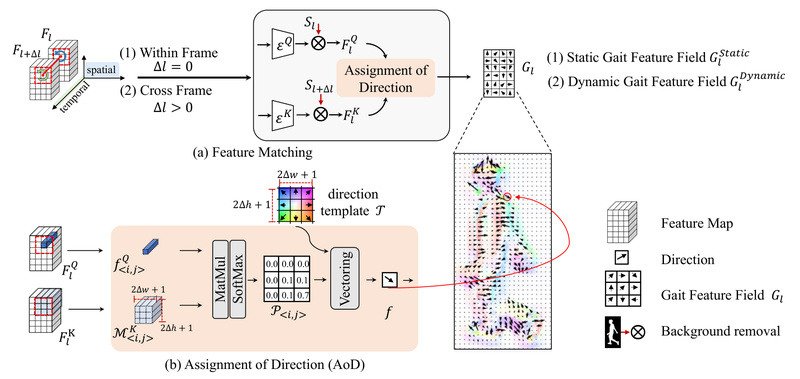
At its core, OpenGait addresses a long-standing challenge in vision-based gait recognition: how to isolate the signal (a person’s unique gait) from the noise (everything else in a walking video). Traditional methods relied on silhouettes or pose skeletons, which discard too much visual information. Newer end-to-end approaches, such as the diffusion-based DenoisingGait introduced in the group’s CVPR 2025 paper, leverage generative priors to "denoise" RGB videos into clean, identity-rich representations. This philosophy—“what I cannot create, I do not understand”—drives OpenGait’s most advanced models, enabling state-of-the-art performance on benchmarks like CASIA-B, CCPG, and SUSTech1K, even in cross-domain settings.
Why OpenGait Stands Out for Practitioners
A Unified Platform for Multiple Gait Modalities
OpenGait isn’t limited to a single data type or model architecture. It natively supports:
- RGB video (via DenoisingGait, BigGait)
- Skeleton maps (via SkeletonGait++)
- LiDAR point clouds (via LidarGait++)
- Multimodal fusion (via MultiGait++)
This flexibility lets you choose the right input modality for your deployment scenario—whether you’re working with standard surveillance cameras, depth sensors, or emerging 3D LiDAR systems.
Engineering-Ready Infrastructure
Beyond algorithms, OpenGait includes features that reduce friction for developers and researchers:
- Distributed Data Parallel (DDP) support for scalable training across GPUs
- Auto Mixed Precision (AMP) to accelerate training without sacrificing accuracy
- TensorBoard and logging integration for transparent experiment tracking
- Pre-configured YAML files for every model, enabling plug-and-play experimentation
These aren’t afterthoughts—they’re baked into the codebase from day one, reflecting the project’s focus on practicality, not just theoretical performance.
Comprehensive Model Zoo and Dataset Coverage
OpenGait supports nine major gait datasets, including CASIA-B, OUMVLP, GREW, Gait3D, and the large-scale GaitLU-1M. Its Model Zoo provides pre-trained checkpoints for all key methods—from GaitBase (CVPR 2023) to DenoisingGait (CVPR 2025)—many of which are also available on Hugging Face. This means you can skip weeks of training and jump straight to evaluation or fine-tuning.
Real-World Applications Beyond the Lab
OpenGait’s design philosophy shines in scenarios where robustness matters more than lab-recorded accuracy:
- Security & Surveillance: Identify individuals in low-resolution, occluded, or nighttime footage where faces are unreadable—using only how they walk. DenoisingGait’s ability to suppress clothing variations makes it resilient to seasonal changes or disguise attempts.
- Healthcare Screening: The ScoNet module (MICCAI 2024) demonstrates how gait patterns can serve as non-invasive biomarkers for conditions like scoliosis, enabling early detection from video alone.
- 3D Biometrics: With LidarGait++ (CVPR 2025), OpenGait extends gait recognition to 3D point clouds, offering viewpoint invariance and robustness to lighting—critical for outdoor or automotive applications.
- Multimodal Identity Systems: Combine gait with face, voice, or fingerprint data using MultiGait++ for layered authentication that’s harder to spoof.
Getting Started: From Clone to Inference in Minutes
Adopting OpenGait is straightforward:
- Clone the repository: The codebase is well-structured, with clear documentation in
0.get_started.md. - Prepare your data: Follow dataset-specific guides for formats like CASIA-B or SUSTech1K.
- Pick a model: For RGB video denoising, select
DenoisingGait; for skeleton input, useSkeletonGait++. - Run inference or training: Use the provided config files—DDP and AMP are enabled by default for efficiency.
- Monitor progress: Logs and metrics are automatically recorded via TensorBoard.
Tutorials cover customization (e.g., adding a new model), advanced training strategies, and integration with existing pipelines like All-in-One-Gait, which combines tracking, segmentation, and recognition into a single workflow.
Limitations and Licensing Considerations
While powerful, OpenGait comes with important constraints:
- Academic use only: The license explicitly prohibits commercial deployment.
- Hardware demands: Models like DenoisingGait (based on diffusion) require substantial GPU memory—AMP helps, but high-end hardware is recommended.
- Domain sensitivity: Performance may degrade when moving from controlled datasets (e.g., CASIA-B) to unconstrained real-world video, though cross-domain results in recent papers show strong generalization.
Users should also note that while the framework is Python-based and uses PyTorch, extending it requires familiarity with deep learning workflows and gait-specific preprocessing (e.g., silhouette extraction).
Summary
OpenGait bridges the gap between cutting-edge gait recognition research and deployable solutions. By providing a unified, extensible platform with support for multiple modalities, engineering-grade tooling, and real-world validation—from scoliosis screening to LiDAR-based 3D identification—it empowers technical decision-makers to evaluate, prototype, and validate gait-based systems with confidence. If your project demands robust, clothing-invariant biometric identification at a distance, OpenGait offers a rare combination of academic rigor and practical readiness.