If you’re building applications that involve comparing, aligning, searching, or evaluating text—whether in natural language processing (NLP), bioinformatics, or computational social science—you’ve likely juggled multiple libraries, inconsistent APIs, or outdated implementations. Enter string2string, a modern, open-source Python library developed by the Stanford NLP Group that unifies a wide spectrum of string-to-string algorithms—both classical and neural—into one consistent, easy-to-use interface.
Built for researchers, engineers, and data scientists who need reliable, off-the-shelf tools for text analysis, string2string eliminates fragmentation by bringing together foundational techniques like edit distance and sequence alignment with cutting-edge neural similarity metrics like BERTScore and semantic search via Faiss—all installable with a single pip command and accessible through clean, intuitive APIs.
Why string2string Stands Out: One Library, Many Domains
Unlike narrowly focused packages, string2string bridges disciplines. It’s equally at home computing DNA sequence alignments in bioinformatics as it is detecting paraphrased essays in educational technology or retrieving semantically similar patent claims in legal AI. This cross-domain flexibility stems from its core design philosophy: provide comprehensive coverage of string transformation and comparison tasks while maintaining ease of use and reproducibility.
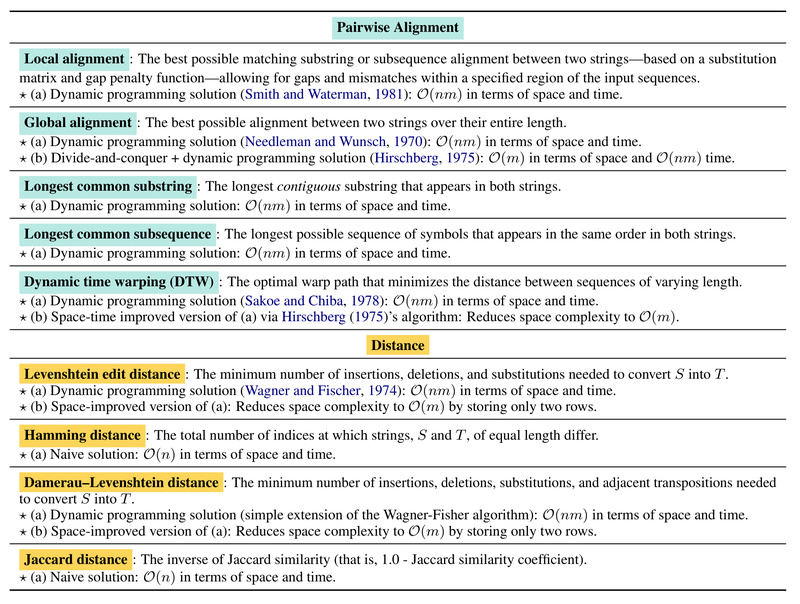
The library supports four major categories of string operations:
- Alignment: Global and local sequence matching
- Distance: Character- and token-level edit differences
- Search: Exact pattern matching and semantic retrieval
- Similarity & Evaluation: Neural and lexical metrics for text quality and relevance
Each category includes both time-tested algorithms and state-of-the-art neural methods, all wrapped in a uniform interface that reduces cognitive load and accelerates prototyping.
Solving Real Problems with Plug-and-Play Algorithms
Sequence Alignment for Bioinformatics and Linguistics
Ever needed to align two gene sequences or compare syntactic structures? string2string provides implementations of the Needleman-Wunsch (global alignment) and Smith-Waterman (local alignment) algorithms. It also includes the space-efficient Hirschberg algorithm for memory-constrained environments.
Example:
from string2string.alignment import NeedlemanWunsch
nw = NeedlemanWunsch()
aligned1, aligned2 = nw.get_alignment(['A','T','G'], ['A','C','G'])
nw.print_alignment(aligned1, aligned2)
Precise Text Differences with Edit Distance
Measuring how many edits (insertions, deletions, substitutions) separate two texts is fundamental in spell checkers, version control, or plagiarism analysis. The library offers the Wagner-Fisher (Levenshtein) algorithm at both character and word levels.
from string2string.distance import LevenshteinEditDistance
from string2string.misc import Tokenizer
dist = LevenshteinEditDistance()
tokenizer = Tokenizer()
text1 = "The quick brown fox"
text2 = "The quick red fox"
print(dist.compute(text1, text2))  # Character-level: 4
print(dist.compute(tokenizer.tokenize(text1), tokenizer.tokenize(text2)))  # Word-level: 1
Fast Pattern Matching and Semantic Search
For exact substring search, the Knuth-Morris-Pratt (KMP) algorithm ensures linear-time performance. For meaning-based retrieval, string2string integrates Faiss with Hugging Face models (like BART) to enable semantic search over text corpora.
from string2string.search import FaissSearch
faiss_search = FaissSearch(model_name_or_path='facebook/bart-large')
faiss_search.initialize_corpus(corpus={'text': ["I love hiking.", "Running keeps me sane."]}, section='text')
results = faiss_search.search(query="I enjoy morning exercise.", k=2)
Reliable Evaluation with Industry-Standard Metrics
The library wraps widely accepted evaluation tools like sacreBLEU and ROUGE, ensuring compatibility with research benchmarks. It also includes neural scorers: BERTScore (contextual embedding similarity) and BARTScore (likelihood-based text quality).
from string2string.metrics import sacreBLEU
bleu = sacreBLEU()
score = bleu.compute(['The cat sat.'], [['The cat sat on the mat.', 'A cat is seated.']])
Visualize and Interpret Results—Out of the Box
Beyond computation, string2string helps you understand results. Built-in visualization tools include:
- Pairwise alignment diagrams that color-code matches, mismatches, and gaps
- Heatmaps for cosine similarity matrices using GloVe or fastText embeddings
These are invaluable for debugging, teaching, or presenting results in reports and papers—without writing custom plotting code.
Ideal Use Cases: Where string2string Delivers Maximum Value
- Academic research: Reproduce classical algorithms or compare neural vs. symbolic methods in one environment
- Rapid prototyping: Test multiple similarity or alignment strategies without switching libraries
- Cross-domain projects: Apply NLP tools to biological sequences or vice versa
- Education: Teach string algorithms with runnable, well-documented examples
The library is especially powerful when you need to combine multiple techniques—e.g., align sequences, compute their edit distance, and visualize the alignment—all in a few lines of code.
Limitations and Practical Considerations
While versatile, string2string has boundaries to keep in mind:
- Requires Python 3.7+
- Neural features (BARTScore, Faiss search) depend on internet access to download Hugging Face models unless cached locally
- Faiss-based semantic search can become slow on large corpora without GPU acceleration
- Some bioinformatics algorithms (e.g., BLAST, FASTA) are listed as works-in-progress and not yet implemented
These are reasonable trade-offs for a library prioritizing breadth and usability over specialized optimization.
Summary
string2string fills a critical gap: it’s the first Python library to unify classical string algorithms and modern neural methods under a single, consistent, and well-documented API. Whether you’re aligning genetic sequences, detecting paraphrased content, evaluating machine translation, or building a semantic search engine, it offers production-ready tools that just work—without forcing you to stitch together incompatible packages.
With easy installation (pip install string2string), comprehensive tutorials, and real-world examples, it lowers the barrier to entry for complex text analysis tasks across disciplines. For project and technical decision-makers seeking a flexible, future-proof foundation for string processing, string2string is a compelling choice.