Change detection in remote sensing—identifying what has changed between two satellite or aerial images taken at different times—is a critical capability for applications ranging from disaster response to urban planning. Traditional approaches rely heavily on convolutional neural networks (CNNs) or vision Transformers, each with well-known limitations: CNNs struggle to capture long-range spatial context due to their local receptive fields, while Transformers demand significant computational resources, making them impractical for large-scale or real-world deployment.
Enter ChangeMamba, a breakthrough framework built on the emerging Visual Mamba architecture—a state space model (SSM) originally inspired by advances in natural language processing. By replacing both CNN and Transformer backbones with a spatiotemporal state space model, ChangeMamba delivers superior accuracy, lower computational overhead, and robust performance on degraded imagery—all without resorting to complex training tricks or data augmentation schemes. Published in IEEE Transactions on Geoscience and Remote Sensing (TGRS) and recognized as both an ESI Highly Cited and Hot Paper, ChangeMamba has quickly become a strong benchmark in the change detection community.
What Problems Does ChangeMamba Solve?
Remote sensing practitioners often face a tough choice:
- Use lightweight CNNs that miss global context, leading to fragmented or inaccurate change maps.
- Deploy powerful but resource-hungry Transformers that are slow to train and hard to scale.
ChangeMamba eliminates this trade-off. Its core innovation lies in leveraging the Mamba state space model to efficiently model long-range spatial dependencies across multi-temporal images while maintaining linear computational complexity relative to input size. This enables it to:
- Capture holistic scene changes (e.g., gradual urban sprawl or widespread deforestation) that local filters miss.
- Run efficiently on modest hardware—critical for field deployments or institutions with limited GPU budgets.
- Maintain performance even when input images are noisy, low-resolution, or partially corrupted—a common reality in real-world remote sensing data.
Three Tasks, One Unified Framework
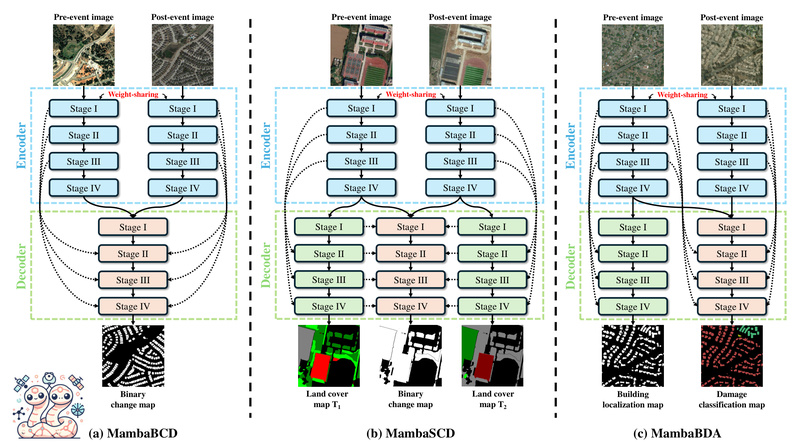
ChangeMamba isn’t a one-trick pony. It provides tailored architectures for three major change detection scenarios:
Binary Change Detection (MambaBCD)
Detect whether change occurred—ideal for monitoring deforestation, urban expansion, or flood extent. Tested on SYSU, LEVIR-CD+, and WHU-CD, MambaBCD consistently outperforms prior CNN/Transformer baselines.
Semantic Change Detection (MambaSCD)
Go beyond “changed/unchanged” to understand what changed. For example, did forest become farmland? Did water turn into built-up area? MambaSCD processes land-cover maps from two time points and outputs per-pixel semantic change labels. It supports the SECOND dataset and is valuable for environmental impact assessments.
Building Damage Assessment (MambaBDA)
After earthquakes, hurricanes, or conflicts, rapid damage estimation saves lives. MambaBDA analyzes pre- and post-disaster building footprints to classify damage severity (e.g., no damage, minor, major, destroyed). It’s evaluated on the large-scale xBD and BRIGHT datasets used in the xView2 Challenge.
All three variants share the same Visual Mamba encoder but differ in their decoders, each equipped with spatiotemporal relationship modeling mechanisms that effectively fuse features from two time points to highlight true changes while suppressing false positives.
Getting Started: Practical and Accessible
Despite its advanced architecture, ChangeMamba is designed for real-world usability:
- Pretrained Models Available: Tiny, Small, and Base variants of MambaBCD, MambaSCD, and MambaBDA are provided, with weights hosted on Zenodo, Google Drive, and BaiduYun.
- Standard Datasets Supported: Clear instructions for preparing SYSU, LEVIR-CD+, WHU-CD, SECOND, and xBD—all widely used benchmarks in the field.
- Simple Training & Inference Commands: One-line scripts for training and inference with configurable parameters like batch size, crop size, and iteration count.
- Modest Hardware Requirements: Runs on standard Linux machines with CUDA-compatible GPUs. Memory issues can typically be resolved by reducing batch size.
To begin:
- Clone the repository:
git clone https://github.com/ChenHongruixuan/MambaCD.git - Set up a Conda environment and install dependencies (including VMamba kernels).
- Download pretrained Visual Mamba weights into the
pretrained_weight/folder. - Organize your dataset into the required folder structure.
- Launch training or inference using the provided Python scripts.
Pro Tip: When running inference, always use the
--resumeflag to load your trained model—not--pretrained_weight_path—to avoid significant accuracy drops, as explicitly warned in the documentation.
Limitations to Consider
While powerful, ChangeMamba has practical constraints you should evaluate against your workflow:
- Linux-Only: The codebase is tested and supported only on Linux systems. Windows or macOS users will need virtualization or containerization workarounds.
- Data Preprocessing Required: Datasets must be structured in a specific directory format, and for semantic tasks like SECOND, you may need to convert RGB land-cover maps to single-channel labels.
- Incomplete Model Checkpoints: Not all model variants have pretrained weights released (e.g., MambaSCD-Small is missing), which may require you to train from scratch.
- Learning Curve: Familiarity with standard remote sensing datasets and basic deep learning workflows (Conda, PyTorch, GPU training) is assumed.
These are manageable for most technical teams but may pose hurdles for non-specialist users.
Summary
ChangeMamba redefines what’s possible in remote sensing change detection by combining the global context awareness of Transformers with the efficiency of CNNs—through the novel lens of state space models. With proven results across five benchmark datasets, support for three critical real-world tasks, and accessible tooling for practitioners, it’s an ideal choice for researchers and engineers in environmental monitoring, disaster management, urban analytics, and defense. If you’re tired of compromising between accuracy and efficiency, ChangeMamba offers a compelling path forward.