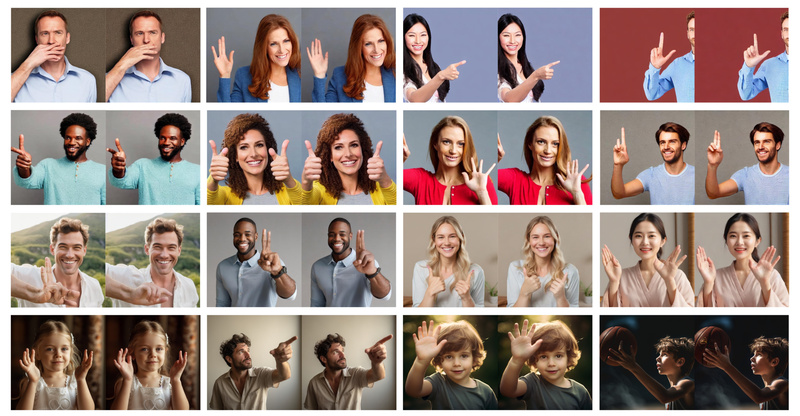
Diffusion models like Stable Diffusion and SDXL have revolutionized AI image generation—but they still stumble on one persistent, high-visibility flaw: malformed hands. Whether it’s six fingers, fused digits, or impossible joint angles, these errors instantly break realism and credibility. For professionals in design, advertising, gaming, or visual storytelling, such flaws can derail otherwise perfect outputs.
HandRefiner offers a practical, lightweight solution: a post-processing tool that surgically corrects hand anatomy while preserving everything else in the image. Built on diffusion-based conditional inpainting and guided by 3D hand mesh priors, HandRefiner fixes hand errors without requiring model retraining, prompt engineering, or full image regeneration. This makes it ideal for integration into existing generative pipelines—especially for users already working with ControlNet, ComfyUI, or AUTOMATIC1111’s WebUI.
Why Hand Accuracy Matters in AI-Generated Imagery
Human hands are among the most complex and expressive structures in visual media. Errors in finger count, proportion, or pose are immediately noticeable—even to non-experts—and can signal “uncanny valley” or low-quality generation. In commercial contexts (e.g., character design, product mockups, or virtual influencers), such flaws reduce trust and professionalism.
Traditional fixes—like manual editing or iterative prompt tweaking—are time-consuming and unreliable. Retraining base models on hand-specific datasets is computationally expensive and often impractical. HandRefiner sidesteps these issues by operating after generation, acting like a precision correction layer that targets only the problematic regions.
How HandRefiner Works: Targeted Correction with 3D-Aware Guidance
HandRefiner uses a two-stage approach:
-
Hand Detection and Mesh Reconstruction: Given an input image with malformed hands, HandRefiner first detects hand regions and reconstructs a 3D hand mesh using a state-of-the-art model (e.g., Mesh Graphormer). This mesh enforces anatomical correctness—exactly five fingers, realistic joint angles, and plausible proportions—while adapting to the original pose.
-
Diffusion-Based Conditional Inpainting: The system then generates a depth map from the corrected mesh and feeds it into a fine-tuned ControlNet module alongside the original image and a user-provided prompt. Using inpainting diffusion, it regenerates only the hand regions, guided by the accurate 3D structure but constrained by the original scene context.
Critically, the rest of the image remains untouched—backgrounds, clothing, lighting, and non-hand anatomy are preserved exactly as generated.
Key Advantages for Practitioners
1. Leverages Synthetic Data Without Domain Gap
HandRefiner exploits a “phase transition” phenomenon in ControlNet: at moderate control strengths (0.4–0.8), the model prioritizes structural guidance over texture fidelity, allowing high-quality results even when trained on synthetic hand datasets. This bypasses the scarcity of real-world hand image annotations.
2. Seamless Integration with Popular Tools
Preprocessors and fine-tuned models are already available for both ComfyUI and AUTOMATIC1111’s Stable Diffusion WebUI. Users can plug HandRefiner into existing workflows without switching frameworks.
3. Lightweight and Efficient
Unlike full-model retraining or iterative regeneration, HandRefiner processes a single image in seconds on consumer GPUs. It’s designed as a drop-in fix, not a system overhaul.
4. Simple Command-Line Interface
Basic usage requires only an input image, an output directory, and a prompt. Batch processing is supported via JSON prompt files, making it scalable for datasets or production pipelines.
Practical Considerations: When HandRefiner Works (and When It Doesn’t)
HandRefiner is highly effective under specific conditions:
- Hand size: Hands should be at least ~60×60 pixels. Smaller hands may lack sufficient detail for reliable mesh fitting.
- Recognizable shape: The original hand must resemble a human hand (e.g., not a fused blob or abstract shape).
- Photorealistic style: The underlying mesh reconstruction model is trained on real human hands, so performance on anime, cartoons, or highly stylized art may be limited.
It does not resize hands—so a disproportionately large malformed hand will remain large after correction. Similarly, if detection fails (e.g., due to extreme occlusion), users can provide manual masks or adjust padding parameters.
For SDXL users: since the official weights are based on Stable Diffusion v1.5, input images should be resized to 512×512 before processing. However, the depth maps and masks generated by HandRefiner can be reused in SDXL-compatible inpainting pipelines with fine-tuned ControlNet models.
Getting Started in Minutes
Installation requires standard dependencies (PyTorch, ControlNet, Mesh Graphormer). Once set up, refining a single image is as simple as:
python handrefiner.py --input_img test/1.jpg --out_dir output --strength 0.55 --weights models/inpaint_depth_control.ckpt --prompt "a man facing the camera, making a hand gesture, indoor" --seed 1
For batch processing, replace --input_img with --input_dir and provide a JSON file mapping filenames to prompts.
Pro tip: Use control strength between 0.4 and 0.8. Values near 1.0 often over-smooth textures, while values below 0.4 may not enforce enough anatomical correction.
If results are inconsistent, try:
- Increasing the
padparameter to expand hand masks - Using a different random seed
- Verifying the quality of the generated depth map
Summary
HandRefiner delivers a rare combination: surgical precision, minimal disruption, and immediate practicality. By isolating the hand-correction problem and solving it with 3D-aware inpainting, it offers a deployable fix for one of generative AI’s most notorious weaknesses. For designers, researchers, and developers tired of hand-related artifacts, HandRefiner isn’t just a research prototype—it’s a ready-to-use tool that integrates smoothly, runs efficiently, and delivers visibly better results with minimal effort.