Facial landmark detection—the task of locating key points on a human face like eyes, nose, and mouth—powers countless applications, from augmented reality filters and facial recognition to emotion analysis and video conferencing enhancements. However, many existing approaches face a tough trade-off: high accuracy often comes at the cost of slow inference, especially on edge devices, while lightweight models tend to sacrifice precision or struggle with real-world variability like extreme poses, occlusions, or lighting changes.
Enter Pixel-in-Pixel Net (PIPNet): a purpose-built solution that delivers speed, accuracy, and robustness without compromise. Designed specifically for “in-the-wild” conditions—where faces appear unpredictably in uncontrolled environments—PIPNet rethinks how heatmap-based landmark detectors operate. By predicting both scores and offsets directly on low-resolution feature maps, it eliminates the need for computationally expensive upsampling layers, dramatically accelerating inference. At the same time, a simple yet effective neighbor regression module enforces local geometric constraints between adjacent landmarks, improving shape consistency and resilience to noise.
What’s more, PIPNet supports generalizable semi-supervised learning (GSSL), enabling it to leverage massive amounts of unlabeled data across domains through a curriculum-based self-training strategy. This makes it uniquely suited for scenarios where labeled data is scarce but diverse real-world imagery abounds.
Why PIPNet Stands Out
Speed Without Sacrificing Accuracy
Traditional heatmap regression models often rely on high-resolution outputs to precisely localize landmarks, requiring multiple upsampling operations that slow down inference—especially on CPUs. PIPNet flips this paradigm: it operates on low-resolution feature maps and predicts both the probability (score) and spatial offset for each landmark in a single, efficient detection head.
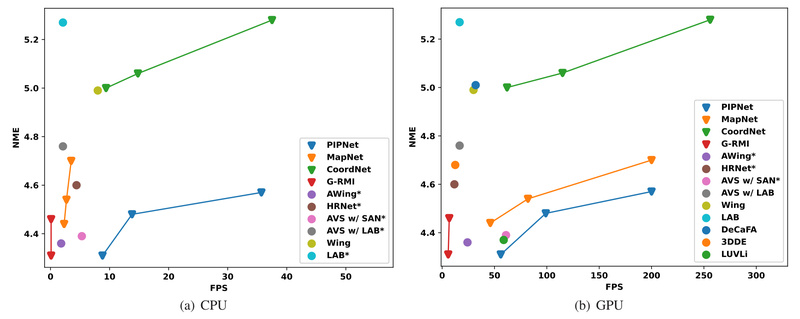
The result? A lightweight PIPNet variant achieves 35.7 FPS on CPU and 200 FPS on GPU while maintaining competitive accuracy with state-of-the-art methods. This makes real-time facial tracking feasible even on resource-constrained devices like smartphones or embedded systems.
Robust Performance Across Diverse Domains
Facial landmark models trained on curated datasets (e.g., 300W or WFLW) often degrade when applied to unseen domains—such as movie frames, social media photos, or surveillance footage. PIPNet addresses this through two key innovations:
- Neighbor Regression Module: By fusing predictions from neighboring landmarks, the model implicitly enforces local shape priors. This reduces erratic predictions under occlusion or extreme angles.
- Self-Training with Curriculum: In its GSSL mode, PIPNet starts by generating pseudo-labels on “easier” unlabeled samples (e.g., well-lit, frontal faces) and progressively incorporates more challenging examples. This staged approach yields higher-quality pseudo-labels and significantly boosts cross-domain generalization.
Benchmarks confirm its effectiveness: PIPNet achieves state-of-the-art results on three out of six major facial landmark datasets under supervised settings and shows consistent gains on cross-domain test sets.
Ideal Use Cases
PIPNet is particularly well-suited for applications that demand real-time performance, deployment flexibility, and adaptability to real-world variability:
- Mobile and Edge AR/VR: With its CPU-friendly speed, PIPNet enables responsive face tracking for filters, virtual try-ons, and avatars directly on user devices—without relying on cloud inference.
- Live Video Analytics: Whether for broadcast monitoring, video conferencing enhancements, or retail analytics, PIPNet can process live camera feeds or video streams with minimal latency.
- Cross-Domain Deployment: When training data comes from controlled environments but deployment targets user-generated content (e.g., social media apps), PIPNet’s GSSL capability helps bridge the domain gap using unlabeled in-the-wild data.
Solving Real Industry Pain Points
PIPNet directly tackles three persistent challenges in facial landmark detection:
- Computational Cost: By avoiding repeated upsampling, PIPNet slashes inference time—critical for latency-sensitive applications.
- Weak Shape Consistency: Most heatmap models treat landmarks independently, leading to anatomically implausible outputs. PIPNet’s neighbor-aware design mitigates this without complex post-processing.
- Domain Sensitivity: Traditional models overfit to training domains. PIPNet’s curriculum-based self-training leverages unlabeled data to generalize better across environments, reducing the need for costly manual relabeling.
Getting Started
The PIPNet repository provides a complete toolkit for evaluation, training, and deployment:
- Input Flexibility: Supports images, video files, and live camera streams out of the box.
- Pre-trained Models: Ready-to-use weights are available for datasets like WFLW and mixed-domain setups (e.g., 300W + CelebA).
- Training Options: Choose between standard supervised learning or the more powerful GSSL mode for cross-domain scenarios.
- Easy Integration: Community projects like torchlm offer PyTorch reimplementations with ONNX export, while lite.ai.toolkit provides optimized C++ runtimes (NCNN, MNN, TNN, ONNX Runtime) for edge deployment.
Setup is straightforward: install dependencies, download datasets into the prescribed structure, and run provided shell scripts for training, testing, or demo inference. A modified FaceBoxes detector is included for face preprocessing—a necessary but well-integrated first step.
Limitations and Practical Considerations
While powerful, PIPNet has clear boundaries users should consider:
- Face-Specific: It detects only facial landmarks—not general object keypoints or body poses.
- Requires Face Detection: PIPNet assumes cropped face images; you’ll need a face detector (e.g., FaceBoxes) upstream.
- Dataset Structure Sensitivity: Custom training demands strict adherence to folder and annotation formats, which may require preprocessing effort.
These are not flaws but design choices that reflect its focused scope: efficient, robust facial landmarking in the wild.
Summary
Pixel-in-Pixel Net redefines what’s possible in real-world facial landmark detection by harmonizing speed, accuracy, and adaptability. Its innovative detection head, neighbor-aware constraints, and curriculum-based semi-supervised learning make it a compelling choice for engineers and researchers building applications that must perform reliably outside the lab. If your project demands real-time face analysis on diverse, uncontrolled imagery—especially on edge hardware—PIPNet offers a battle-tested, open-source foundation worth adopting.