Overview
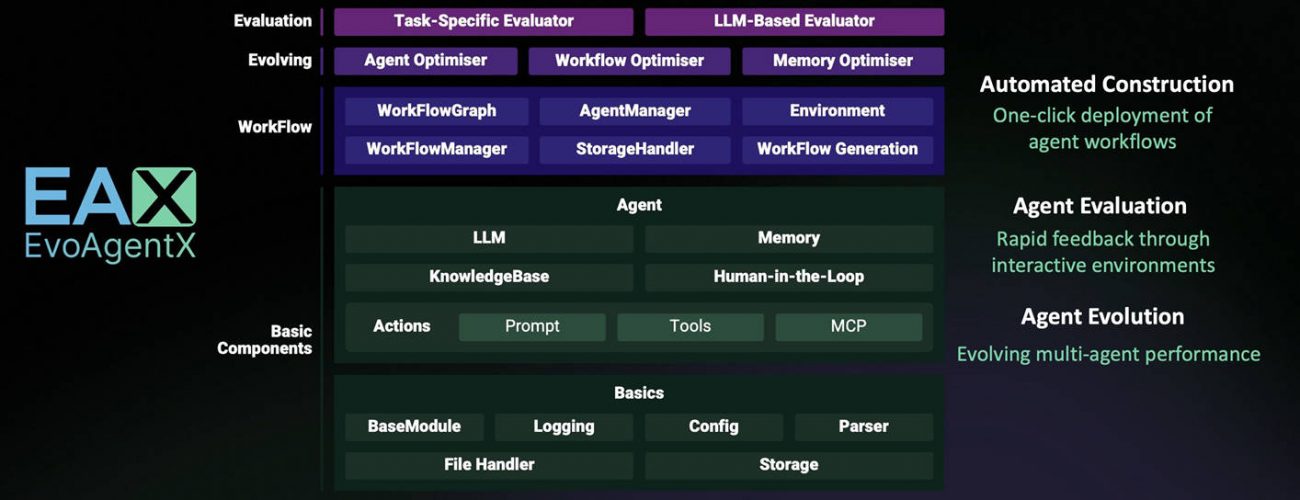
Building reliable, scalable systems with large language models (LLMs) often involves stitching together multiple agents, tools, and prompts—a process that quickly becomes brittle, labor-intensive, and hard to maintain. Enter EvoAgentX, an open-source framework designed to automate the entire lifecycle of agentic workflows: from initial construction and real-world execution to continuous self-improvement through evolutionary optimization.
Unlike traditional multi-agent systems that require developers to manually define agent roles, communication protocols, and tool integrations, EvoAgentX starts with a single natural language goal and automatically generates a structured, multi-agent workflow tailored to the task. More importantly, it doesn’t stop there—through built-in evaluation and self-evolution algorithms, the framework iteratively refines prompts, tool usage, and even workflow topology to boost performance over time.
This makes EvoAgentX particularly valuable for AI researchers, automation engineers, and product teams who need robust, adaptive, and tool-aware agent systems—without drowning in prompt engineering or orchestration boilerplate.
Core Capabilities That Address Real-World Agent Challenges
Automatic Workflow Generation from Plain English
Describe your objective in natural language—e.g., “Generate HTML code for the Tetris game” or “Summarize the latest arXiv papers on AI in finance”—and EvoAgentX constructs a complete multi-agent workflow. It determines how many agents are needed, what roles they should play (e.g., researcher, coder, reviewer), and how they should collaborate. This eliminates the need for manual DAG design or static prompt chaining.
Built-In Evolution Engine for Continuous Improvement
Static prompts decay in effectiveness as tasks evolve. EvoAgentX integrates three state-of-the-art optimization algorithms:
- TextGrad: Optimizes prompts and reasoning traces using gradient-like feedback from evaluations.
- AFlow: Uses Monte Carlo Tree Search to evolve both agent prompts and workflow structure.
- MIPRO: Performs black-box, model-agnostic prompt optimization through iterative reranking.
These algorithms run in the background, using task-specific metrics to guide improvements—turning your agent system into a self-evolving ecosystem.
Rich Tool Integration for Real-World Interaction
Agents in EvoAgentX aren’t just chatbots—they can act. The framework ships with a comprehensive suite of built-in tools, including:
- Code interpreters (Python, Docker)
- Search engines (Google, Wikipedia, arXiv, DDGS)
- Filesystem and shell utilities
- Vector databases (FAISS), SQL/NoSQL clients
- Browser automation (low-level and LLM-driven)
- Image generation and analysis
When generating a workflow, EvoAgentX automatically assigns relevant tools to agents based on the goal, enabling them to fetch data, run code, browse the web, or generate reports.
Human-in-the-Loop (HITL) for Critical Oversight
For high-stakes tasks—like sending emails, executing trades, or approving content—EvoAgentX supports human-in-the-loop checkpoints. You can configure interceptors that pause execution before sensitive actions and request explicit approval or input from a human operator, ensuring safety without sacrificing automation.
Flexible LLM and Memory Support
EvoAgentX works with any LLM via LiteLLM, OpenRouter, or direct API integrations—including OpenAI, Claude, Deepseek, Kimi, and Qwen. It also supports both short-term (session-based) and long-term (persistent) memory modules, allowing agents to retain context and learn across interactions.
Where EvoAgentX Delivers Maximum Impact
EvoAgentX shines in scenarios that demand collaboration, tool use, and iterative refinement. Proven applications include:
- Automated Financial Research: Generate HTML reports with market indices, stock prices, institutional activity, and buy/sell recommendations—all from a single prompt.
- Scientific Literature Summarization: Retrieve, filter, and synthesize recent arXiv papers by topic and date range, with optional expansion to Google Scholar or other databases.
- Code Generation & Debugging: Build agents that write, test, and refine code across multiple iterations—validated on benchmarks like MBPP with measurable gains.
- Multi-Hop Reasoning: Solve complex QA tasks (e.g., HotPotQA) by coordinating specialized agents for retrieval, inference, and verification.
These aren’t hypothetical demos—they’re backed by empirical results on standard benchmarks and real-world GAIA tasks.
Getting Started: From Goal to Executing Workflow in Minutes
Using EvoAgentX is straightforward:
- Install:
pip install evoagentx
- Configure your LLM (e.g., OpenAI):
from evoagentx.models import OpenAILLMConfig, OpenAILLM config = OpenAILLMConfig(model="gpt-4o-mini", openai_key=os.getenv("OPENAI_API_KEY")) llm = OpenAILLM(config=config) - Define a goal and generate a workflow:
from evoagentx.workflow import WorkFlowGenerator, WorkFlow
from evoagentx.agents import AgentManager

goal = "Find and summarize the latest research on AI in finance on arXiv"
workflow_graph = WorkFlowGenerator(llm=llm).generate_workflow(goal)
agent_manager = AgentManager()
agent_manager.add_agents_from_workflow(workflow_graph, llm_config=config)
workflow = WorkFlow(graph=workflow_graph, agent_manager=agent_manager, llm=llm)
output = workflow.execute()
Optional enhancements—like adding the ArxivToolkit, enabling HITL, or selecting an evolution algorithm—are just a few lines of code away.
Key Limitations and Practical Considerations
While powerful, EvoAgentX has realistic boundaries:
- It relies on external LLM APIs for core reasoning (though local models are supported via LiteLLM).
- Tool selection matters: you must provide relevant toolkits for the generator to consider (e.g., don’t expect web search without a search toolkit).
- Visual workflow editing is not yet available—it’s on the roadmap—but workflows can be saved, loaded, and introspected programmatically.
These are not roadblocks but design choices that prioritize modularity and extensibility over monolithic convenience.
Summary
EvoAgentX solves a critical bottleneck in agentic AI: the manual, static, and non-adaptive nature of current multi-agent systems. By automating workflow generation, enabling real-world tool use, and embedding self-evolution directly into the architecture, it delivers measurable performance gains—7.44% higher F1 on HotPotQA, 10% better pass@1 on MBPP, and up to 20% accuracy improvement on GAIA—while drastically reducing engineering overhead.
For teams building agent-based applications in research, automation, or product development, EvoAgentX provides a scalable, open-source foundation that evolves with your needs—turning vague goals into robust, self-improving systems with minimal code.
The project is MIT-licensed, actively maintained, and welcomes community contributions. If you’re tired of hand-crafting brittle agent pipelines, EvoAgentX offers a smarter, automated alternative that learns as it works.