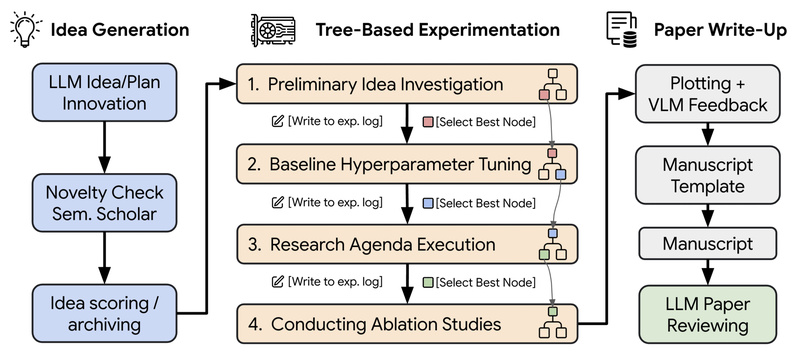
In an era where AI is reshaping how knowledge is created, AI-Scientist-v2 emerges as a breakthrough system that autonomously conducts full-cycle scientific research—from idea generation to peer-reviewed paper submission. Developed by Sakana AI, it is the first AI system to produce a workshop paper entirely on its own that successfully passed human peer review at an ICLR 2025 workshop.
For technical decision-makers, research leads, and engineering teams exploring automation in early-stage R&D, AI-Scientist-v2 offers a practical path to scale exploratory science without manual scaffolding. Unlike prior approaches that depend on human-written code templates, this version operates with true autonomy across diverse machine learning domains, making it a compelling tool for rapid hypothesis testing and proof-of-concept generation.
Core Innovations and Differentiators
Beyond Templates: Truly Autonomous Research Workflows
AI-Scientist-v2 eliminates the reliance on pre-defined human-authored code templates that constrained its predecessor (v1). Instead, it starts from a high-level research topic and builds experiments from scratch using LLM-generated code, enabling broader exploration in open-ended scientific problems.
While v1 excels in structured tasks with clear objectives (e.g., benchmarking known methods), v2 is purpose-built for discovery-driven scenarios where the solution path is unknown. This trade-off results in lower success rates but unlocks creative potential—ideal for teams seeking novel angles in crowded research areas.
Progressive Agentic Tree Search
At the heart of AI-Scientist-v2 is a novel progressive agentic tree search mechanism, coordinated by a dedicated experiment manager agent. This approach:
- Explores multiple experimental paths in parallel (controlled via
num_workers). - Dynamically debugs failed experiments up to a configurable depth (
max_debug_depth). - Grows independent "trees" of research trajectories (
num_drafts) to increase the chance of viable outcomes.
The search process is guided by iterative reflection and pruning, mimicking how human researchers pivot when initial hypotheses fail. The result is a more robust exploration of the scientific solution space without human intervention.
Integrated Scientific Writing and Visual Refinement
Once experiments conclude, the system autonomously:
- Analyzes results and generates publication-ready visualizations.
- Writes a complete scientific manuscript (including abstract, methodology, results, and discussion).
- Refines figures and narrative using a Vision-Language Model (VLM) feedback loop during internal review.
This end-to-end capability ensures that even complex findings are communicated clearly—critical for internal reports or submission-ready drafts.
Practical Use Cases for Technical Teams
AI-Scientist-v2 is not a replacement for domain experts but a force multiplier for them. Key applications include:
- Rapid prototyping of ML research directions: Test dozens of ideas in days rather than months.
- Baseline study generation: Automatically produce initial analyses for new datasets or architectures.
- Idea expansion under resource constraints: When human bandwidth is limited, use v2 to explore fringe hypotheses that might otherwise be deprioritized.
- Workshop paper drafting: Accelerate submission cycles for academic or industrial R&D teams targeting fast-turnaround venues.
Crucially, it shines in open-ended, exploratory settings—not in highly constrained engineering tasks where templates (like v1) remain more reliable.
Getting Started: A Streamlined Workflow
The system follows a two-stage pipeline:
Stage 1: Ideation from a Research Topic
-
Create a Markdown file (e.g.,
my_topic.md) with sections:Title,Keywords,TL;DR, andAbstract. -
Run the ideation script:
python ai_scientist/perform_ideation_temp_free.py --workshop-file "ai_scientist/ideas/my_topic.md" --model gpt-4o-2024-05-13 --max-num-generations 20
This outputs a JSON file (
my_topic.json) containing vetted, novel research ideas.
Stage 2: Full Paper Generation via Tree Search
Launch the main pipeline using the generated JSON:
python launch_scientist_bfts.py --load_ideas "ai_scientist/ideas/my_topic.json" --model_writeup o1-preview-2024-09-12 --model_review gpt-4o-2024-11-20 --model_agg_plots o3-mini-2025-01-31
Requirements:
- Linux with NVIDIA GPU (CUDA + PyTorch).
- API keys for LLMs (OpenAI, Gemini, or Claude via AWS Bedrock).
- Optional: Semantic Scholar API key for citation novelty checks.
Runtime & Cost:
- Ideation: ~(2–5.
- Full experiment + writing: ~)20–25 (using Claude 3.5 Sonnet for experiments).
- Total time: Several hours per run.
Security Note: Since the system executes LLM-written code, always run in a sandboxed environment (e.g., Docker) to prevent unintended system access or package installation.
Limitations and Operational Considerations
While powerful, AI-Scientist-v2 comes with important caveats:
- Lower success rate: Due to its exploratory nature, not every run yields a valid paper. Success heavily depends on the LLM’s reasoning quality (Claude 3.5 Sonnet is recommended for experiments).
- ML-domain focus: Generalization is strongest within machine learning; adaptation to biology, chemistry, or physics may require significant prompt engineering.
- Hardware demands: May trigger CUDA out-of-memory errors on smaller GPUs. Mitigate by constraining model size in the ideation prompt.
- No web safety guarantees: Autonomous code execution poses risks—never run in production or shared environments without isolation.
Summary
AI-Scientist-v2 represents a significant leap toward autonomous scientific discovery. By combining agentic tree search, template-free experimentation, and integrated writing with visual refinement, it enables technical teams to systematically explore the unknown at scale. While not a silver bullet, it offers a unique advantage for organizations seeking to accelerate early-stage research, validate unconventional ideas, or augment human creativity with AI-driven exploration. With its code publicly available and design optimized for real-world ML domains, it’s a compelling tool for forward-looking R&D teams ready to pilot the future of automated science.