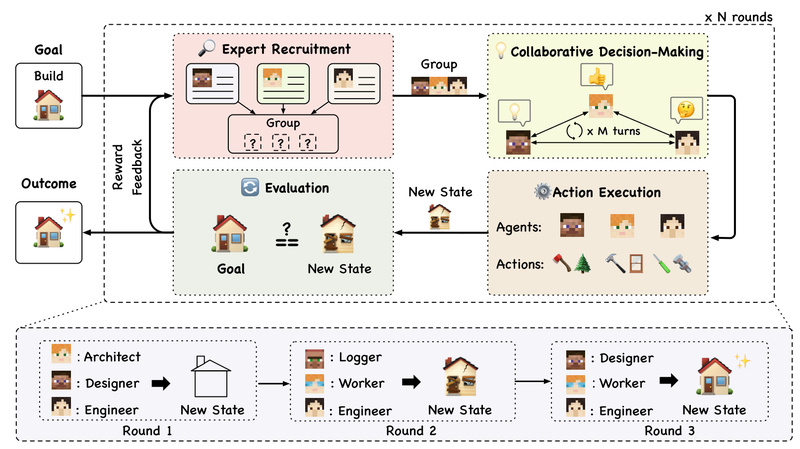
In today’s AI landscape, single-agent systems—powered by large language models (LLMs)—often hit a ceiling when tackling complex, multi-step problems. What if, instead of relying on one “smart” agent, you could deploy a team of specialized agents that collaborate like human experts? That’s exactly what AgentVerse enables. Developed by OpenBMB and accepted at ICLR 2024, AgentVerse is an open-source framework designed to orchestrate multiple LLM-based agents either to solve practical tasks collaboratively or to simulate social interactions in controlled environments.
Whether you’re a technical lead evaluating tools for automating software development, a researcher studying emergent agent behaviors, or an engineer prototyping multi-agent workflows, AgentVerse offers a flexible, research-backed foundation—without requiring you to build everything from scratch.
Two Modes for Two Different Goals
AgentVerse isn’t a one-size-fits-all tool. It intentionally separates its functionality into two distinct frameworks to serve different use cases:
Task-Solving Mode: Multi-Agent Systems That Deliver Results
In Task-Solving mode, AgentVerse assembles agents into a unified system where each plays a specialized role—like a software architect, coder, and tester working together on a feature. This mode is engineered for real-world productivity, supporting applications such as:
- Automated coding: Teams of agents jointly solve programming challenges (e.g., HumanEval benchmark).
- Consulting workflows: Agents simulate expert panels for brainstorming or decision support.
- Database administration: Multi-agent coordination to interpret and execute complex queries.
By distributing cognitive load across agents, this framework often outperforms single-agent baselines in both accuracy and robustness—especially on tasks requiring planning, tool use, or domain-specific reasoning.
Simulation Mode: Observe, Interact, and Experiment
In Simulation mode, AgentVerse becomes a sandbox for exploring how agents behave in social or game-like settings. Users define custom environments and observe emergent dynamics, such as cooperation, competition, or even deception. Examples include:
- NLP Classroom: One agent acts as a professor; others as students asking and answering questions.
- Prisoner’s Dilemma: Agents negotiate under strategic incentives, revealing social strategy patterns.
- Interactive games: Like a Pokémon-themed H5 demo where users converse with in-game characters.
This mode is invaluable for researchers in AI alignment, cognitive science, or human-computer interaction who need safe, reproducible environments to study group behavior.
Solving Real Pain Points with Out-of-the-Box Examples
AgentVerse directly addresses common frustrations in LLM deployment:
- Limited reasoning depth: A single agent might miss edge cases; a team can cross-check and refine outputs.
- Tool integration complexity: AgentVerse provides pre-configured setups for agents to jointly use web browsers, code interpreters (e.g., Jupyter), or search engines via XAgent’s ToolServer.
- Lack of behavioral insight: Most frameworks focus only on task completion. AgentVerse uniquely bridges utility and scientific inquiry by exposing how agents interact under collaboration pressure.
For example, running a code generation task on HumanEval isn’t just a benchmark—it’s a template for building your own coding assistant team. Similarly, the NLP Classroom isn’t just a demo—it’s a starting point for simulating team meetings, customer support scenarios, or educational tutoring systems.
Getting Started Without a PhD
Despite its academic origins, AgentVerse is designed for practitioners. Setup is straightforward:
- Install via pip (
pip install -U agentverse) or from source. - Configure your LLM backend—whether OpenAI, Azure OpenAI, or local models like LLaMA-2 or Vicuna via vLLM or FastChat (FSChat).
- Run pre-built examples with one command:
- Task-solving:
agentverse-tasksolving --task tasksolving/brainstorming - Simulation (CLI):
agentverse-simulation --task simulation/nlp_classroom_9players - Simulation (GUI):
agentverse-simulation-gui --task simulation/nlp_classroom_9players
- Task-solving:
Local model support is particularly valuable for teams with data privacy requirements or limited API budgets. The framework abstracts away much of the orchestration complexity, letting you focus on agent roles and task design.
Current Limitations to Keep in Mind
AgentVerse is powerful but not magic. Be aware of these practical constraints:
- Documentation is still evolving: While examples are well-structured, comprehensive guides are pending.
- Conversation memory is basic: Long, multi-turn dialogues across agents aren’t yet supported with advanced memory mechanisms.
- Tool-based simulations require extra setup: Integrating BMTools or XAgent’s ToolServer adds a layer of dependency management.
- CLI-centric: There’s no no-code interface; users should be comfortable editing YAML config files and running commands.
That said, the active community (via Discord and Hugging Face) and clean codebase make it feasible for motivated engineers to extend the system.
Why AgentVerse Stands Out for Technical Decision-Makers
Among multi-agent frameworks, AgentVerse distinguishes itself through:
- Dual-purpose design: It’s not just for research or production—it genuinely supports both.
- Peer-reviewed foundation: Accepted at ICLR 2024, with empirical evidence of collaborative gains.
- Open and extensible: Full source code, support for local/cloud LLMs, and modular architecture.
- Community momentum: Featured in NVIDIA’s developer blog and backed by active contributors.
For teams looking to move beyond solo-agent demos and into deployable, collaborative AI systems—or to rigorously study agent interactions—AgentVerse offers a rare combination of scientific rigor and engineering practicality.
Summary
AgentVerse lowers the barrier to building, testing, and deploying multi-agent LLM systems. Whether your goal is automating a technical workflow or investigating how artificial agents negotiate, deceive, or cooperate, AgentVerse provides the scaffolding to do it quickly, reproducibly, and at scale. While not yet a turnkey enterprise product, its flexibility, active development, and strong academic grounding make it a compelling choice for forward-looking technical teams ready to explore the next frontier of LLM applications.