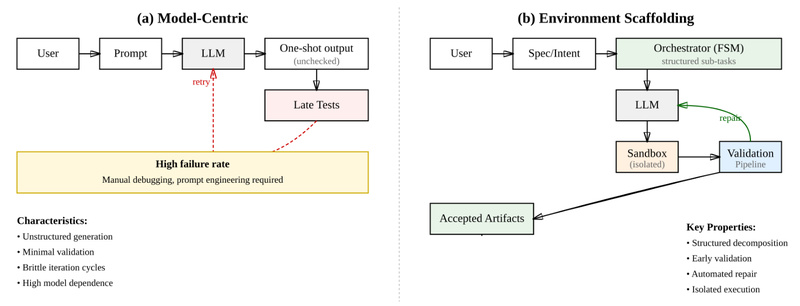
Imagine turning a simple idea—like “a task manager with user authentication, real-time updates, and a clean UI”—into a fully working, tested, and deployable web application in minutes. That’s the promise of app.build, an open-source AI agent framework designed not just to generate code, but to deliver production-grade applications with built-in validation, testing, and deployment infrastructure.
Unlike generic code-generation tools that output raw snippets prone to syntax errors or logical gaps, app.build treats application creation as a structured, multi-stage engineering process. It breaks down development into small, verifiable tasks—each executed in isolated sandboxes and validated using language-specific tooling like ESLint, TypeScript, PHPStan, pytest, and Playwright. The result? Applications that aren’t just syntactically correct, but functionally viable from day one.
Backed by empirical evaluation across 30 generation tasks, app.build achieves a 73.3% viability rate, with 30% of outputs scoring “perfect” on quality metrics. Even more impressively, open-weight models reach 80.8% of the performance of leading closed models—when provided with structured environments. This underscores app.build’s core philosophy: scaling reliable AI agents requires scaling their environments, not just their models.
What Makes app.build Different?
Built for Production, Not Just Prototypes
Many AI coding assistants stop at generating source files. app.build goes further: every output includes linting, type safety, unit and integration tests, database provisioning (via Neon Postgres), GitHub repository creation, and CI/CD setup through the app.build platform. You don’t just get code—you get a complete, deployable system.
Multi-Layered Validation Pipeline
Each component of the generated app undergoes rigorous checks:
- Static analysis: ESLint (JavaScript/TypeScript), PHPStan (PHP), ruff/pyright (Python)
- Runtime verification: Automatic smoke tests with Playwright for web apps
- Architectural conformance: Enforced project structure and interface contracts
This layered approach catches errors early and ensures consistency across frontend, backend, and database layers.
Task-Based Generation in Isolated Sandboxes
Instead of asking an LLM to “write an entire app,” app.build decomposes development into atomic, context-aware tasks:
- For tRPC apps: schema → API handlers → React components
- For Laravel apps: migrations → Eloquent models → controllers → Inertia pages
Each task runs in a sandbox with only the necessary context, reducing hallucination and improving correctness. Only after passing validation does a task get integrated into the final codebase.
Supported Application Stacks
app.build currently offers three opinionated but production-ready stacks:
tRPC CRUD Web Applications
Full-stack apps using Bun, React, Vite, Fastify, tRPC, and Drizzle ORM. Features include:
- End-to-end TypeScript typing
- Automatic Playwright smoke tests
- ESLint and runtime validation
Laravel Web Applications (Alpha)
Modern PHP 8+ apps with Laravel 12, React, Tailwind CSS, and Inertia.js, including:
- Built-in auth via Laravel Breeze
- Form Request validation and Eloquent models with PHPDoc
- Feature tests and architecture checks
Data-Oriented Applications
Python-based dashboards using NiceGUI and SQLModel, ideal for internal tools:
- Pytest-driven validation
- Dependency management via
uv - Runtime data integrity checks
All stacks automatically provision a Neon Postgres database and publish code to a GitHub repo with CI/CD enabled.
Solving Real AI Code Generation Pain Points
Traditional LLM-based code generation often fails in practice due to:
- Unreliable output: Missing edge cases, incorrect APIs, or broken imports
- No tests: Code that compiles but doesn’t work
- No deployment path: Raw files with no build, test, or deploy pipeline
app.build addresses these by baking software engineering best practices directly into the generation loop. Validation isn’t an afterthought—it’s a prerequisite at every stage.
How to Use app.build
You have two options:
Use the Managed Service
The easiest way is via the official app.build platform, where you provide a prompt and receive a complete, hosted application with CI/CD and database ready to go.
Run Locally with Custom LLMs
For full control, run the agent locally. app.build supports a wide range of models:
- Cloud: OpenAI, Anthropic, Gemini, OpenRouter
- Local: Ollama, LM Studio
You can override defaults like this:
LLM_BEST_CODING_MODEL=ollama:devstral
LLM_UNIVERSAL_MODEL=lmstudio:
LLM_BEST_CODING_MODEL=openrouter:deepseek/deepseek-coder
The environment remains consistent—only the model backend changes—ensuring reliability regardless of inference provider.
Limitations to Consider
While powerful, app.build has boundaries:
- Only three stacks are supported (tRPC, Laravel alpha, Python/NiceGUI)
- Laravel support is still in alpha—expect occasional rough edges
- Architectures are opinionated; highly custom or legacy-integrated systems may not fit
- Full CI/CD and Neon DB provisioning require the app.build platform
It’s optimized for standard CRUD apps, internal dashboards, and MVPs—not for niche frameworks or deeply bespoke architectures.
Why This Matters for the Future of AI Agents
app.build demonstrates a critical insight: reliable agentic systems need structured environments as much as strong models. By providing reference implementations of validation, task decomposition, and stack-specific orchestration, it offers a blueprint for production-grade AI development.
With over 3,000 applications already generated by the community, it’s not just a research prototype—it’s a working tool for real developers who need working software, fast.
Summary
app.build redefines what “AI-generated code” can mean: not just text that resembles code, but validated, tested, and deployable applications built with engineering rigor. For technical decision-makers, startup founders, or engineering teams looking to accelerate prototyping or internal tooling, it offers a rare combination of speed, correctness, and production readiness—all from a single prompt.