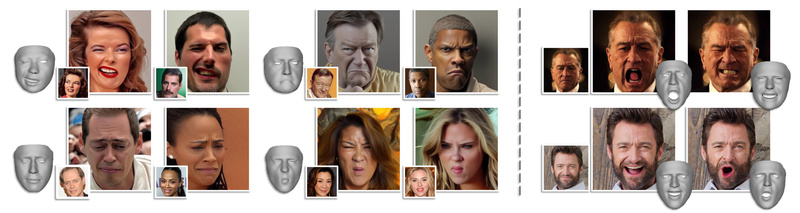
Creating realistic, diverse human faces that remain visually consistent with a specific identity—while allowing fine-grained control over expressions—is a persistent challenge in generative AI. Many existing models either preserve identity at the cost of expression fidelity or offer expressive control that distorts who the person is. Arc2Face solves this dilemma by combining robust identity conditioning with precise, blendshape-guided expression synthesis, all built on a scalable diffusion architecture.
Developed by researchers at Imperial College London and FAU Erlangen-Nürnberg, Arc2Face is a foundation model trained on the large-scale WebFace42M dataset. It generates high-quality face images in seconds using only an ArcFace identity embedding—no reference image is needed during generation. More recently, the team introduced an Expression Adapter that enables accurate control over facial expressions, from basic emotions to subtle micro-expressions and even asymmetric or extreme poses, without compromising identity consistency.
For product teams, researchers, and developers building applications in digital avatars, synthetic media, or AI-driven storytelling, Arc2Face offers a rare balance: strong identity preservation, fast inference, and modular control over pose and expression.
Why Identity Consistency and Expression Control Matter
In real-world applications like virtual assistants, personalized gaming characters, or synthetic training data, maintaining a consistent identity across different scenes or emotions is essential. If a character smiles, talks, or looks surprised, they should still unmistakably be “themselves.”
Prior diffusion-based face generators often fail here: tweaking expressions or head poses can unintentionally alter identity traits—skin tone, facial structure, or distinctive features—leading to visual drift. Arc2Face addresses this by anchoring generation directly to an ArcFace embedding, a compact yet discriminative representation widely used in face recognition systems. This ensures that every output remains tied to the original identity, even when generating dozens of variations.
Core Capabilities That Deliver Practical Value
Identity-Consistent Generation from a Single Embedding
Arc2Face requires only a face embedding (extracted via ArcFace from one photo) to generate multiple diverse, photorealistic face images. No need to fine-tune the model or train on subject-specific data. This makes it ideal for rapid prototyping or scaling across thousands of identities.
Built-in Support for Pose Control via ControlNet
Using a companion ControlNet model trained on 3D pose estimates (via EMOCA), users can specify head orientation and generate faces matching a desired pose—useful for aligning synthetic faces to video frames or 3D avatars.
Fine-Grained Expression Control with Blendshape Guidance
The new Expression Adapter unlocks unprecedented control. By leveraging FLAME blendshape parameters—extracted from a target expression image using SMIRK—the model can recreate that exact expression on any identity. This includes rare or nuanced expressions often missed by emotion-label-based systems.
Additionally, a Reference Adapter allows partial preservation of background and appearance from a source image, enabling realistic expression transfer in real-world photos.
Fast Inference with LCM-LoRA Acceleration
For latency-sensitive applications, Arc2Face supports LCM-LoRA, reducing inference to just 2–4 steps while maintaining reasonable quality. This enables near real-time generation on consumer GPUs—critical for interactive tools or web demos.
Where Arc2Face Adds Real-World Value
Arc2Face shines in scenarios demanding both identity fidelity and expressive flexibility:
- Personalized Avatars: Generate consistent characters for games, VR, or metaverse platforms that react with realistic emotions.
- AI-Powered Storytelling: Create storyboards or animated sequences with the same character showing different moods—without manual editing or identity drift.
- Synthetic Data Generation: Produce large-scale, identity-preserving face datasets with controlled variations in pose and expression for training robust vision models.
- Virtual Try-Ons & Digital Twins: Simulate how a user might look with different expressions or head angles while retaining their core appearance.
- Creative Tools: Integrate into design workflows via ComfyUI, Gradio, or Replicate for non-experts to explore expressive face synthesis without deep ML knowledge.
Getting Started Is Straightforward
Arc2Face integrates cleanly with the Hugging Face diffusers library. The typical workflow involves:
- Extracting an ArcFace embedding from a source image using the included
antelopev2face analysis pipeline. - Projecting that embedding into the model’s latent space.
- Generating images via a standard Stable Diffusion pipeline—now conditioned on identity instead of text.
Optional modules (ControlNet for pose, Expression/Reference Adapters for expression transfer) can be added incrementally. Community integrations like ComfyUI-Arc2Face and Replicate demos further lower the entry barrier for developers and designers.
Limitations and Practical Considerations
While powerful, Arc2Face has boundaries users should understand:
- It requires a detectable, front-facing (or near-frontal) face to extract a reliable ArcFace embedding. Heavily occluded, profile, or non-human faces may not work well.
- Expression control depends on the quality of blendshape estimation from the input reference. Poor landmark detection can lead to inaccurate or distorted expressions.
- The LCM-LoRA acceleration, while fast, trades off some detail and realism—best suited for drafts or real-time previews, not final assets.
- The model was trained on human faces; it is not designed for animals, cartoons, or stylized art.
These constraints are typical for identity-conditioned generative models, but Arc2Face’s modular design allows users to assess fit-for-purpose based on their specific needs.
Summary
Arc2Face stands out as a practical, high-fidelity solution for generating identity-consistent human faces with controllable expressions and poses. By leveraging ArcFace embeddings and blendshape-guided diffusion, it bridges a critical gap between identity preservation and expressive freedom—making it a compelling choice for AI storytellers, avatar developers, and synthetic data engineers. With open-source availability, fast inference options, and ecosystem support (ComfyUI, Gradio, Replicate), it’s designed not just for researchers, but for builders who want to ship real applications.