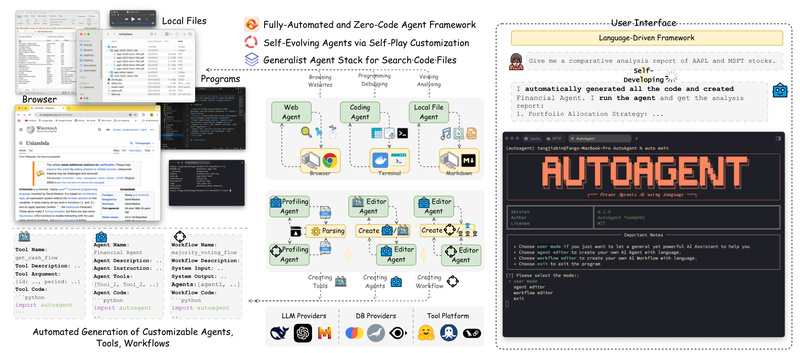
Building AI agents today usually means writing code. Frameworks like LangChain and AutoGen have unlocked incredible capabilities—but they also demand programming skills. That’s a problem, because only about 0.03% of the global population can code. What if anyone—product managers, researchers, educators, or business analysts—could create their own intelligent LLM agents without writing a single line?
Enter AutoAgent, a fully-automated, zero-code framework that lets users build, customize, and deploy LLM agents using natural language alone. No coding. No manual configuration. Just describe what you want in plain English, and AutoAgent handles the rest: creating agents, tools, workflows, and even managing file systems—all autonomously.
Designed as an “Agent Operating System,” AutoAgent doesn’t just lower the barrier to entry—it removes it entirely. Whether you need a deep research assistant, a customer support bot, or a custom multi-agent workflow, AutoAgent turns natural language into functional AI systems, instantly and reliably.
Why AutoAgent Matters: Democratizing AI Agent Development
Most existing agent frameworks assume technical fluency. AutoAgent challenges that assumption. By enabling natural language–driven development, it opens AI agent creation to non-technical professionals who understand their domain but not Python or API integrations.
This isn’t just convenience—it’s inclusion. A marketing analyst can now build an agent to scrape and summarize competitor reports. A biology professor can create a research assistant that reads scientific papers and drafts literature reviews. These users don’t need engineers; they just need to articulate their goals.
AutoAgent’s vision is clear: if you can describe a task, you should be able to automate it with AI.
Key Features That Set AutoAgent Apart
Natural Language–Driven Agent Creation
Describe your desired agent (“a travel planner that books flights and hotels”) or workflow (“a team of agents that analyzes quarterly sales and writes executive summaries”), and AutoAgent automatically generates the underlying architecture—roles, tools, communication protocols—without any code.
Zero-Code Framework for Everyone
All customization happens through conversation. The Agent Editor creates standalone agents; the Workflow Editor builds coordinated multi-agent systems. Both require zero programming. Even tool creation (e.g., connecting to a weather API) is handled automatically when you describe the need.
Self-Managing System with Dynamic Optimization
AutoAgent includes a self-managing file system and an LLM-powered actionable engine that iteratively refines agent behavior. If a task fails or performance lags, the system can self-correct—adjusting workflows or regenerating tools—based on feedback or outcomes.
Built-In “User Mode” for Deep Research
Out of the box, AutoAgent offers a ready-to-use multi-agent research assistant (called “User Mode”) that rivals commercial services like Deep Research. It supports file uploads, complex queries, and detailed report generation—all via CLI—and works with any major LLM, from Claude 3.5 Sonnet to DeepSeek-R1 and Gemini.
Self-Play Customization for Continuous Improvement
Using a “self-play” mechanism, AutoAgent can simulate interactions between agents to test and improve designs before deployment. This enables robust, battle-tested agent systems even when users provide incomplete or high-level instructions.
Real-World Use Cases
AI Research Assistant for Professionals
Use User Mode to automate information retrieval, data synthesis, and report writing. Ideal for consultants, analysts, or academics who need fast, accurate insights without manual web scraping or spreadsheet wrangling.
Rapid Prototyping for Teams Without Engineers
Product teams can prototype customer onboarding bots, sales assistants, or data validation agents using only natural language—no dev backlog required. Test ideas in hours, not weeks.
Interactive Learning Tools in Education
Educators can build AI tutors that answer student questions, generate quizzes, or explain complex topics—customized to specific curricula—without relying on IT support.
Developer-Friendly Alternative
Even developers benefit: instead of wiring up agents manually in LangChain, they can describe a workflow in natural language and let AutoAgent generate the scaffolding, saving time on boilerplate code.
Getting Started Is Surprisingly Simple
AutoAgent is open source and runs via a clean command-line interface. Here’s how to begin:
- Install: Clone the repo and install with pip:
git clone https://github.com/HKUDS/AutoAgent.git
cd AutoAgent && pip install -e .
- Set API Keys: Create a
.envfile with your preferred LLM provider keys (OpenAI, Anthropic, Gemini, DeepSeek, etc.). Only the ones you plan to use are needed. - Launch: Run one of two commands:
auto deep-researchfor the ready-to-use research assistant.auto mainto access full capabilities (Agent Editor, Workflow Editor, and User Mode).
AutoAgent automatically handles Docker setup and model-specific configurations. Switching between LLMs is as easy as changing the COMPLETION_MODEL environment variable—no code changes required.
Limitations and Practical Considerations
While powerful, AutoAgent isn’t without current constraints:
- No GUI yet: All interaction is through CLI. A web interface is under development.
- Tool creation isn’t supported in Workflow Editor: If you need custom tools, use Agent Editor first.
- Relies on external LLM APIs: Costs and availability depend on your chosen provider (e.g., Anthropic or OpenAI).
- Basic technical hygiene still helps: Users should understand how to manage API keys or, optionally, import browser cookies for website access.
These are pragmatic trade-offs—not blockers—and they’re actively being addressed in the roadmap (including GUI support and expanded sandbox environments).
Performance That Earns Trust
AutoAgent isn’t just user-friendly—it’s effective. On the GAIA benchmark, which tests general AI assistants on real-world tasks, AutoAgent outperforms existing state-of-the-art methods. Its Retrieval-Augmented Generation (RAG) capabilities also consistently beat alternative LLM-based solutions in multi-hop reasoning tasks.
And unlike paid services charging $200/month for deep research features, AutoAgent is free, open source, and self-hosted—giving users full control, privacy, and cost predictability.
Summary
AutoAgent represents a fundamental shift: from code-centric AI development to language-first agent creation. It solves a real, widespread problem—the “code barrier”—by empowering non-technical users to build sophisticated, multi-agent LLM systems through natural conversation.
With strong benchmark performance, support for all major LLMs, and a truly zero-code experience, AutoAgent is not just another framework. It’s a gateway to accessible, personalized AI.
If you’ve ever wanted to automate a complex task with AI but didn’t know where to start—AutoAgent is ready for you today.