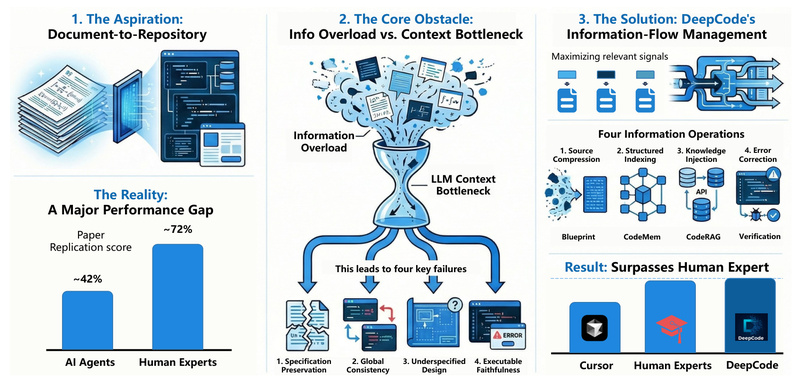
Imagine being able to feed a research paper, a technical specification, or even a rough product description into a system—and minutes later receive a complete, tested, and documented codebase that actually works. That’s not science fiction anymore. DeepCode is an open, agentic coding framework that does exactly this, and it’s already outperforming top commercial tools like Cursor and Claude Code—and even PhD-level researchers—on rigorous benchmarks like PaperBench.
Built by the Data Intelligence Lab at The University of Hong Kong, DeepCode redefines what’s possible in autonomous software engineering. It’s not just another code generator; it’s a multi-agent system designed to solve one of the hardest problems in AI-powered development: turning dense, ambiguous, or highly technical documents into reliable, production-grade implementations—without human intervention.
For technical leaders, researchers, and engineering teams drowning in boilerplate work or delayed prototyping cycles, DeepCode offers a path to reclaim time, reduce errors, and accelerate innovation.
What Makes DeepCode Different?
Unlike single-model code completers, DeepCode treats code synthesis as a channel optimization problem. It balances four key operations under strict context limits: compressing source intent into blueprints, indexing code knowledge structurally, injecting relevant context via retrieval-augmented generation (CodeRAG), and iteratively correcting errors in a closed loop.
This architecture enables three standout capabilities:
Paper2Code: From Academic Papers to Working Implementations
DeepCode excels at converting complex algorithms from machine learning or systems papers into fully functional code. On the PaperBench benchmark—where agents must reproduce 20 ICML 2024 papers from scratch—DeepCode scored 75.9%, surpassing the best human experts (72.4%) and leaving prior tools like PaperCoder (51.1%) far behind.
Text2Web: Instant Front-End from Plain Descriptions
Describe a UI in natural language—”a responsive dashboard with user login, chart widgets, and dark mode”—and DeepCode generates clean, modern HTML/CSS/JavaScript, complete with structure, styling, and interactivity.
Text2Backend: Scalable Server Logic from Simple Prompts
Need a REST API with user authentication, database models, and rate limiting? Just describe it. DeepCode produces modular, well-structured back-end code in Python, Node.js, or other stacks, pre-wired with tests and documentation.
All outputs are production-ready: properly organized, type-safe (where applicable), tested, and documented—no manual cleanup required.
Real Problems DeepCode Solves
Technical teams face recurring bottlenecks that slow down innovation:
- Researchers waste weeks reimplementing baselines instead of exploring new ideas.
- Startups delay MVP launches because engineering bandwidth is consumed by repetitive scaffolding.
- Product teams lose momentum when concepts sit in design docs for months before becoming testable prototypes.
- Developers duplicate effort by rebuilding patterns that already exist in open-source codebases.
DeepCode directly addresses these by automating the research-to-code and idea-to-prototype pipelines. It’s not about replacing developers—it’s about eliminating undifferentiated heavy lifting so your team can focus on what truly matters: architecture, innovation, and user value.
Critically, DeepCode doesn’t just “write code”—it orchestrates a full development workflow. It plans, retrieves relevant examples, generates, tests, debugs, and documents—mimicking the cognitive process of an expert engineer, but at machine speed.
How It Works: A Seamless User Experience
Using DeepCode is intentionally frictionless. You have two interface options:
- Web Dashboard: Upload a PDF, DOCX, or TXT file—or paste a URL—and watch real-time progress as agents parse, plan, and implement. Results include the full codebase, unit tests, and README documentation.
- CLI Tool: For CI/CD integration or headless environments, run
deepcodefrom the terminal with the same input flexibility.
Under the hood, DeepCode uses the Model Context Protocol (MCP) to coordinate specialized agents: one decodes your intent, another parses the document, a third mines GitHub for reference implementations, and a final agent synthesizes everything into coherent, executable code. The system even segments large papers automatically to stay within LLM context limits—ensuring nothing gets lost in translation.
Getting Started: Requirements and Setup
DeepCode is open-source (MIT licensed) and easy to install:
pip install deepcode-hku
curl -O https://raw.githubusercontent.com/HKUDS/DeepCode/main/mcp_agent.config.yaml
curl -O https://raw.githubusercontent.com/HKUDS/DeepCode/main/mcp_agent.secrets.yaml
You’ll need API keys for at least one LLM provider (OpenAI, Anthropic, or Google), configured in mcp_agent.secrets.yaml. Optional features—like web search for up-to-date library references—require Brave or Bocha API keys, but core functionality works without them.
Supported input formats include PDF, DOCX, PPTX, TXT, HTML, and live URLs. Output is delivered as a structured project directory with source code, tests, and docs.
Current Limitations
- Relies on external LLMs: You must have access to commercial models (no fully offline mode).
- Best for well-specified tasks: Ambiguous or highly novel problems may require iteration.
- Internet access recommended: For CodeRAG and web search features to function optimally.
- Not yet suitable for safety-critical domains: While code quality is high, regulated environments may require manual audit.
When to Use (and When to Hold Off)
Adopt DeepCode if you:
- Reproduce academic papers regularly (e.g., ML research labs).
- Need rapid MVP development for startups or internal tools.
- Automate boilerplate for common service patterns (CRUD APIs, data pipelines, etc.).
- Want to reduce the gap between product specs and working prototypes.
Consider alternatives if you:
- Operate in air-gapped or highly regulated environments with no LLM access.
- Require 100% code auditability from the first line (DeepCode’s output, while high-quality, should still be reviewed).
- Work with legacy systems that defy modern architectural patterns.
Summary
DeepCode represents a leap forward in agentic coding. By combining multi-agent orchestration, intelligent retrieval, and closed-loop validation, it solves the long-standing challenge of high-fidelity document-to-code synthesis. Its benchmark-beating performance—and real-world utility across research, front-end, and back-end tasks—makes it a compelling tool for any team serious about accelerating development without sacrificing quality.
With open-source access, dual interfaces (web and CLI), and MIT licensing, DeepCode lowers the barrier to entry while delivering enterprise-grade results. For technical decision-makers looking to turn ideas into code faster than ever before, it’s time to take a closer look.