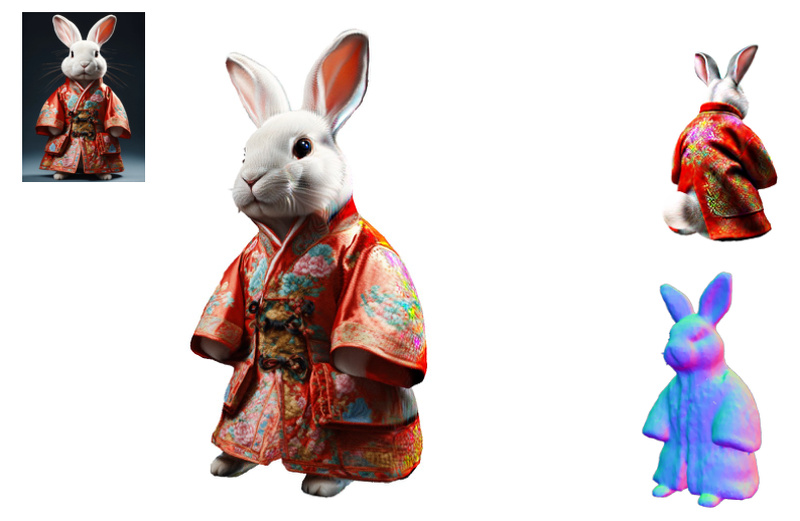
Creating high-quality 3D assets has traditionally required expert modeling skills, extensive manual labor, or expensive capture setups—barriers that limit accessibility for developers, digital artists, and researchers. DreamCraft3D changes this paradigm by enabling the generation of detailed, photorealistic, and multi-view consistent 3D objects from just one 2D reference image. Built on a novel hierarchical framework with a bootstrapped diffusion prior, DreamCraft3D directly addresses two longstanding challenges in 3D generative AI: geometric inconsistency and texture degradation across viewpoints—common issues often referred to as the “Janus problem.”
Unlike earlier diffusion-based 3D generation methods that struggle to balance geometry and appearance, DreamCraft3D decouples the process into distinct, optimized stages. This allows each aspect—shape and surface detail—to be refined with specialized priors and feedback mechanisms, resulting in coherent, realistic 3D outputs suitable for real-world applications.
How DreamCraft3D Solves Key 3D Generation Challenges
Hierarchical Generation for Separated Geometry and Texture Optimization
DreamCraft3D adopts a three-stage pipeline:
- Coarse Geometry Estimation: Using NeRF and NeuS representations guided by a view-dependent diffusion model (e.g., Zero123), it first constructs a rough but structurally sound 3D shape that respects the input image from multiple angles.
- Geometry Refinement: The initial mesh is refined to improve surface smoothness and structural fidelity while maintaining multi-view consistency.
- Texture Refinement: This final stage dramatically enhances surface realism through a technique called Bootstrapped Score Distillation.
This staged approach ensures that early geometric errors don’t propagate into texture synthesis—a common flaw in end-to-end 3D generation systems.
Bootstrapped Score Distillation: Closing the Texture Consistency Gap
A major innovation in DreamCraft3D is its Bootstrapped Score Distillation mechanism. Standard score distillation (as used in DreamFusion) leverages pre-trained 2D diffusion models to guide 3D optimization. However, these models lack scene-specific 3D knowledge, leading to inconsistent textures when rendered from unseen angles.
DreamCraft3D solves this by:
- Rendering multiple views of the evolving 3D scene.
- Training a personalized diffusion model (via DreamBooth LoRA) on these augmented views.
- Using this scene-aware diffusion model to provide increasingly accurate, view-consistent texture guidance.
Crucially, the 3D scene and the diffusion model are optimized alternately: the improved 3D model yields better training data for the diffusion prior, which in turn delivers stronger feedback for the next 3D refinement step. This mutual reinforcement loop “bootstraps” the system toward high-fidelity results.
Tackling the Janus Problem Head-On
The “Janus problem”—where a 3D object appears correct from the input view but distorts or collapses from other angles—is mitigated through view-dependent priors and the bootstrapped refinement loop. By enforcing consistency during both geometry sculpting and texture synthesis, DreamCraft3D produces assets that look plausible from any viewpoint, a critical requirement for interactive applications like AR/VR and gaming.
Practical Use Cases for Developers and Creators
DreamCraft3D is especially valuable in scenarios where rapid, high-quality 3D asset creation is needed from minimal input:
- Game Development: Quickly prototype characters, props, or environments from concept art or reference photos.
- E-Commerce: Generate interactive 3D product visualizations from catalog images, enhancing customer engagement without 3D scanning.
- AR/VR Content: Populate immersive experiences with realistic objects derived from user-uploaded photos.
- Digital Art & Design: Empower artists to explore 3D ideation without mastering complex modeling software.
Because it starts from a single image and produces exportable textured meshes (e.g., OBJ + MTL), DreamCraft3D fits naturally into existing creative pipelines.
Getting Started: A Modular, Stage-Based Workflow
Using DreamCraft3D involves a clear, modular workflow:
-
Preprocess the Input Image:
Runpreprocess_image.pyto remove the background and generate depth and normal maps using Omnidata—a critical step for initializing geometric priors. -
Run the Three Training Stages Sequentially:
- Stage 1: Coarse geometry via NeRF/NeuS using a global diffusion prior (e.g., Zero123).
- Stage 2: Refine geometry with explicit surface representation.
- Stage 3: Boost texture fidelity using bootstrapped score distillation.
-
(Optional) Custom DreamBooth LoRA for Problematic Cases:
If multi-view inconsistencies persist—particularly with complex or ambiguous subjects—you can generate synthetic multi-view images using Zero123++, then fine-tune a DeepFloyd IF model via DreamBooth LoRA. This custom prior significantly improves view consistency during Stage 1.
Each stage builds upon the last, allowing users to inspect intermediate results and adjust parameters as needed.
Hardware and Technical Requirements
DreamCraft3D is computationally demanding. To run the default configurations, you’ll need:
- An NVIDIA GPU with at least 20GB VRAM (40GB recommended, e.g., A100).
- Python ≥ 3.8 and PyTorch ≥ 1.12 with CUDA support.
- Comfort with command-line execution and configuration files.
Memory usage can be reduced by lowering rendering resolutions (e.g., 128×128), though this may affect output quality. The project is built on threestudio, so familiarity with that framework is helpful but not required—the provided configs and scripts streamline the process.
Note that the team has since released DreamCraft3D++, which improves both generation quality and efficiency, suggesting active development and ongoing optimization.
Summary
DreamCraft3D represents a significant leap in single-image 3D generation by combining hierarchical modeling with a self-improving, scene-specific diffusion prior. It directly tackles core limitations of prior methods—geometric inconsistency and poor texture coherence—through its innovative bootstrapped optimization loop. While it demands substantial GPU resources and technical setup, the payoff is a reliable pipeline for creating view-consistent, photorealistic 3D assets from everyday 2D images. For practitioners in gaming, e-commerce, AR/VR, or digital content creation, DreamCraft3D offers a powerful, research-backed solution to accelerate 3D production without sacrificing quality.