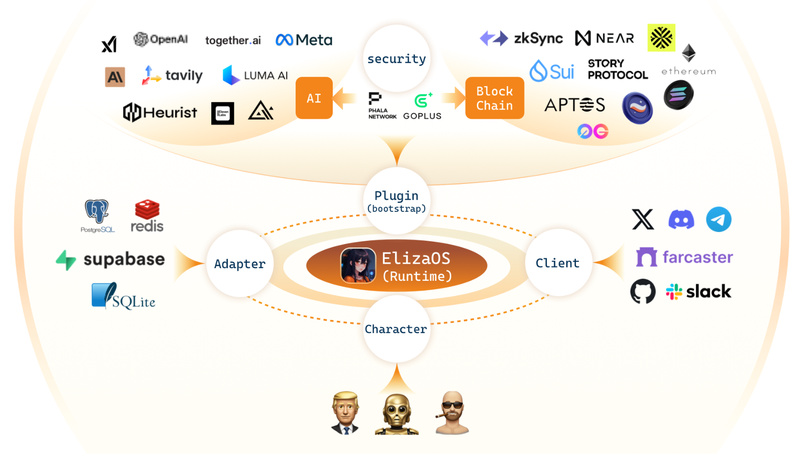
In today’s fast-evolving landscape of artificial intelligence and decentralized systems, developers increasingly need tools that bridge the gap between large language model (LLM)-powered agents and Web3 infrastructure. Enter ElizaOS—an open-source, Web3-friendly AI Agent Operating System designed from the ground up to make building, deploying, and managing autonomous agents not only possible but effortless.
Unlike generic agent frameworks that treat blockchain integration as an afterthought, ElizaOS treats Web3 capabilities—such as reading and writing on-chain data or interacting with smart contracts—as first-class features. Every component is a regular TypeScript program under full user control, ensuring transparency, extensibility, and seamless interoperability with decentralized applications (dApps). Whether you’re automating on-chain workflows, creating intelligent customer support for a DeFi protocol, or building NPCs for a blockchain-based game, ElizaOS provides a unified, production-ready platform that “just works” out of the box.
Why Eliza Stands Out Among AI Agent Frameworks
Built for Web3 from Day One
While many AI agent systems focus solely on chat or task automation in centralized environments, ElizaOS is purpose-built for the decentralized world. It enables agents to read blockchain state, trigger smart contract functions, and respond to on-chain events—all without requiring you to stitch together custom middleware or reinvent core infrastructure. This native Web3 integration solves a major pain point for builders who previously had to retrofit general-purpose agent frameworks into Web3 contexts.
Model-Agnostic and Future-Proof
ElizaOS doesn’t lock you into a single LLM provider. It supports OpenAI, Anthropic, Gemini, Llama, Grok, and others through a unified interface. This flexibility ensures your agents can evolve alongside advancements in model capabilities—and lets you choose cost, performance, or privacy trade-offs based on your specific use case.
Multi-Agent Architecture Designed for Real Complexity
Real-world applications rarely rely on a single “smart” agent. ElizaOS embraces a multi-agent design, allowing you to compose teams of specialized agents that collaborate, delegate, and reason collectively. Need one agent to monitor wallet activity, another to draft social posts, and a third to execute trades? Eliza’s architecture makes orchestration intuitive.
Developer-First Tooling: CLI, Web UI, and Plugins
ElizaOS ships with a full suite of developer tools:
- A powerful CLI for scaffolding, testing, and deploying agents in minutes.
- A modern React-based web dashboard to manage agents, view conversations, and inspect logs in real time.
- A rich plugin system that lets you extend core functionality—for example, adding new blockchain networks, message channels, or custom RAG pipelines.
With built-in connectors for Discord, Telegram, Farcaster, and more, your agents can engage users across the social and communication platforms that matter most in Web3 communities.
No Database Drama
New users can get started immediately using pglite, an in-process PostgreSQL-compatible database that requires zero external setup. This removes a common friction point during prototyping while still allowing migration to full-scale databases later.
Ideal Use Cases: Where Eliza Shines
ElizaOS isn’t just a research toy—it’s engineered for real-world deployment. Consider these practical scenarios:
- DeFi Protocol Support Bots: Autonomous agents that answer user questions about token economics, monitor liquidity health, or alert teams to unusual on-chain activity—all while citing live blockchain data.
- On-Chain Data Monitors: Agents that track specific wallet addresses, NFT mints, or governance proposals and trigger actions (e.g., sending alerts or executing hedging strategies via smart contracts).
- Blockchain Game NPCs: Intelligent non-player characters that remember player interactions, trade in-game assets, or adapt behavior based on on-chain reputation scores.
- DAO Assistants: Agents that summarize governance discussions, draft voting recommendations, or automate routine operational tasks like grant disbursements.
In each case, ElizaOS eliminates the need to build a bespoke agent infrastructure from scratch.
Getting Started: From Zero to Agent in 5 Minutes
ElizaOS prioritizes developer velocity. Here’s how quickly you can launch your first agent:
- Install the CLI:
bun install -g @elizaos/cli - Create a project:
elizaos create my-agent(choose pglite and OpenAI for simplicity) - Add your API key via
elizaos env edit-local - Run
elizaos start
Within minutes, your agent is live at http://localhost:3000 with a full web interface and REST API. For advanced users, the full monorepo (hosted on GitHub) supports custom plugin development and contribution.
Limitations and Practical Considerations
While ElizaOS is powerful, it does come with realistic constraints:
- Requires Node.js v23+ and Bun as the runtime—Windows users need WSL2.
- Depends on third-party LLM APIs for core reasoning (unless you self-host models like Llama).
- Assumes basic TypeScript proficiency, as all logic is written in standard TypeScript without hidden abstractions.
These aren’t dealbreakers—they’re trade-offs for a system that’s transparent, debuggable, and production-oriented.
Summary
ElizaOS fills a critical void in the AI agent ecosystem: a unified, open-source framework that natively supports Web3 interactions without sacrificing developer experience. By combining multi-agent orchestration, model-agnostic design, real-time UI, and seamless blockchain connectivity, it empowers builders to ship intelligent, autonomous applications faster and with less technical debt. If you’re working at the intersection of AI and decentralized systems, ElizaOS isn’t just another tool—it’s the foundation you’ve been waiting for.