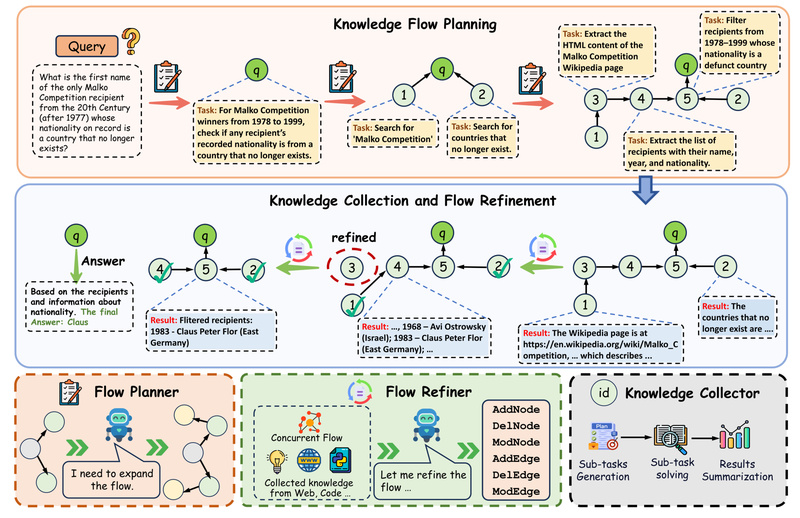
Deep research—whether in scientific discovery, engineering design, or AI innovation—is rarely linear. It demands navigating complex dependencies, synthesizing cross-disciplinary insights, and iteratively refining hypotheses based on intermediate results. Traditional agentic systems often fall short here: they follow rigid pipelines, lack adaptability, and struggle with multi-step reasoning.
Enter FlowSearch, the core reasoning engine behind InternAgent, a multi-agent framework that redefines how AI supports deep research. Unlike conventional approaches, FlowSearch doesn’t just process queries—it dynamically constructs, evolves, and refines a structured knowledge flow that mirrors the iterative, branching nature of real scientific inquiry. By enabling parallel exploration, hierarchical task decomposition, and real-time adaptation to reasoning feedback, FlowSearch delivers a new level of autonomy and intelligence for end-to-end research automation—from hypothesis generation to experimental validation.
How FlowSearch Transforms Deep Research
Structured, Evolving Knowledge Flows—Not Static Pipelines
At its heart, FlowSearch replaces fixed workflows with living knowledge graphs. As a research task unfolds, FlowSearch continuously maps out subtasks, dependencies, evidence sources (e.g., papers, code, data), and reasoning paths. This structure isn’t pre-defined; it’s actively built and adjusted as new insights emerge. If an experiment fails or a new paper reveals a better approach, FlowSearch re-routes the knowledge flow accordingly—just like a human researcher would.
This dynamic scaffolding ensures that reasoning remains coherent, traceable, and scalable, even across highly interdisciplinary problems like molecular dynamics + machine learning or genomics + time-series forecasting.
Strategic Planning with Parallelism and Hierarchy
FlowSearch doesn’t work sequentially. Instead, it decomposes high-level research goals into hierarchical subtasks and executes them in parallel where possible. For example, while one agent retrieves relevant literature on enhancer activity prediction, another could be prototyping baseline models, and a third evaluating experimental feasibility.
This parallel-hierarchical strategy dramatically accelerates research cycles without sacrificing depth—making it ideal for open-ended exploration where the “right” path isn’t known upfront.
Feedback-Driven Adaptation During Execution
Perhaps most critically, FlowSearch learns while it works. Intermediate outcomes—such as a failed simulation, an unexpected correlation, or a low validation score—trigger automatic reassessment of the current knowledge flow. FlowSearch can backtrack, pivot to alternative methodologies, or refine its original hypothesis, all within the same execution loop.
This closed-loop adaptability is what enables InternAgent to achieve state-of-the-art results on notoriously difficult benchmarks like GAIA, GPQA, HLE, and TRQA—tasks that require synthesis across documents, code, math, and real-world constraints.
Real-World Impact Across Scientific Domains
FlowSearch isn’t a theoretical construct—it’s battle-tested across 12 diverse scientific and AI research tasks, including:
- Molecular Dynamics Simulation (predicting atomic forces with lower error)
- Reaction Yield Prediction (improving R² by up to +7.8 over baselines)
- Power Flow Estimation in electrical grids (reducing RMSE significantly)
- Genomic Tasks like enhancer activity and transcription prediction
- AI-Centric Workflows such as VLM fine-tuning, 3D autonomous driving, and semantic segmentation
In each case, FlowSearch’s ability to integrate literature, code, and experimental feedback into a unified reasoning process leads to measurable performance gains. On the MLE-Bench—a rigorous test of machine learning engineering autonomy—InternAgent-MLE (powered by FlowSearch) achieved a 36.44% medal rate in just 12 hours, outperforming all competitors.
Solving Core Pain Points for Researchers and Engineers
If you’ve ever:
- Gotten stuck in shallow analysis because your tool couldn’t “think deeper”,
- Manually juggled literature review, coding, and debugging across disconnected tools,
- Felt frustrated by rigid automation that couldn’t adapt when experiments failed,
…then FlowSearch addresses your pain directly. It automates not just execution, but the cognitive architecture of research itself. By embedding strategic planning, real-time reflection, and cross-modal synthesis into a single system, it reduces the cognitive load on human researchers and lets them focus on high-level insight and validation.
Getting Started with FlowSearch
FlowSearch is implemented within the InternAgent framework, available at:
https://github.com/Alpha-Innovator/InternAgent
To begin experimenting:
- Set up a Conda environment with Python 3.11
- Install dependencies via
pip install -r requirements.txt - Configure your preferred LLM (e.g., o4-mini, Qwen-235B) and API key in
launch_dolphin.sh - Run an auto-research workflow with
bash launch_dolphin.sh
The current open-sourced version includes foundational capabilities for paper retrieval, idea generation, coding, and experimental execution. Full support for all 12 research task types is coming soon.
Note: FlowSearch is designed for research automation, not casual querying. It works best when given a well-scoped scientific or engineering problem with access to relevant data and computational resources.
Important Limitations to Consider
- Partial Open-Sourcing: While the core framework is available, the complete InternAgent system (covering all 12 task types) is still being prepared for full release.
- Model Dependency: Performance scales with the underlying LLM—best results are seen with strong models like o4-mini or Qwen-235B.
- Domain Data Required: Users must supply or link to task-specific datasets (e.g., for time series, genomics, or point clouds).
- Not a General Chatbot: FlowSearch excels in structured, goal-oriented research—not open-ended conversation.
Summary
FlowSearch represents a paradigm shift in agentic reasoning for deep research. By replacing static pipelines with dynamic, feedback-sensitive knowledge flows, it enables AI systems to plan, explore, adapt, and validate like skilled researchers. For technical decision-makers facing complex, multi-step problems in science or AI development, FlowSearch—via InternAgent—offers a powerful, extensible, and empirically validated path toward end-to-end research automation. If your work demands both breadth and depth of reasoning, it’s time to consider making FlowSearch part of your toolkit.