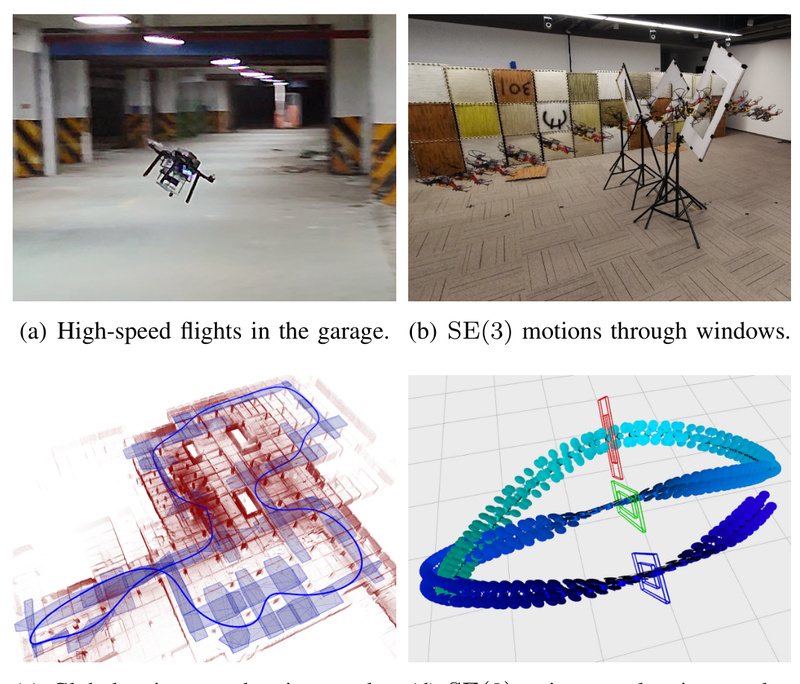
Autonomous multicopters—whether used in drone racing, delivery, inspection, or swarm coordination—face a persistent challenge: generating trajectories that are simultaneously smooth, dynamically feasible, computationally efficient, and geometrically aware. Many existing planners force trade-offs: high-quality paths take too long to compute, fast planners ignore aerodynamic effects like drag, or constraint handling is approximate and unreliable.
GCOPTER (Geometrically Constrained Trajectory Optimization for Multicopters) bridges this gap. Developed by researchers at ZJU FAST Lab, it is an open-source, optimization-based trajectory planner that delivers real-time, high-fidelity trajectories for multicopters under complex spatial and dynamic constraints. Built on a novel sparse trajectory representation called MINCO, GCOPTER transforms a traditionally hard, constrained optimization problem into a fast, unconstrained one—without sacrificing accuracy or physical realism.
For engineers, roboticists, and researchers working on aerial autonomy, GCOPTER offers a rare combination: mathematical rigor, practical speed, and real-world robustness.
Why GCOPTER Stands Out
Exact Handling of Geometric Constraints
Traditional planners often approximate obstacle avoidance using simplified bounding volumes or penalty functions, which can lead to infeasible or unsafe trajectories near tight spaces. GCOPTER takes a different approach: it uses smooth maps to exactly eliminate geometric constraints (e.g., flight corridors, polyhedral safe zones) in a lightweight, differentiable way. This ensures the generated path never violates spatial boundaries—critical for navigation in cluttered or structured environments like forests, warehouses, or urban canyons.
Support for Realistic Multicopter Dynamics
Many trajectory generators assume idealized point-mass or linear dynamics. GCOPTER goes further: it explicitly supports user-defined state-input constraints, including nonlinear drag effects that significantly impact high-speed flight. Through differential flatness and backward differentiation of the flatness map, it integrates complex aerodynamic models while maintaining computational tractability. This means your drone won’t just follow a mathematically smooth path—it will follow one that’s actually flyable at speed.
Efficient Optimization via MINCO Representation
At the heart of GCOPTER is MINCO (Minimum Control Effort Trajectory Representation), a sparse parameterization that enables linear-complexity operations for spatial-temporal deformation. By decoupling dense constraint evaluation (e.g., checking 1000 points along a trajectory) from sparse optimization variables (e.g., only a few dozen control points), GCOPTER achieves orders-of-magnitude speedups over dense-parameterization methods—without losing solution quality.
This efficiency is not theoretical: benchmarks in the original IEEE T-RO paper show GCOPTER outperforming specialized planners in both speed and trajectory smoothness, even on resource-limited onboard computers.
Ideal Applications
GCOPTER is particularly well-suited for scenarios demanding both agility and safety:
- Autonomous drone racing: Generate time-optimal, high-speed trajectories through narrow gates while respecting thrust and tilt limits.
- Multicopter swarms: Plan collision-free, synchronized paths for dozens of drones in confined spaces.
- Long-distance autonomous flight: Create energy-efficient global trajectories that account for wind and drag over kilometers of flight.
- Real-time replanning: React to newly detected obstacles by rapidly re-optimizing a local segment while preserving global feasibility.
- SE(3) whole-body planning: Coordinate full 6-DoF motion for drones with gimbals, manipulators, or payload constraints.
Notably, GCOPTER has already powered multiple peer-reviewed systems published in IEEE RA-L and ICRA, and featured by IEEE Spectrum—a strong signal of its real-world viability.
Getting Started
GCOPTER is designed for ROS-based robotics workflows. To try it:
- Install dependencies:
sudo apt install libompl-dev cpufrequtils
sudo cpufreq-set -g performance  # for consistent benchmarking
- Clone and build:
mkdir -p ~/ROS/src && cd ~/ROS/src
git clone https://github.com/ZJU-FAST-Lab/GCOPTER.git
cd .. && catatin_make
source devel/setup.bash
- Launch the global planning demo:
roslaunch gcopter global_planning.launch
The demo opens RViz for 3D visualization and rqt_plot for real-time telemetry (thrust, tilt angle, body rates). You can click start/goal points in RViz—the planner instantly generates a corridor and a dynamically feasible trajectory.
Configuration files allow tuning of physical parameters (mass, drag coefficients, max thrust, etc.). For faster computation in less demanding scenarios, you can simplify the model to a point-mass—though the full drag-aware model is recommended for high-speed applications.
Limitations and Considerations
While powerful, GCOPTER is not a universal motion planner:
- It assumes the multicopter system is differentially flat, which holds for standard quadcopters but may not extend to unconventional aerial platforms (e.g., fixed-wing hybrids or morphing drones).
- The framework is tightly integrated with ROS, making it most suitable for robotics research or deployment environments already using this ecosystem.
- Some advanced features mentioned in the roadmap—such as a local replanner or uniform MINCO variants—may still be under development; users should check the GitHub repository for the latest module availability.
That said, for standard multicopter platforms operating in 3D environments, GCOPTER provides one of the most mature and efficient solutions available today.
Summary
GCOPTER redefines what’s possible in real-time multicopter trajectory planning. By unifying geometric constraint handling, realistic dynamics (including nonlinear drag), and a highly efficient optimization backbone, it eliminates the traditional compromises between speed, safety, and fidelity. Whether you’re building a racing drone, a delivery fleet, or a research platform for aerial autonomy, GCOPTER offers a battle-tested, open-source foundation that scales from simulation to real-world deployment.
With extensive validation in high-profile applications—from swarm coordination to drone racing—and a clean, modular codebase, it’s a compelling choice for any project requiring high-performance, constraint-aware aerial motion planning.