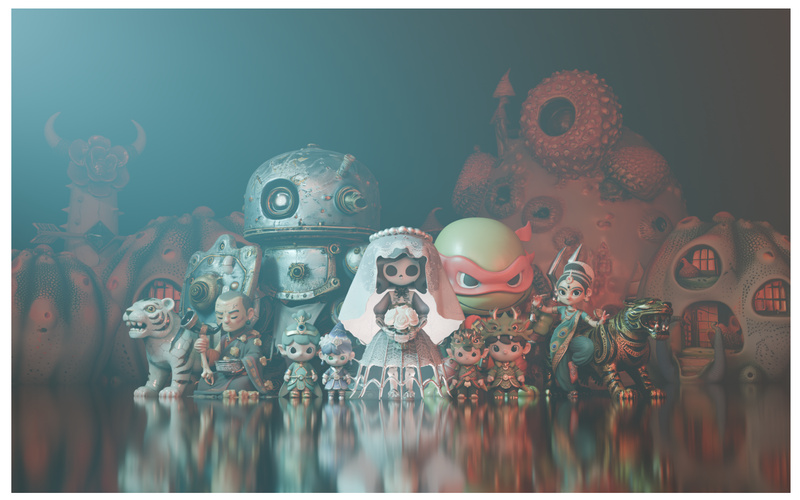
Creating high-quality 3D assets has long been a bottleneck in industries like gaming, virtual reality, industrial design, and digital content creation. Traditional workflows demand specialized modeling skills, time-intensive manual labor, and complex rendering pipelines. Enter Hunyuan3D 2.1—Tencent’s latest open-source 3D generative system that transforms a single 2D image into a fully textured, high-resolution 3D model with physically-based rendering (PBR) materials. Designed for both researchers and practitioners, Hunyuan3D 2.1 lowers the barrier to professional-grade 3D content generation while delivering state-of-the-art fidelity and condition-following accuracy.
Unlike many earlier 3D AIGC (AI-Generated Content) systems that output basic RGB textures or lack open training infrastructure, Hunyuan3D 2.1 offers full model weights, complete training code, and a production-ready PBR pipeline—making it uniquely suited for real-world deployment and community-driven innovation.
Core Innovations That Set Hunyuan3D 2.1 Apart
Fully Open-Source Framework for Reproducibility and Customization
Hunyuan3D 2.1 is one of the first 3D generative systems to release both model weights and training code under an open-source license. This transparency empowers developers to:
- Fine-tune models on domain-specific data (e.g., furniture, vehicles, characters)
- Debug, modify, or extend the architecture for custom use cases
- Reproduce results confidently for academic validation
This openness accelerates both research iteration and industrial integration—no longer confined to black-box APIs or restricted commercial licenses.
Physically-Based Rendering (PBR) Texture Synthesis
Previous image-to-3D systems often generate textures as simple RGB color maps, which look flat under dynamic lighting. Hunyuan3D 2.1 replaces this with a PBR material pipeline, simulating how light interacts with real-world surfaces. The result? Assets with:
- Realistic metallic reflections
- Accurate roughness and gloss variation
- Subsurface scattering for materials like skin or wax
This level of material realism is essential for applications in VR, film, and product visualization, where lighting consistency across scenes is non-negotiable.
How Hunyuan3D 2.1 Solves Real Industry Pain Points
Simplifies the 3D Content Pipeline
Historically, going from concept art to a usable 3D asset involved multiple specialists: concept artists, modelers, UV unwrappers, texture painters, and lighting technicians. Hunyuan3D 2.1 condenses this into a two-stage automated workflow:
- Shape Generation: The Hunyuan3D-DiT model creates a detailed mesh from a single input image.
- Texture Synthesis: The Hunyuan3D-Paint model generates PBR-compliant textures (albedo, metallic, roughness, etc.) aligned to the geometry.
This drastically reduces turnaround time—from days to minutes—while maintaining high visual fidelity.
Outperforms Existing Methods in Benchmark Evaluations
Independent benchmarks confirm Hunyuan3D 2.1’s superiority. On metrics like ULIP-T/I, Uni3D-T/I, CLIP-FiD, and CMMD, it consistently surpasses both open-source and proprietary alternatives, including Michelangelo, Craftsman, TripoSG, and even its predecessor Hunyuan3D 2.0.
Notably, Hunyuan3D-Paint-2.1 achieves:
- 24.78 CLIP-FiD (lower is better)
- 0.9207 CLIP-I similarity (higher is better)
- 2.191 CMMD (lower indicates better distribution alignment)
These scores reflect not only visual quality but also strong alignment between input conditions and output geometry/texture—a critical requirement for controllable generation.
Practical Use Cases
Hunyuan3D 2.1 shines in scenarios requiring speed, consistency, and photorealism:
- Game Development: Rapidly prototype characters, props, or environments from concept sketches.
- Virtual Reality & Metaverse: Populate immersive worlds with diverse, high-fidelity assets without manual modeling.
- Industrial Design: Visualize product variants (e.g., furniture, electronics) from marketing images for client review.
- Digital Twins: Generate 3D counterparts of real-world objects for simulation or AR applications.
Because it supports single-image input, it integrates naturally into existing creative workflows where reference imagery is already available.
Getting Started: Flexible and Developer-Friendly
Hunyuan3D 2.1 is designed for ease of adoption across technical skill levels:
Programmatic API (Diffusers-Style)
For developers, the system offers a clean, intuitive API similar to Hugging Face’s diffusers library:
from hy3dshape.pipelines import Hunyuan3DShapePipeline
from hy3dpaint.textureGenPipeline import Hunyuan3DPaintPipeline, Hunyuan3DPaintConfig

# Generate untextured mesh
shape_pipeline = Hunyuan3DShapePipeline.from_pretrained('tencent/Hunyuan3D-2.1')
mesh = shape_pipeline(image='assets/demo.png')[0]

# Add PBR textures
paint_pipeline = Hunyuan3DPaintPipeline(Hunyuan3DPaintConfig(max_num_view=6, resolution=512))
textured_mesh = paint_pipeline(mesh, image_path='assets/demo.png')
Local Gradio Interface
For non-programmers or quick prototyping, a built-in Gradio app provides a no-code GUI:
python3 gradio_app.py --model_path tencent/Hunyuan3D-2.1 --subfolder hunyuan3d-dit-v2-1 --texgen_model_path tencent/Hunyuan3D-2.1 --low_vram_mode
Community Integrations
The ecosystem is already expanding:
- ComfyUI plugin for node-based 3D generation
- Unity support for direct import into game engines
Cross-platform compatibility (Windows, macOS, Linux) ensures broad accessibility.
Hardware Requirements and Limitations
While powerful, Hunyuan3D 2.1 has realistic resource demands:
- Shape generation: ~10 GB VRAM
- Texture generation: ~21 GB VRAM
- Full pipeline (shape + texture): ~29 GB VRAM
A capable NVIDIA GPU (e.g., RTX 3090 or better) is recommended. The system also assumes:
- Input images are clear, well-lit, and minimally occluded
- Users have basic Python and PyTorch familiarity for setup
It is not suited for ultra-low-resource environments or fully no-code SaaS expectations—this is a developer-first tool with professional output.
Summary
Hunyuan3D 2.1 represents a significant leap toward democratizing high-fidelity 3D content creation. By combining open-source transparency, PBR material realism, and strong benchmark performance, it directly addresses core pain points in gaming, design, and simulation workflows. For technical decision-makers seeking a reliable, extensible, and production-ready 3D AIGC solution, Hunyuan3D 2.1 offers a compelling balance of quality, control, and community support.
With full weights, training code, and active integrations available today, now is the ideal time to evaluate it for your next 3D generation project.