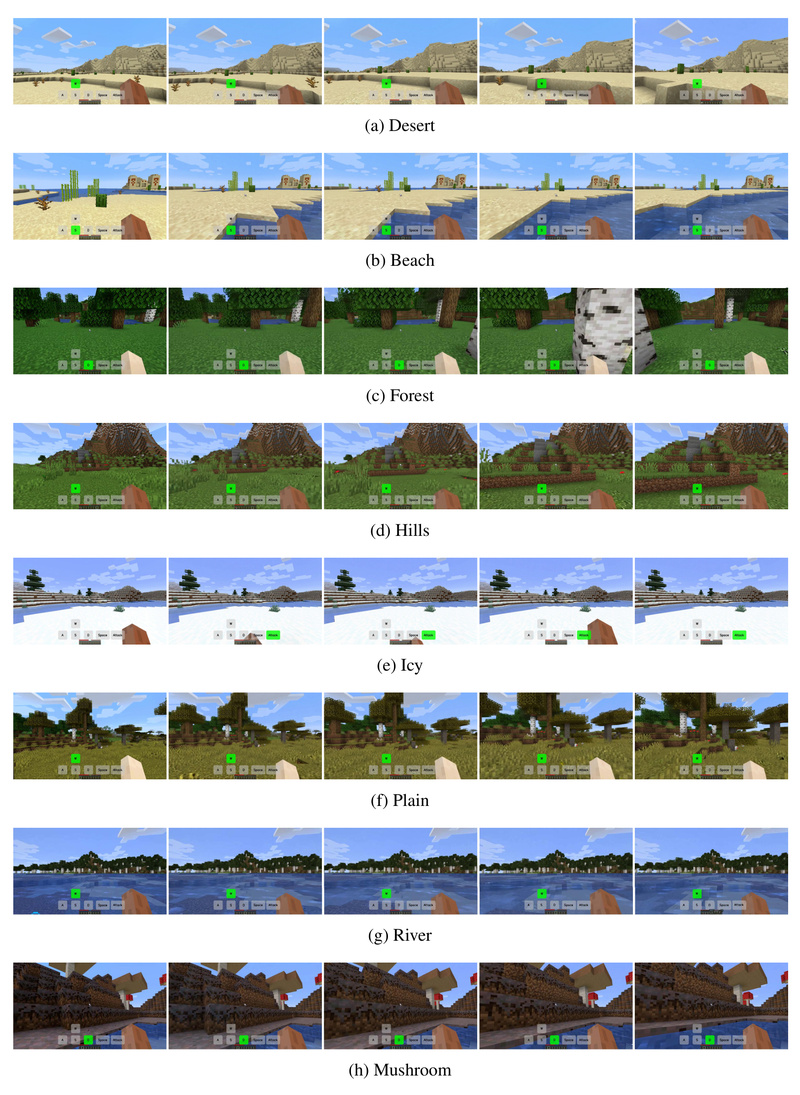
Matrix-Game is an open-source interactive world foundation model developed by Skywork AI, specifically designed for real-time, controllable generation of game environments—starting with Minecraft. Unlike conventional video prediction or world modeling approaches that passively forecast future frames, Matrix-Game enables precise user control over character actions and camera movements while generating temporally coherent, high-fidelity video sequences.
This capability addresses a critical gap in simulation, gaming, and synthetic data generation: the need for responsive, action-conditioned world models that reflect user intent with visual accuracy and physical plausibility. Built on over 17 billion parameters and trained on more than 3,700 hours of Minecraft gameplay—including fine-grained keyboard and mouse annotations—Matrix-Game represents a significant leap in interactive content creation for structured virtual worlds.
Why Controllable World Generation Matters
Traditional generative models often treat video as a sequence to be predicted, not as an environment to be interacted with. This limits their usefulness in applications where user agency is essential—such as AI game testing, virtual prototyping, or training embodied agents.
Matrix-Game flips this paradigm by adopting an image-to-world generation framework: given a reference image (current game state), motion context (recent visual history), and explicit user actions (e.g., “move forward + jump”), it generates the next segment of gameplay that faithfully executes those commands. This tight coupling between input actions and visual outcomes makes it uniquely suited for scenarios demanding high-fidelity interactivity.
Key Technical Innovations
Two-Stage Training Pipeline
Matrix-Game is trained in two stages:
- Unlabeled pretraining on 2,700+ hours of raw Minecraft gameplay to learn environmental dynamics, object permanence, and visual consistency.
- Action-labeled fine-tuning on 1,000+ hours of clips with synchronized keyboard/mouse inputs, enabling the model to map discrete user commands to plausible visual consequences.
This hybrid approach balances broad world understanding with precise behavioral control.
17B-Parameter Architecture for High-Fidelity Output
With over 17 billion parameters, Matrix-Game maintains temporal coherence across long sequences while preserving fine visual details—such as block textures, lighting, and character animations—critical for perceptual realism in gaming contexts.
GameWorld Score: A Unified Evaluation Benchmark
To objectively measure performance, the team introduced GameWorld Score, a comprehensive benchmark assessing four dimensions:
- Visual quality
- Temporal smoothness
- Action controllability
- Understanding of physical rules (e.g., gravity, collision)
This ensures evaluations go beyond pixel-level metrics to capture functional realism.
Performance Against Prior Models
In controlled experiments, Matrix-Game consistently outperforms existing open-source Minecraft world models like Oasis and MineWorld across all GameWorld Score categories. The most significant gains appear in action controllability and physical consistency—areas where prior models often produce plausible-looking but unresponsive or physically implausible outputs.
Double-blind human evaluations further validate these results, with participants consistently rating Matrix-Game outputs as more realistic and responsive to user input across diverse scenarios (e.g., building, exploration, combat).
Ideal Use Cases
Matrix-Game is particularly valuable for:
- AI-driven game testing: Simulate thousands of gameplay trajectories under specific control sequences to stress-test game logic.
- Interactive content prototyping: Rapidly generate controllable gameplay clips without running a full game client.
- Synthetic data generation: Produce labeled, action-conditioned video datasets for training downstream agents or perception models.
- Assistive game AI: Power non-player characters (NPCs) or coaching systems that must understand and respond to real-time player actions in visually rich environments.
While currently optimized for Minecraft, the underlying architecture provides a blueprint for extending controllable world modeling to other structured simulators.
Getting Started
Both Matrix-Game-1.0 (released May 2025) and Matrix-Game-2.0 (released August 2025, featuring real-time long video generation) are open-sourced under the MIT License. The official repository includes:
- Pretrained model weights
- Inference scripts
- The GameWorld Score evaluation toolkit
Users can generate interactive videos by providing:
- A reference frame (e.g., current game screenshot)
- A short motion context (e.g., last few frames)
- A sequence of keyboard/mouse actions
This makes integration into research workflows or toolchains straightforward for teams with GPU resources sufficient to run large vision-language models.
Limitations and Practical Considerations
Despite its strengths, adopters should note:
- Minecraft-specific design: The model is trained exclusively on Minecraft data; transferring to other games or real-world environments requires retraining or adaptation.
- Hardware demands: The 17B-parameter footprint implies significant GPU memory and compute requirements.
- 2D visual output: While the world is 3D, the model generates 2D video sequences—cameras and perspectives are part of the control signal but not full 3D scene reconstruction.
For non-Minecraft applications, Skywork AI points users to Matrix-3D, a related project focused on explorable 3D scene generation for games and VR.
Summary
Matrix-Game sets a new standard for interactive, action-conditioned world modeling in simulated environments. By combining large-scale pretraining with fine-grained action supervision, it delivers unprecedented control over generated gameplay while maintaining visual and physical realism. For researchers and developers working on game AI, synthetic data, or controllable simulation, Matrix-Game offers a powerful, open-source foundation that bridges the gap between user intent and dynamic world response.
With model weights, benchmarks, and demos publicly available, evaluating its fit for your project is as simple as cloning the repository and running a test generation—no proprietary APIs or closed ecosystems required.