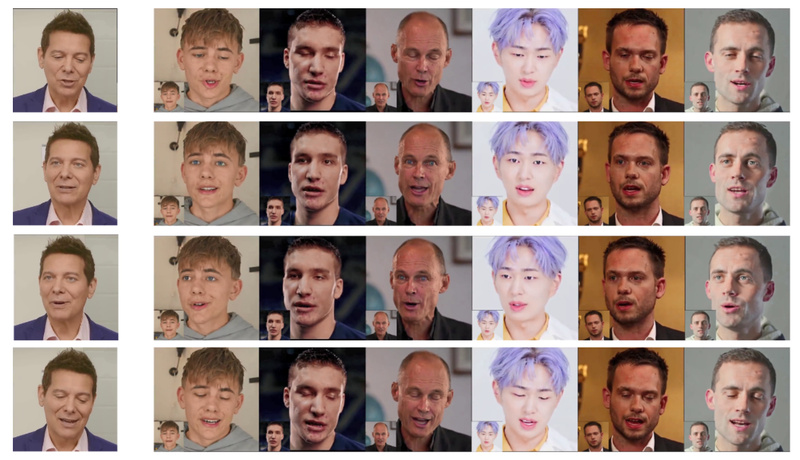
MegActor represents a significant leap forward in portrait animation by directly leveraging raw driving videos—rather than simplified proxies like facial landmarks or keypoints—to produce vivid, expressive, and identity-preserving animated portraits. Developed by MEGVII Research, MegActor tackles two persistent challenges in the field: identity leakage, where the driver’s appearance unintentionally contaminates the animated output, and performance degradation caused by irrelevant visual content, such as background clutter or fine facial details like wrinkles. By solving these problems with innovative data synthesis and conditioning strategies, MegActor enables high-fidelity animation using only publicly available datasets—offering a powerful, open-source alternative to commercial systems.
Its evolution, MegActor-S (also known as MegActor-Sigma), further extends this capability by introducing flexible mixed-modal control, allowing users to animate portraits using visual inputs, audio inputs, or both—each with independently adjustable motion intensity. This makes MegActor not just a research novelty, but a practical tool for real-world applications.
Solving Core Challenges in Portrait Animation
Traditional portrait animation methods often depend on intermediate representations—such as 2D landmarks or 3D meshes—to transfer motion from a driving video to a reference image. While effective in controlled settings, these approaches discard rich expressive information present in raw video, leading to less natural or emotionally flat results.
More critically, when models attempt to use raw videos directly, they often suffer from identity leakage: the animated face begins to resemble the driver rather than preserving the identity of the reference subject. Additionally, background elements and inconsistent skin textures or wrinkles in the driving video can introduce visual artifacts or instability.
MegActor addresses both issues through three key innovations:
-
Synthetic Data Generation: To decouple motion from identity, MegActor uses a data pipeline that generates training videos with consistent expressions and movements but varying identities. This explicitly trains the model to separate what moves from who is moving.
-
Background Stabilization via CLIP: The reference image’s background is segmented and encoded using CLIP. This semantic embedding is injected into the diffusion model via a text-conditioning module, ensuring the background remains stable and consistent throughout animation.
-
Appearance Style Transfer: Before motion extraction, the appearance of the reference image is transferred onto the driving video. This neutralizes distracting facial details (e.g., lighting, skin texture, or age-related features) in the driver, allowing the model to focus purely on motion semantics.
These techniques enable MegActor to work directly with unprocessed, real-world videos—eliminating the need for manual annotation or complex preprocessing pipelines.
Flexible Mixed-Modal Control with MegActor-S
Building on the original MegActor, MegActor-S introduces a Diffusion Transformer (DiT) architecture that supports audio-visual co-control. This is particularly useful in scenarios where speech and facial expressions must be synchronized—such as virtual avatars for customer service or AI presenters.
Key advancements in MegActor-S include:
- Modality Decoupling Control: A training strategy that balances the differing influence strengths of audio (weak but semantic) and video (strong but potentially overpowering) signals.
- Amplitude Adjustment: An inference-time technique that lets users independently scale the motion intensity driven by audio versus video—enabling subtle lip-sync with minimal head movement, or expressive gesticulation without vocal input.
This flexibility allows developers to tailor animation behavior to specific use cases without retraining the model.
Practical Use Cases for Teams
MegActor is well-suited for product and research teams working on:
- Virtual avatars for video conferencing, gaming, or digital humans in customer-facing applications
- AI-generated media, such as animated newsreaders, educational content, or personalized storytelling
- Research in expression transfer, identity preservation, and multimodal generative modeling
Because MegActor is trained solely on filtered public datasets and provides pretrained weights, it lowers the barrier to entry for teams without access to proprietary data or large-scale annotation resources. The inclusion of a 10-minute demo dataset further accelerates prototyping.
Getting Started
Deployment is straightforward for teams with standard GPU infrastructure:
- Set up the environment using the provided
env_sigma.yml(Linux required). - Download pretrained weights from Hugging Face.
- Run inference with a single command, supplying a reference portrait and a driving video (or audio file for MegActor-S).
For interactive testing, a Gradio-based demo is included, enabling quick validation without coding. Training is modular, split into three stages—audio, visual, and motion—allowing teams to fine-tune specific modalities as needed.
Summary
MegActor redefines what’s possible in open-source portrait animation by harnessing the full richness of raw driving videos while solving long-standing issues of identity leakage and background interference. Its successor, MegActor-S, adds practical multimodal control for real-world applications. With clear documentation, public weights, and a modular design, MegActor empowers developers and researchers to build expressive, identity-consistent digital avatars—without relying on closed-source or commercial systems.