Open-Sora is a groundbreaking open-source initiative that makes high-quality AI video generation accessible, efficient, and affordable. With the release of Open-Sora 2.0, the project demonstrates that training a commercial-grade video generation model is possible for just \(200,000—a fraction of the cost typically associated with leading systems like Runway Gen-3 or Sora. What sets Open-Sora apart isn’t just its low cost, but its full transparency: open weights, open training code, and open evaluation protocols empower developers, researchers, and creators to replicate, customize, and deploy video generation without vendor lock-in or hidden fees.
In an era where video content dominates digital engagement, Open-Sora removes the traditional barriers of compute expense, proprietary black boxes, and limited resolution or duration. Whether you’re prototyping a startup idea, fine-tuning a model for domain-specific videos, or building the next AI-powered creative tool, Open-Sora offers a complete, end-to-end pipeline that runs on accessible hardware.
Flexible and Multi-Modal Video Generation
Open-Sora supports a rich set of generation modes out of the box:
- Text-to-Video (T2V): Generate videos directly from natural language prompts.
- Image-to-Video (I2V): Animate a static image with motion guided by text.
- Video-to-Video (V2V): Edit or stylize existing video clips.
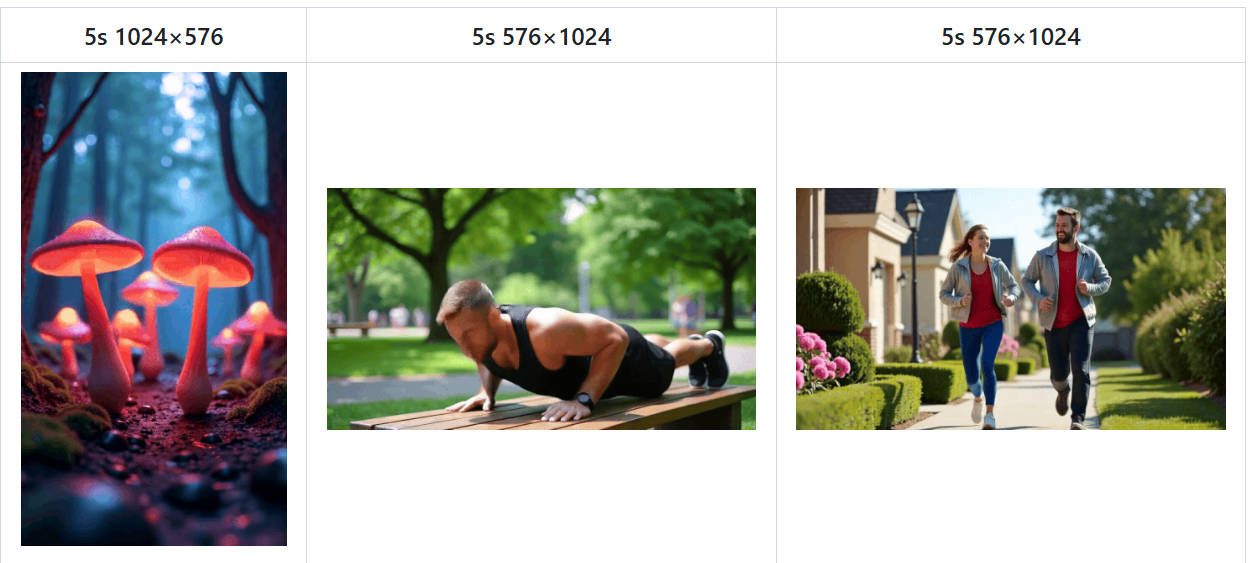
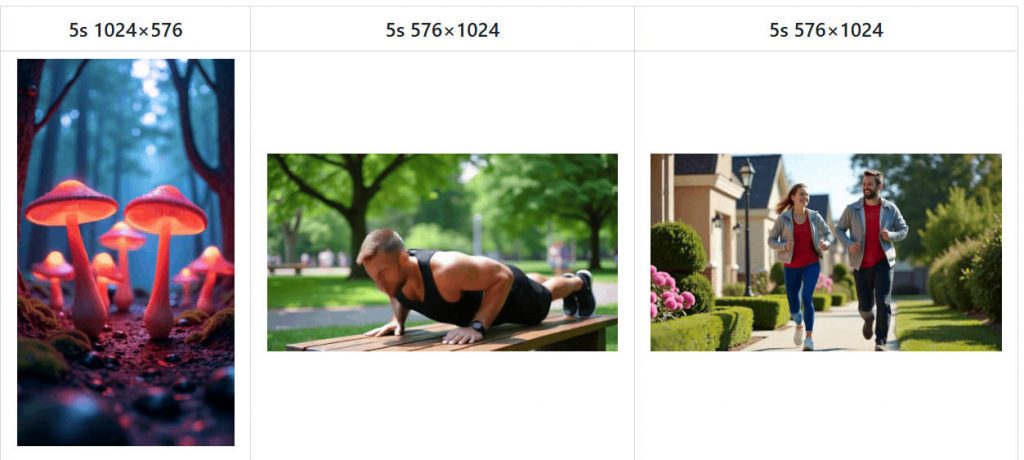
The model handles variable resolutions—from 256px to 768px—and supports multiple aspect ratios, including 16:9 (landscape), 9:16 (vertical mobile), 1:1 (square), and cinematic 2.39:1. Video lengths range from 2 to 16 seconds, with frame counts following the 4k+1 pattern (e.g., 17, 33, 65 frames), optimized for smooth motion under the rectified flow framework.
This flexibility makes Open-Sora ideal for social media content (e.g., TikTok, Instagram Reels), marketing assets, educational explainers, or concept art—where format adaptability is as important as visual quality.
Advanced Control and Quality Enhancements
Beyond basic generation, Open-Sora introduces practical features that give users fine-grained control:
- Motion Score: Adjust how dynamic the output should be. A score of 1 yields subtle motion (e.g., gentle rain), while 7 creates high-energy scenes (e.g., crashing waves). Users can even enable dynamic motion scoring, where an LLM evaluates and sets the optimal motion level per prompt.
- Prompt Refinement: If your input prompt is vague, Open-Sora can automatically refine it using an LLM (like ChatGPT), improving coherence and visual fidelity without manual rewriting.
- Reproducibility: Set random seeds for both the sampling process and global execution to ensure consistent results—critical for debugging, testing, or production workflows.
For the highest text-to-video quality, Open-Sora leverages the Flux text-to-image model to generate a strong initial frame before animating it—a two-stage pipeline that significantly boosts visual realism compared to direct T2V.
Getting Started in Minutes
Open-Sora is designed for ease of adoption. Installation requires only a standard Python environment (3.10+) and PyTorch ≥2.4. Key acceleration libraries like xFormers and FlashAttention are supported for speed and memory efficiency.
Model download is straightforward via Hugging Face or ModelScope:
huggingface-cli download hpcai-tech/Open-Sora-v2 --local-dir ./ckpts
Inference is equally simple:
torchrun --nproc_per_node 1 scripts/diffusion/inference.py configs/diffusion/inference/t2i2v_256px.py --prompt "raining, sea" --save-dir samples
For 768px generation, multi-GPU setups (e.g., 8×H100) with ColossalAI’s sequence parallelism are recommended, but 256px runs comfortably on a single GPU—even with memory offloading enabled.
Performance That Competes, Cost That Disrupts
According to VBench—a comprehensive benchmark for AI video quality—Open-Sora 2.0 closes the gap with OpenAI’s Sora from 4.52% (in v1.2) down to just 0.69%. Human preference studies confirm it performs on par with HunyuanVideo (11B) and even the much larger Step-Video (30B).
Yet, while competitors may require millions in compute, Open-Sora 2.0 was trained for \)200K, thanks to innovations in:
- Data curation (e.g., MiraData with structured captions)
- Model architecture (unified spatial-temporal DiT with shift-window attention)
- Training efficiency (rectified flow, score conditioning, 3D-VAE compression)
- System optimization (ColossalAI-powered parallelism)
This cost-performance balance makes Open-Sora uniquely suited for startups, academic labs, and indie creators who need enterprise-grade output without enterprise-scale budgets.
Practical Limitations to Consider
While Open-Sora is powerful, users should be aware of current constraints:
- Max video length is ~16 seconds (129 frames), suitable for short-form content but not long narratives.
- 768px resolution requires 4–8 GPUs for efficient inference; 256px is more accessible for single-GPU setups.
- Best T2V results depend on Flux for image initialization—adding a dependency for optimal quality.
- No built-in audio generation; video is purely visual.
These trade-offs are typical in the current state of open-source video models, but Open-Sora pushes the frontier further than most.
Integrating Open-Sora Into Your Workflow
Because everything—from preprocessing to training to inference—is open and modular, Open-Sora fits seamlessly into diverse technical ecosystems:
- Researchers can fine-tune the model on custom datasets using the provided training scripts.
- Developers can wrap inference logic into APIs or web apps (a Gradio demo is already available).
- Creative studios can batch-generate variations using CSV prompt lists and automate refinement.
- Educators can use it to demonstrate modern diffusion-based video synthesis in coursework.
With full access to the VAE, Transformer backbone, and captioning models (e.g., PLLaVA), teams can also experiment with architectural modifications or data augmentation strategies.
Summary
Open-Sora redefines what’s possible in open-source AI video generation. By delivering commercial-level quality at a tenth of the cost, supporting multiple modalities and resolutions, and providing full transparency, it empowers a new wave of innovation in content creation. If you need a production-ready, community-supported, and future-proof video generation foundation—without the black-box limitations of proprietary systems—Open-Sora is the clear choice.