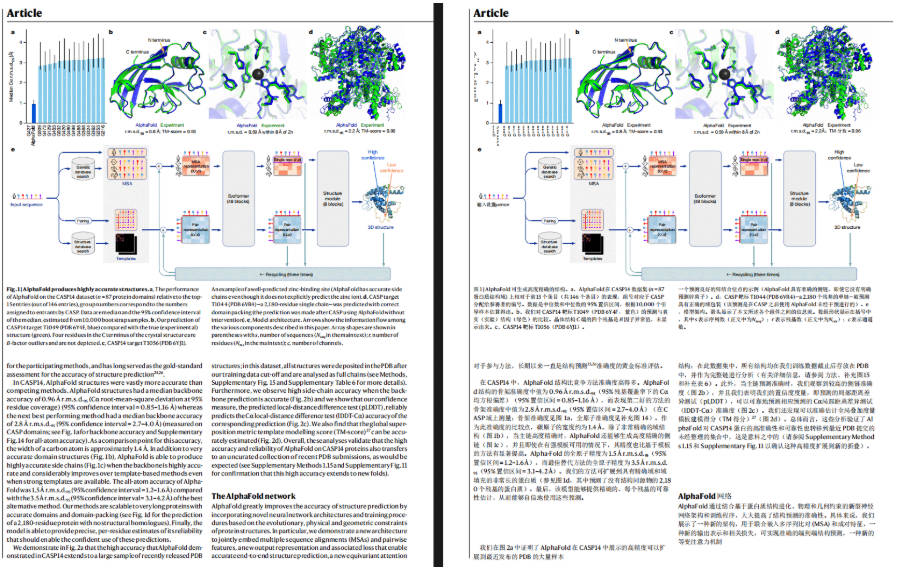
Translating scientific documents has always been a frustrating experience—especially when the output PDF ends up with scrambled equations, broken tables, or missing annotations. Traditional translation tools treat scientific PDFs like plain text, completely ignoring the rich structural information that gives these documents their meaning. The result? A translated document that’s technically in your language, but practically unreadable.
PDFMathTranslate solves this problem head-on. It’s the world’s first open-source software designed specifically for translating scientific PDFs while preserving their original layouts—including complex mathematical formulas, charts, tables of contents, and annotations. Built on recent advances in layout detection and large language models, PDFMathTranslate delivers both accuracy and fidelity, making it an essential tool for researchers, educators, and technical professionals working across language barriers.
What Problem Does PDFMathTranslate Solve?
Scientific communication shouldn’t be limited by language—but layout distortion has long been the hidden cost of translation. When you run a research paper through standard tools, formulas like E = mc² may become garbled text, multi-column layouts collapse into chaos, and figure references lose alignment. These errors aren’t just cosmetic; they compromise scientific integrity and usability.
PDFMathTranslate was created to ensure that translation doesn’t mean sacrifice. By intelligently parsing the document structure using DocLayout-YOLO and reconstructing the output with precise formatting, it retains the document’s original visual and semantic integrity—so you get a translation that’s not only linguistically accurate but also structurally faithful.
Core Capabilities That Set It Apart
PDFMathTranslate offers a unique blend of features tailored for technical and academic workflows:
- Full layout preservation: Mathematical expressions, charts, tables, footnotes, and even annotations stay exactly where they belong.
- Multi-language support: Translate from or into English, Simplified Chinese, Traditional Chinese, Japanese, Korean, and more.
- Flexible translation backends: Choose from Google Translate, DeepL, OpenAI, or the experimental BabelDOC engine depending on your accuracy and cost needs.
- Dual output formats: Generate either a clean monolingual PDF (
-mono.pdf) or a side-by-side bilingual version (-dual.pdf) for comparison or teaching. - Batch and partial processing: Translate entire folders with
--dir, or just specific pages with-p—ideal for reviewing sections of a long paper.
Who Should Use It?
This tool is built for anyone who regularly works with multilingual scientific content:
- Researchers accessing non-English literature (e.g., Japanese engineering reports or Chinese clinical studies).
- University instructors preparing translated handouts while keeping equations intact.
- International teams sharing technical documentation across language boundaries.
- Students collaborating on global projects who need to understand foreign-language sources without layout confusion.
If your work depends on precise formatting—not just words—PDFMathTranslate is designed for you.
How to Get Started—No Coding Required
You don’t need to be a developer to use PDFMathTranslate. Multiple access paths make it easy for all users:
- Try it instantly online via free demos on Hugging Face, ModelScope, or the Immersive Translate (BabelDOC) platform—no installation needed.
- Run locally with a GUI: Install via
pip install pdf2zh, then launch the web interface withpdf2zh -iand access it athttp://localhost:7860. - Pre-built Windows app: Download the
.exefrom the releases page—just unzip and double-click (installvc_redist.x64.exeif needed). - Deploy in the cloud or server: Use the official Docker image (
docker run -p 7860:7860 byaidu/pdf2zh) for scalable, containerized translation. - Integrate with Zotero: Use the dedicated plugin to translate PDFs directly from your reference manager.
For Python users, both pip and the faster uv installer are supported (requires Python 3.10–3.12).
Advanced Control for Power Users
While simple by default, PDFMathTranslate offers fine-grained control when needed:
- Specify source (
-li en) and target (-lo zh) languages explicitly. - Switch translation services on the fly:
pdf2zh paper.pdf -s deepl. - Use compatibility mode (
--compatible) for problematic PDFs that resist parsing. - Skip font subsetting (
--skip-subset-fonts) to avoid rendering issues on some systems. - Load custom layout models via
--onnxif you’ve fine-tuned DocLayout-YOLO for your domain.
All these options are accessible through straightforward command-line flags—no configuration headaches.
Known Limitations—and Practical Workarounds
Like any tool bridging AI and document engineering, PDFMathTranslate has realistic constraints:
- Model download issues: The layout parser (
wybxc/DocLayout-YOLO-DocStructBench-onnx) may be hard to fetch in some regions. Fix this by settingHF_ENDPOINT=https://hf-mirror.combefore running. - Python version requirement: Local installs require Python 3.10–3.12 for compatibility with dependencies.
- Demo resource limits: Online services restrict usage to prevent abuse—use local or Docker deployments for heavy workloads.
- Windows runtime dependency: Standalone
.exeusers may need to install Microsoft Visual C++ Redistributable.
These are well-documented, and the project provides clear workarounds in its FAQ.
The Road Ahead: Active Development and Community Support
PDFMathTranslate isn’t static. Version 2.0—now available in the PDFMathTranslate/PDFMathTranslate-next repository—introduces major upgrades: better handling of multi-column text, improved cross-page semantic consistency, and enhanced dynamic scaling. The experimental BabelDOC backend further pushes quality boundaries using web-based rendering logic.
With over 222,000 downloads and acceptance at EMNLP 2025 (a top-tier NLP conference), the project is both academically validated and widely adopted in practice.
Summary
PDFMathTranslate fills a critical gap in scientific communication: it enables accurate, layout-preserving translation of technical documents where traditional tools fail. Whether you’re reviewing a foreign-language paper, teaching a multilingual class, or sharing research globally, this tool ensures that your translated output remains as precise and usable as the original.
It’s free, open-source, easy to use, and built specifically for the challenges of STEM content. For anyone tired of broken equations and mangled tables after translation, PDFMathTranslate isn’t just an alternative—it’s the solution.