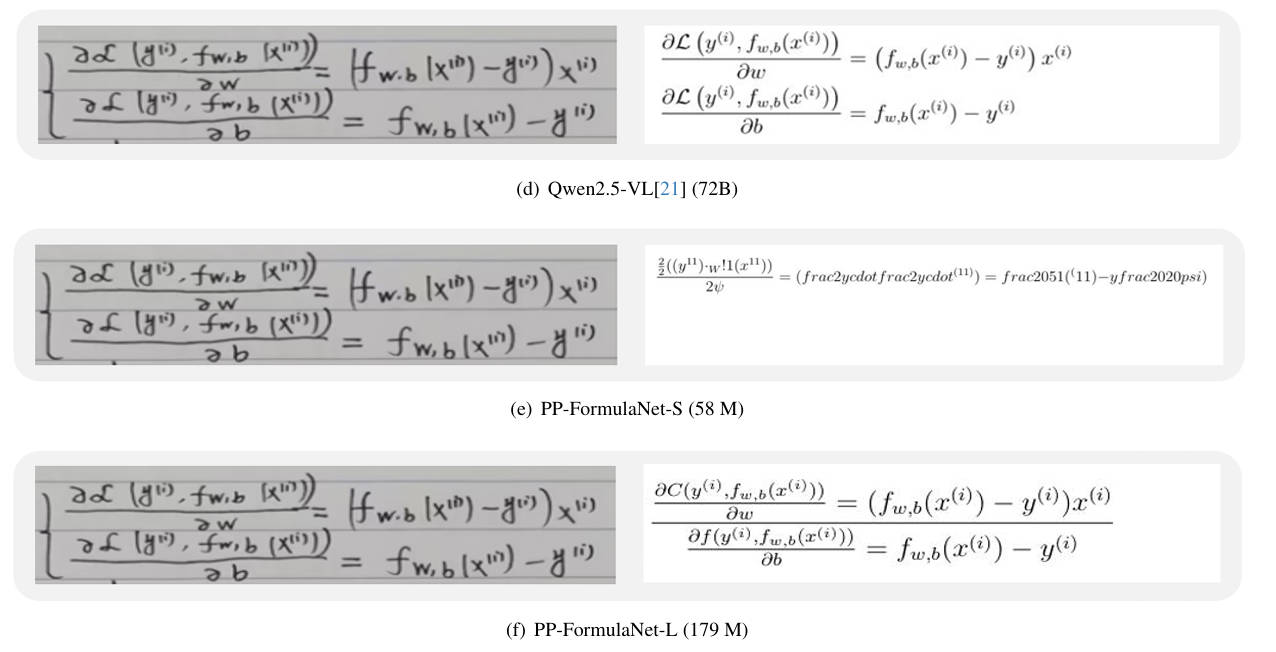
In the world of scientific publishing, academic research, and educational technology, one persistent bottleneck remains: converting handwritten or printed mathematical expressions from document images into machine-readable, structured code—typically LaTeX. Manual transcription is slow, error-prone, and unscalable. PP-FormulaNet, developed as part of the PaddleX toolkit by PaddlePaddle, directly addresses this challenge with a state-of-the-art formula recognition system that balances both accuracy and efficiency without compromise.
Built for real-world deployment, PP-FormulaNet offers two specialized models—PP-FormulaNet-L for maximum recognition fidelity and PP-FormulaNet-S for lightning-fast inference—making it adaptable to diverse application requirements. Whether you’re building a document digitization pipeline, an accessibility tool for visually impaired users, or an automated grading system for STEM coursework, PP-FormulaNet provides a production-ready, open-source solution that integrates seamlessly into modern AI workflows.
Two Models, One Mission: Accuracy When You Need It, Speed When You Demand It
PP-FormulaNet doesn’t force users to choose between performance and precision. Instead, it delivers both through two purpose-built variants:
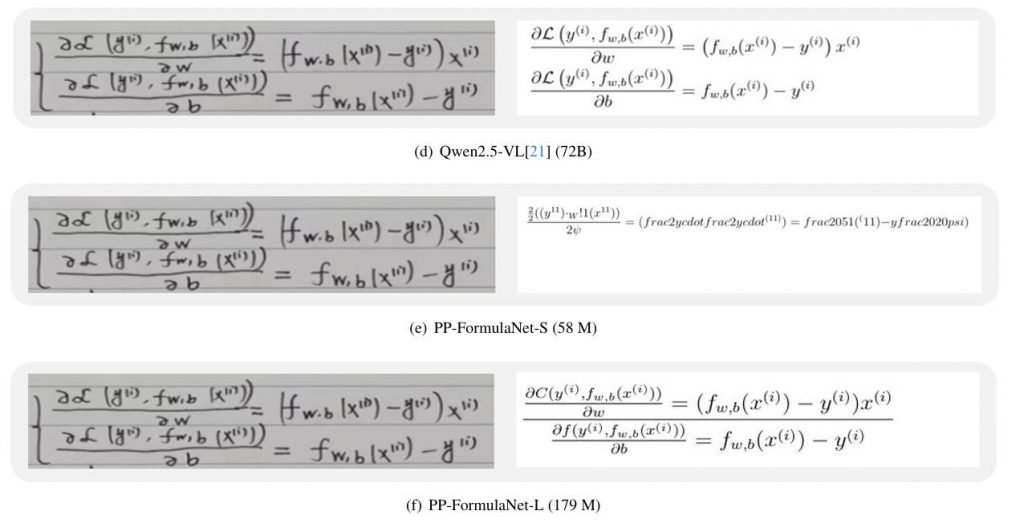
- PP-FormulaNet-L targets high-accuracy scenarios and outperforms leading models like UniMERNet by a significant 6% in recognition accuracy. This makes it ideal for applications where correctness is non-negotiable—such as academic publishing or scientific data extraction.
- PP-FormulaNet-S prioritizes inference speed, operating over 16 times faster than comparable models. This variant suits latency-sensitive use cases like real-time educational apps, mobile scanning tools, or large-scale batch processing of technical documents.
This dual-model strategy empowers developers and researchers to align model selection with actual business or research constraints—no longer needing to over-engineer or under-deliver.
Seamless Integration into Document Intelligence Workflows
PP-FormulaNet is not a standalone research prototype—it’s engineered for immediate adoption in real systems. As part of PaddleX 3.0, it benefits from a unified pipeline architecture that abstracts away low-level complexities while supporting end-to-end development from training to deployment.
Users can invoke PP-FormulaNet in two intuitive ways:
- Command-line interface: A single command runs inference:
paddlex --pipeline formula_recognition --input your_formula_image.png --device gpu:0
- Python API: Just a few lines of code enable programmatic integration:
from paddlex import create_pipeline
pipeline = create_pipeline(pipeline="formula_recognition")
result = pipeline.predict("your_formula_image.png")
Moreover, PP-FormulaNet integrates naturally with other PaddleX capabilities—such as PP-StructureV3 for full-document layout parsing—enabling holistic document understanding where formulas are correctly identified, localized, and converted within complex multi-element pages.
Hardware-Agnostic Deployment Across Modern AI Infrastructures
PP-FormulaNet supports deployment across a wide range of hardware, including NVIDIA GPUs, as well as domestic Chinese AI accelerators like Huawei Ascend (NPU), Baidu Kunlun (XPU), and Hygon DCUs. This flexibility ensures that organizations can deploy the model on their existing infrastructure without costly re-architecting.
Thanks to PaddleX’s standardized inference interface and support for high-performance backends like Paddle Inference and ONNX Runtime, PP-FormulaNet delivers consistent performance whether running in the cloud, on edge devices, or within enterprise servers.
Practical Considerations and Limitations
While PP-FormulaNet sets a new benchmark in formula recognition, users should be aware of a few practical constraints:
- It requires PaddlePaddle ≥ 3.0.0 and Python 3.8–3.12, so environment setup must align with these dependencies.
- Input image quality matters: blurry, low-resolution, or heavily distorted formula images may reduce recognition accuracy.
- The model excels on standard printed mathematical notation (as found in textbooks, papers, and journal articles) but may struggle with highly stylized, rare, or freehand handwritten symbols outside its training distribution.
That said, the project provides thoroughly documented pre-trained models, usage tutorials, and benchmark results to help users evaluate and mitigate these limitations quickly.
Getting Started Is as Simple as One Command
New users can evaluate PP-FormulaNet within minutes. The official repositories—PaddleX and PaddleOCR—host not only the source code and models but also comprehensive documentation covering installation, inference, fine-tuning, and deployment.
With pre-trained weights and demo scripts readily available, teams can move from curiosity to validation in a single afternoon—dramatically lowering the barrier to adoption.
Summary
PP-FormulaNet redefines what’s possible in mathematical expression recognition by delivering a rare combination: top-tier accuracy and exceptional speed, all within a developer-friendly, production-ready framework. By offering two optimized models, supporting diverse hardware, and integrating smoothly into broader document intelligence pipelines, it solves a long-standing pain point for researchers, educators, and enterprises working with technical documents. For anyone seeking a reliable, scalable, and open-source solution to convert visual math into structured LaTeX—without reinventing the wheel—PP-FormulaNet is a compelling and future-proof choice.