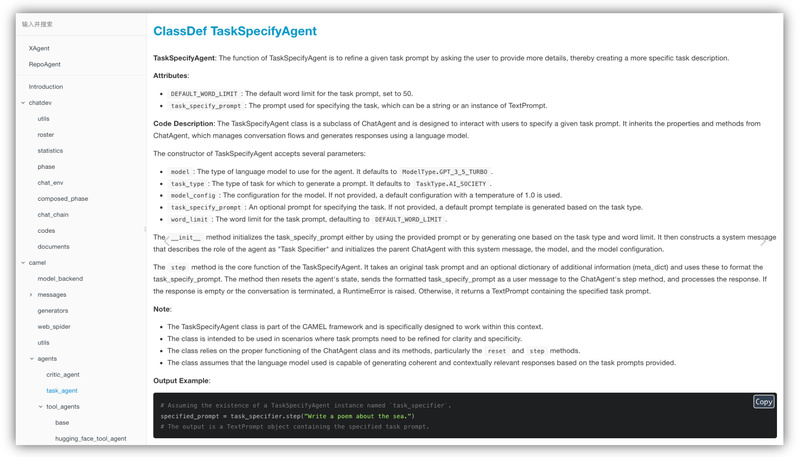
Keeping code documentation up to date is one of the most universally acknowledged yet consistently neglected tasks in software development. For teams without dedicated technical writers—or those moving fast in agile or open-source environments—the burden of documenting every function, class, and module often falls by the wayside. Outdated or missing documentation slows onboarding, increases cognitive load, and introduces risk during maintenance and refactoring.
Enter RepoAgent: an open-source, LLM-powered framework that automatically generates, updates, and maintains comprehensive, repository-level documentation for Python codebases. Unlike tools that only annotate individual files or functions, RepoAgent understands your entire codebase as a connected system—tracking dependencies, call flows, and structural relationships—and produces cohesive, human-readable Markdown documentation that evolves with your code.
Why RepoAgent Solves a Real Pain Point
Traditional documentation tools either require manual effort or produce shallow, syntactic descriptions. RepoAgent changes the game by leveraging large language models (LLMs) to generate contextual, high-quality explanations that reflect how code actually works—not just what it declares.
This is especially valuable in scenarios like:
- Onboarding new engineers to a complex codebase
- Maintaining public or internal open-source projects
- Reducing documentation debt in fast-moving startups or research labs
- Ensuring long-term code maintainability without constant human oversight
By automating the heavy lifting, RepoAgent frees developers to focus on what they do best: writing code—not documentation.
Key Features That Make RepoAgent Stand Out
Git-Aware Change Detection
RepoAgent monitors your Git repository for file additions, deletions, and modifications. When you commit changes, it automatically identifies what needs to be documented or updated—no manual intervention required.
AST-Based Code Structure Analysis
Using Abstract Syntax Tree (AST) parsing, RepoAgent deeply analyzes Python code to understand classes, functions, imports, and variables. This structural awareness enables precise, object-level documentation that captures intent, not just syntax.
Bidirectional Call Relationship Mapping
One of RepoAgent’s most powerful capabilities is its ability to trace how code elements call each other—both upstream and downstream. This global perspective ensures documentation explains not just what a function does, but how it fits into the larger system.
Seamless Markdown Updates
Documentation is generated in clean, standard Markdown and stored in a dedicated folder (e.g., markdown_docs). When code changes, RepoAgent updates only the affected sections—preserving formatting, structure, and existing custom content.
Multi-Threaded Performance
Large repositories (like XAgent, with over 270,000 lines of Python) are handled efficiently thanks to concurrent processing. This ensures documentation generation remains fast even as your project scales.
Beautiful, GitBook-Ready Output
The generated docs are structured for immediate use with static site generators like GitBook, making it trivial to publish professional-looking documentation websites for your team or community.
Ideal Use Cases
RepoAgent shines in environments where documentation is critical but resources are limited:
- Open-source maintainers who want to lower contribution barriers
- Research teams shipping reproducible code with clear explanations
- Startups moving quickly but needing sustainable code hygiene
- Enterprise projects requiring audit-ready, up-to-date technical specs
It’s currently optimized for Python, making it a natural fit for AI/ML, data science, and backend engineering workflows.
Getting Started in Minutes
Adopting RepoAgent is straightforward:
-
Install via pip:
pip install repoagent
-
Set your LLM API key (supports OpenAI or local models like Qwen, GLM4, etc.):
export OPENAI_API_KEY=your_key_here
-
Run documentation generation in your target repo:
repoagent run --target-repo-path /path/to/your/project
-
(Optional) Enable auto-updates with a pre-commit hook:
- Add a
.pre-commit-config.yamlfile - Install the hook with
pre-commit install - Now, every
git commitautomatically refreshes relevant documentation
- Add a
You can preview changes before committing with:
repoagent diff
This low-friction integration means your docs stay current without disrupting developer workflows.
Limitations and Practical Considerations
While powerful, RepoAgent has a few current constraints to keep in mind:
- Language support: As of now, it primarily supports Python. Multi-language support (Java, C++, etc.) is planned but not yet available.
- LLM dependency: You need access to an LLM API—either cloud-based (e.g., OpenAI) or a self-hosted model. Offline use is possible with local LLMs.
- Human review recommended: While the generated content is high-quality, nuanced explanations (e.g., architectural rationale or security considerations) may still benefit from manual refinement.
These limitations are transparent and align with the tool’s current scope: automating routine documentation, not replacing human insight.
Summary
RepoAgent directly addresses one of software engineering’s oldest challenges: keeping documentation accurate, useful, and up to date. By combining AST analysis, Git integration, and LLM-powered writing, it delivers repository-level documentation that’s both technically precise and contextually rich.
For Python-based projects drowning in undocumented code or struggling with onboarding overhead, RepoAgent offers a practical, scalable, and open-source solution. It integrates seamlessly into existing workflows, requires minimal setup, and—most importantly—saves time while improving codebase health.
If you’re a tech lead, open-source maintainer, or researcher looking to reduce documentation debt without adding headcount, RepoAgent is worth adopting today.