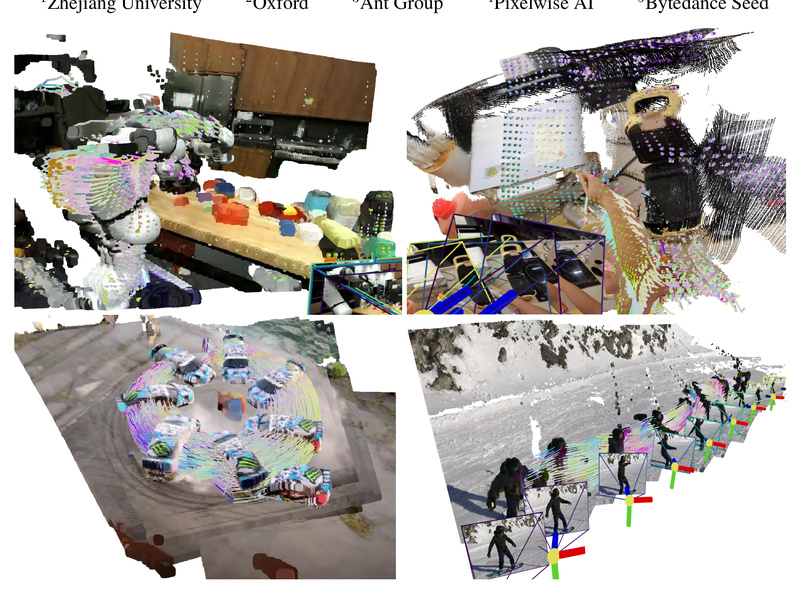
If you’ve ever tried to track 3D points in a monocular video—say, for robotics perception, AR/VR content creation, or sports motion analysis—you know how hard it is. Traditional approaches often stitch together separate depth estimation, camera pose, and 2D tracking modules, resulting in slow, brittle pipelines that struggle with real-world variability.
Enter SpatialTrackerV2: a unified, feed-forward model that tracks 3D points directly from a single RGB video stream, without relying on modular workarounds. What makes it stand out? It’s 50× faster than state-of-the-art dynamic 3D reconstruction methods while matching their accuracy—and it outperforms existing 3D point trackers by 30%. For practitioners who need reliable, real-time 3D motion analysis with minimal hardware (just a standard camera), this is a game changer.
How SpatialTrackerV2 Works
At its core, SpatialTrackerV2 treats 3D point tracking not as a sequence of disjoint tasks, but as a single, differentiable problem. It decomposes world-space 3D motion into three intuitive components:
- Scene geometry (monocular depth),
- Camera ego-motion (6-DoF pose changes), and
- Pixel-wise object motion (foreground dynamics).
By jointly learning these factors in an end-to-end architecture, the model avoids error propagation across stages—a common pitfall in traditional pipelines. More impressively, it’s trained on heterogeneous data sources: synthetic sequences, posed RGB-D videos, and even unlabeled in-the-wild footage. This enables robust generalization without requiring perfect depth maps or ground-truth camera poses at inference time.
Key Advantages for Technical Decision-Makers
Unified Architecture, No Patchwork Required
Unlike legacy systems that cobble together off-the-shelf depth estimators, SLAM modules, and optical flow tools, SpatialTrackerV2 integrates everything into one trainable network. This simplifies deployment, reduces debugging overhead, and improves consistency in motion estimation.
Speed Meets Accuracy
Achieving reconstruction-level accuracy at 50× the speed means you can now run dense 3D tracking on consumer hardware or edge devices—something previously reserved for offline, high-resource setups.
Flexible Input Support
While it excels with monocular RGB video (ideal for mobile or drone applications), it also accepts RGB-D + camera poses when available, offering a smooth upgrade path as sensor capabilities improve.
Practical Use Cases
SpatialTrackerV2 is especially valuable in scenarios where:
- Only a single camera is available (e.g., smartphones, webcams, or legacy surveillance systems),
- Real-time or near-real-time 3D motion understanding is needed (e.g., robotic manipulation, gesture control, or athlete biomechanics),
- You need to track arbitrary points over time without predefined object categories (e.g., scientific visualization of protein dynamics or material deformation).
It’s also well-suited for content creation pipelines in AR/VR, where accurate 3D correspondence across frames enables stable virtual object anchoring.
Getting Started: From Code to Results in Minutes
The project provides a streamlined setup for rapid prototyping:
-
Clone the repository:
git clone https://github.com/henry123-boy/SpaTrackerV2.git
cd SpaTrackerV2
git submodule update --init --recursive  # for example data
-
Set up the environment (Python 3.11 + PyTorch 2.4):
conda create -n SpaTrack2 python=3.11
conda activate SpaTrack2
pip install torch==2.4.1 torchvision==0.19.1 torchaudio==2.4.1 --index-url https://download.pytorch.org/whl/cu124
pip install -r requirements.txt
-
Run inference with one of two input modes:
- Monocular RGB video:
python inference.py --data_type="RGB" --data_dir="examples" --video_name="protein" --fps=3
- RGB-D + camera poses (e.g., from datasets like MegaSAM):
sh scripts/download.sh
python inference.py --data_type="RGBD" --data_dir="assets/example1" --video_name="snowboard" --fps=1
- Monocular RGB video:
-
Visualize interactively using the included Gradio demo (with SAM integration):
pip install gradio==5.31.0 pako
python app.py
This workflow lets engineers and researchers test the model on real or synthetic sequences within minutes—no complex calibration or external dependencies required.
Current Limitations and Roadmap
As of now, only the offline inference version (SpaTrack2-offline) is publicly available. The online tracking variant, which would enable real-time streaming applications, is still in development. Additionally:
- Training and evaluation code has not yet been released, limiting fine-tuning or dataset adaptation.
- Support for alternative depth backbones (e.g., DepthAnything, Metric3D, UniDepth) is planned but not implemented.
That said, the current release offers a production-ready inference tool for 3D point tracking—ideal for integration into perception stacks, research baselines, or rapid prototyping.
Summary
SpatialTrackerV2 redefines what’s possible in monocular 3D point tracking by replacing fragile, multi-stage pipelines with a fast, accurate, and end-to-end feed-forward model. For technical teams working on robotics, AR/VR, sports science, or dynamic scene understanding, it offers a rare combination: simplicity in deployment, speed in execution, and robustness across real-world conditions. While full extensibility is still on the roadmap, the current version delivers immediate value for anyone needing reliable 3D motion analysis from a single video stream.