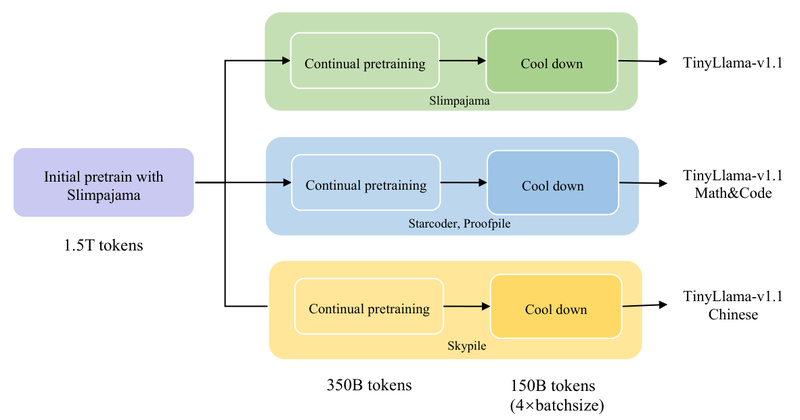
TinyLlama is a compact yet powerful open-source language model with just 1.1 billion parameters—but trained on an impressive 3 trillion tokens. Built on the same architecture and tokenizer as Llama 2, TinyLlama delivers strong downstream performance while maintaining a small memory footprint, making it ideal for resource-constrained environments. Unlike many small models that sacrifice capability for size, TinyLlama leverages community-driven optimizations like FlashAttention-2 and Lit-GPT to achieve high training throughput and efficient inference. Its open availability, compatibility with existing Llama 2 tools, and strong empirical results make it a compelling choice for technical decision-makers seeking a lightweight, production-ready language model.
Why TinyLlama Delivers Exceptional Efficiency
Speed and Hardware Utilization
TinyLlama’s training pipeline achieves a throughput of 24,000 tokens per second per A100-40G GPU, translating to 56% model FLOPs utilization—a remarkable figure for a model of this scale without activation checkpointing. This efficiency stems from a suite of fused operations: fused LayerNorm, SwiGLU, cross-entropy loss, and rotary positional embeddings, alongside FlashAttention-2 for faster attention computation.
Compared to similar models, TinyLlama trains significantly faster:
- TinyLlama-1.1B: 3,456 A100 GPU hours for 300B tokens
- Pythia-1.0B: 4,830 GPU hours
- MPT-1.3B: 7,920 GPU hours
This speedup reduces both cost and time-to-deployment—critical advantages for teams with limited compute budgets.
Extended Training on Massive Data
While many small models train for only one epoch, TinyLlama underwent approximately 3 epochs over 3 trillion tokens, drawing from a curated mix of the SlimPajama and StarCoder datasets (with a 7:3 natural language to code ratio). The extended training yields consistent performance gains, as evidenced by rising commonsense evaluation scores—from 48.28 at 503B tokens to 53.86 at 2.5T tokens—before a slight dip at 3T tokens (attributed to a bos_id bug, now documented by the team).
Real-World Applications Enabled by TinyLlama’s Compact Design
On-Device and Edge Deployment
With its 1.1B parameters, TinyLlama fits comfortably on consumer hardware. When quantized to 4-bit precision, the model weighs just 637 MB, enabling offline capabilities such as:
- Real-time machine translation on laptops or mobile devices
- Local voice assistant backends without cloud dependency
- Embedded NLP in IoT or automotive systems
The project explicitly notes compatibility with RTX 3090/4090 GPUs, broadening access beyond data-center-grade hardware.
Accelerating Larger Models via Speculative Decoding
TinyLlama excels as a draft model in speculative decoding, where it predicts candidate tokens in parallel with a larger target model (e.g., Llama-2-7B). Correct predictions are accepted instantly, while mismatches trigger fallback—greatly boosting overall throughput. The repository includes a dedicated speculative_decoding/ tutorial using llama.cpp, making adoption straightforward.
Real-Time Interactive Systems
Its fast inference speeds—71.8 tokens/sec on a Mac M2 (4-bit, batch=1) and 7,094 tokens/sec on an A40 GPU (batch=100)—make TinyLlama suitable for latency-sensitive applications like:
- Dynamic dialogue generation in video games
- Live customer support bots
- Rapid content summarization in collaborative tools
Solving Practical Pain Points for Technical Teams
TinyLlama directly addresses common hurdles in deploying language models:
- Limited GPU memory: Runs on 40GB GPUs during training with a 16K tokens/GPU batch size.
- High inference costs: Small size reduces both latency and operational expenses.
- Slow iteration cycles: Fast training allows rapid experimentation and customization.
- Integration friction: Full compatibility with Llama 2 means existing tooling (e.g.,
llama.cpp,vLLM,Hugging Face Transformers) works out of the box.
For teams without access to large-scale clusters, TinyLlama offers a rare combination: production-grade performance with hobbyist-friendly hardware requirements.
Getting Started: Pretrained Models, Fine-Tuning, and Inference
Ready-to-Use Checkpoints
The team releases both base and chat models at regular intervals:
- Base models: From 105B to 3T tokens (e.g.,
TinyLlama-1.1B-intermediate-step-1431k-3T) - Chat models: Fine-tuned on OpenAssistant data (e.g.,
TinyLlama-1.1B-Chat-V0.4at 1.5T tokens)
Since the base model’s learning rate hadn’t fully cooled at 3T tokens, the team recommends using the chat-finetuned versions for dialogue tasks.
Customization and Fine-Tuning
A simple full-parameter fine-tuning script is included in the sft/ directory, trained on the openassistant-guanaco dataset. For low-memory environments (<4GB), the project points users to QLoRA and bitsandbytes, enabling efficient adaptation even on modest hardware.
Inference Support
TinyLlama works seamlessly with:
- llama.cpp for CPU and Apple Silicon deployment
- vLLM for high-throughput GPU serving
- Standard Hugging Face pipelines for quick prototyping
This plug-and-play compatibility drastically lowers the barrier to integration.
Limitations and Practical Considerations
While TinyLlama excels in efficiency, users should be aware of its constraints:
- Context length: Fixed at 2,048 tokens, limiting use in long-document tasks.
- Training convergence: The 3T-token checkpoint shows a slight performance dip vs. 2.5T, likely due to a bos_id bug—review the project notes for details.
- Task complexity: Not a replacement for 7B+ models in advanced reasoning, code generation, or knowledge-intensive QA.
- Fine-tuning scope: The official chat models use basic datasets and hyperparameters; community contributions are encouraged to push performance further.
TinyLlama is best deployed where speed, size, and cost outweigh the need for maximal reasoning depth.
Summary
TinyLlama demonstrates that small language models, when trained long enough on high-quality data and optimized with modern techniques, can deliver surprising capability without heavy infrastructure. Its blend of open accessibility, Llama 2 compatibility, and edge-ready efficiency makes it an outstanding option for technical teams building real-time, on-device, or cost-sensitive NLP applications. Whether you’re accelerating a larger model, deploying locally, or experimenting with custom fine-tunes, TinyLlama offers a lean, fast, and future-proof foundation.