Data scientists and machine learning engineers routinely rely on pandas and NumPy for data wrangling, exploration, and modeling. These libraries are powerful, expressive, and deeply embedded in the Python data science ecosystem. But they hit a hard wall when datasets outgrow a single machine’s memory—leading to crashes, slowdowns, or the need for costly rewrites using distributed frameworks like Spark or Dask.
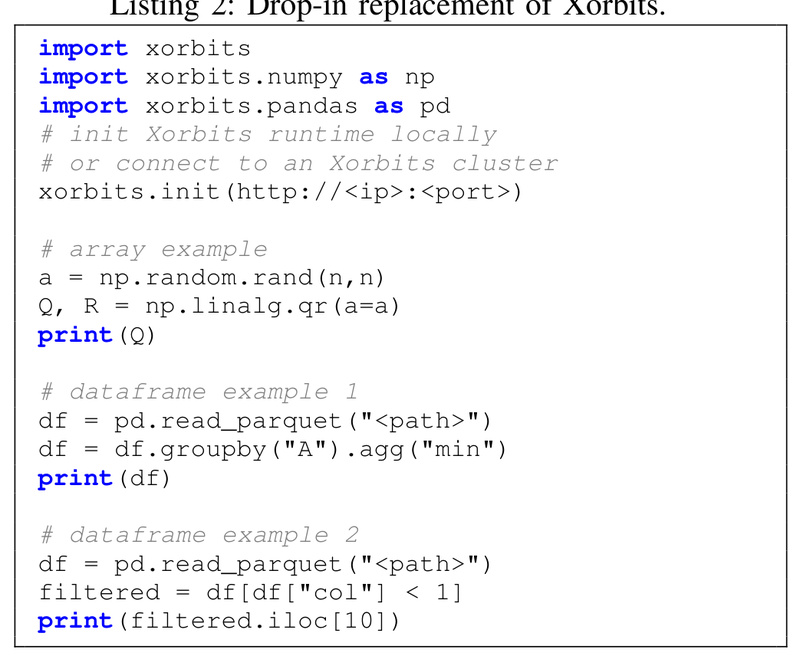
Xorbits changes this. It’s an open-source computing framework designed to let you scale your existing pandas and NumPy code to multi-core machines or large clusters—without rewriting your logic or learning distributed systems. With just a one-line import change, your notebook that used to choke on a 10 GB CSV can now process terabytes seamlessly.
Built for real-world production environments and already running on clusters with up to 5,000 CPU cores, Xorbits delivers high performance, near-complete API compatibility, and automatic memory management. Whether you’re analyzing user behavior for an e-commerce platform or building credit risk models in finance, Xorbits removes the infrastructure barrier so you can focus on your data and models—not on scaling plumbing.
Why Scaling Data Science Shouldn’t Require Rewriting Code
Traditional scaling approaches force data scientists to abandon familiar APIs in favor of lower-level abstractions. Spark’s DataFrame API, for instance, deviates significantly from pandas, and even Dask requires careful attention to partitioning, shuffling, and memory layout. These shifts introduce friction, bugs, and maintenance overhead—especially when prototypes need to move into production.
Xorbits solves this by preserving the pandas and NumPy interfaces you already know. Under the hood, it intelligently distributes computation while dynamically managing data partitioning to avoid Out-of-Memory (OOM) errors and data skew—common failure modes in other distributed systems. This “lift-and-shift” capability is transformative: your existing scripts, notebooks, and functions work as-is, just faster and at larger scale.
Key Capabilities That Address Real Engineering Pain Points
Near-Complete API Compatibility (96.7%)
Xorbits supports 96.7% of pandas and NumPy APIs—60 percentage points higher than the closest alternative. This means your existing data cleaning pipelines, groupby operations, merges, and array math will likely run without modification. For teams maintaining large codebases, this drastically reduces migration risk and accelerates adoption.
Automatic Memory and Workload Management
Unlike systems that require manual tuning of partitions or cluster resources, Xorbits automatically tiles operators and balances workloads across available cores or nodes. Its novel “dynamic switching” between graph construction and execution phases enables efficient memory reuse and avoids the OOM crashes that plague naive distributed executions.
Proven Performance Gains
In benchmark evaluations, Xorbits delivers an average 2.66× speedup over the fastest state-of-the-art pandas-compatible frameworks. This isn’t just theoretical—it’s validated on workloads from real production systems in e-commerce and financial services, where responsiveness and reliability are non-negotiable.
Unified Support for the Broader ML Ecosystem
Beyond pandas and NumPy, Xorbits integrates with PyTorch, XGBoost, and other key libraries. This makes it suitable not only for preprocessing but also for distributed training and inference—enabling end-to-end scalability from raw data to deployed models.
Ideal Use Cases for Technical Decision-Makers
Xorbits excels in scenarios where your current workflow is bottlenecked by single-machine limits but rewriting in a new framework isn’t viable. Consider these examples:
- E-commerce user behavior analysis: Processing billions of clickstream events to compute session statistics, funnel drop-offs, or cohort retention—tasks that easily exhaust RAM on a laptop.
- Financial risk modeling: Running Monte Carlo simulations or aggregating transaction histories across millions of accounts using familiar vectorized operations.
- ML feature engineering at scale: Generating hundreds of time-series features from historical logs using pandas-style rolling windows and groupby transforms—now distributed across a cluster.
In each case, Xorbits preserves your team’s productivity while unlocking cluster-scale compute. There’s no need to hire distributed systems engineers or retrain data scientists on new DSLs.
Getting Started Takes Minutes, Not Days
Adopting Xorbits is intentionally frictionless:
-
Install via PyPI:
pip install xorbits
-
Replace your import statement:
# Before
import pandas as pd

# After
import xorbits.pandas as pd
That’s it. Your existing code now benefits from multi-core acceleration on your laptop—or scales to a cluster if you configure one. No decorators, no explicit partitioning, no cluster configuration in your notebook. Xorbits handles orchestration transparently.
For advanced users, optional configuration (e.g., specifying cluster endpoints or resource limits) is available—but never required for basic scaling.
Current Limitations and Future Roadmap
Xorbits currently builds on Mars internally—a proven foundation—but its roadmap signals a more ambitious future. Key upcoming milestones include:
- Transitioning from pandas-native to Arrow-native storage, which will reduce memory overhead and improve columnar processing efficiency.
- Introducing native compute engines leveraging vectorization and code generation for even faster execution.
- Expanding API coverage to support more niche or advanced pandas/NumPy functions.
While Xorbits already covers the vast majority of common operations, teams relying on highly specialized or undocumented pandas behaviors should validate compatibility in their specific workflows.
Summary
Xorbits eliminates the false choice between developer productivity and scalable computation. By enabling seamless scaling of pandas and NumPy workloads—from a laptop to a 5,000-core cluster—with minimal code changes, it empowers data teams to tackle larger problems without rearchitecting their entire stack. Its high API compatibility, automatic memory management, and proven speed advantages make it a compelling choice for technical leaders evaluating scalable data science infrastructure. If your organization is hitting the limits of single-machine data processing, Xorbits offers a pragmatic, low-friction path forward.