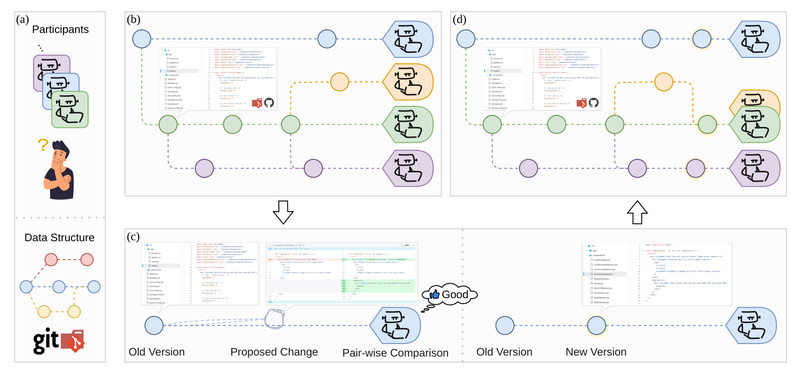
Modern software development faces persistent bottlenecks: slow iteration cycles, coordination overhead in large teams, opaque AI-assisted coding workflows, and limited scalability when exploring multiple implementation paths simultaneously. Enter EvoGit—a decentralized multi-agent framework that reimagines code creation as an evolutionary, collaborative process. By replacing centralized orchestration with Git-native coordination, EvoGit enables autonomous coding agents to evolve a shared codebase asynchronously, without explicit communication or shared memory. All interactions emerge implicitly through a Git-based phylogenetic graph that records every change, branch, and merge as a transparent, auditable lineage.
Originally developed by Bill Huang and team, EvoGit earned first place in the Multi-Agent Track at the AgentX Competition. It’s not just a research prototype—it’s a practical tool for tech leads, engineering managers, and AI researchers seeking to automate exploratory development while retaining full traceability and strategic control.
Why EvoGit Solves Real Development Pain Points
Traditional AI-assisted coding tools often assume a single-agent, linear workflow: one model generates code in response to a prompt. This approach fails in complex scenarios requiring iterative refinement, parallel exploration, or emergent collaboration.
EvoGit directly addresses four critical challenges:
- Coordination Overhead: Large teams (or multi-agent systems) waste time synchronizing state. EvoGit eliminates this by letting agents operate independently, using Git itself as the coordination medium.
- Lack of Traceability: Most AI coding tools obscure how or why a solution evolved. In EvoGit, every agent decision is a Git commit—fully versioned, diffable, and reproducible.
- Limited Exploration: Linear workflows can’t test multiple architectural hypotheses at once. EvoGit’s branching model supports massive parallel exploration of design alternatives.
- Human Burnout: Constant coding intervention defeats the purpose of automation. EvoGit shifts the human role from coder to strategic product manager—providing only high-level goals and sparse feedback.
Core Strengths: How EvoGit Works Differently
Decentralized, Stigmergic Collaboration
Agents in EvoGit never talk to each other directly. Instead, they interact indirectly through the shared Git repository—akin to stigmergy in ant colonies, where individuals modify the environment to influence others. This design removes bottlenecks from centralized schedulers or message queues.
Git-Native Architecture
EvoGit doesn’t layer a new coordination protocol on top of Git. It is Git. Branches represent evolutionary trajectories. Commits encode agent proposals. Merges reflect convergence. This means the entire system integrates seamlessly with existing developer toolchains—no new infrastructure required.
Full Auditability and Reproducibility
Every autonomous edit is immutably recorded. You can replay the entire development history, inspect divergent branches, or roll back to any intermediate state. This is invaluable for compliance, debugging, and understanding how a solution emerged.
Strategic Human Oversight
Humans define the initial goal in the main branch and occasionally review the Git graph. With just a few feedback interventions—promoting promising branches or pruning dead ends—they guide evolution without writing code. In demonstrations, as few as 5–10 feedback actions steered complex projects to completion.
Ideal Use Cases: Where EvoGit Shines
EvoGit excels in scenarios that demand exploration, modularity, and transparent evolution rather than deterministic, single-path execution.
Rapid Prototyping of Full-Stack Applications
In one demo, EvoGit agents built a complete, interactive web page—from responsive layout and dark-mode toggle to CSS animations—based only on a high-level product description. The human never wrote code; they simply reviewed branches and gave directional feedback.
Meta-Level Algorithm Synthesis
EvoGit can evolve systems that write code. In a second experiment, agents constructed a meta-program that automatically designs and refines solvers for the bin-packing optimization problem. The result was a human-readable, efficient solver generated entirely through autonomous evolution—saved as best_solution.py.
Large-Scale Autonomous Coding Experiments
For AI researchers, EvoGit provides a native environment to study emergent collaboration, evolutionary search in code space, and agent-based software synthesis—all with built-in instrumentation via Git logs.
How to Use EvoGit in Practice
Using EvoGit follows a simple, Git-first workflow:
- Seed the Repository: A human initializes the
mainbranch with a minimal codebase and a high-level goal (e.g., “Build a todo app with dark mode”). - Launch Autonomous Agents: Agents create independent branches named
host<i>-individual<j>, each proposing edits based on their internal logic and the current state of the Git graph. - Asynchronous Evolution: Agents read from any existing branch (including peers’) and push new commits to their own branch, enabling implicit knowledge sharing.
- Strategic Human Review: Periodically, the human inspects the Git history (via
git log --graphor GitHub’s network view), merges high-potential branches, and deletes unproductive ones.
Critically, no coding is required during evolution. Interaction happens purely through Git operations and high-level feedback—making it accessible to technical leads, not just engineers.
Current Limitations and Considerations
While powerful, EvoGit is not a drop-in replacement for all development workflows:
- Best for Exploratory, Not Production-Critical Systems: It’s optimized for prototyping and research, not deploying mission-critical services.
- Git Fluency Required: Users must be comfortable navigating branches, commits, and merge conflicts.
- Human Guidance Remains Essential: Though minimal, feedback is necessary to avoid combinatorial explosion of low-quality branches.
- Agent Quality Matters: Performance depends on the underlying coding agents’ capabilities; EvoGit orchestrates but doesn’t replace them.
EvoGit works best when users can interpret evolutionary outcomes and make strategic pruning decisions based on Git history.
Summary
EvoGit redefines collaborative software development by leveraging Git not just as a version control system, but as the nervous system of a decentralized, multi-agent coding ecosystem. It solves real-world bottlenecks—coordination overhead, opaque AI workflows, and limited exploration—while delivering full traceability and minimal human intervention. For engineering leaders and AI practitioners seeking to scale autonomous coding in a transparent, auditable way, EvoGit offers a compelling new paradigm. Open-sourced and competition-proven, it’s ready for adoption in research, prototyping, and next-generation development pipelines.