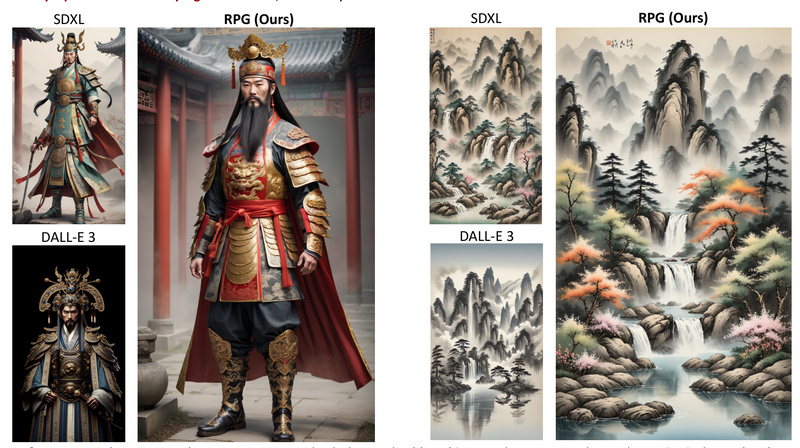
Text-to-image generation has made remarkable strides, yet even state-of-the-art models like DALL·E 3 or Stable Diffusion XL (SDXL) often stumble when faced with complex prompts involving multiple objects, precise attributes, and intricate spatial relationships. Enter RPG-DiffusionMaster, a novel, training-free framework that bridges the reasoning power of multimodal large language models (MLLMs) with the generative fidelity of diffusion models—without requiring any model fine-tuning.
Introduced in the ICML 2024 paper “Mastering Text-to-Image Diffusion: Recaptioning, Planning, and Generating with Multimodal LLMs,” RPG-DiffusionMaster tackles one of the toughest challenges in AI image synthesis: compositional correctness. By decomposing a single complex scene into simpler, spatially-aware sub-tasks, RPG leverages MLLMs—whether cloud-based (like GPT-4, Gemini-Pro, or OpenAI o1) or locally run (like MiniGPT-4 or Llama2)—to “recaption, plan, and generate” each region independently. The result? Images that faithfully respect object counts, attribute bindings, and layout instructions that would confuse conventional pipelines.
Best of all, RPG works out-of-the-box with popular diffusion backbones like SD 1.5, SDXL, and the newer IterComp, and supports ultra-high-resolution outputs (up to 2048×1024) while remaining fully compatible with ControlNet for pose, depth, or edge guidance.
Why Standard Diffusion Models Fall Short
Before exploring RPG’s solution, it’s worth understanding the pain points it solves. In practice, many text-to-image systems suffer from:
- Attribute misbinding: Prompting “a blonde girl in a red dress and a brunette boy in a blue shirt” might yield a red-haired girl or a boy in red.
- Object omission or duplication: Failing to generate exactly two cats, or accidentally adding a third.
- Spatial confusion: Ignoring “left/right” or “foreground/background” cues, leading to chaotic compositions.
- Semantic drift: Losing coherence when prompts combine disparate themes (e.g., “a cyberpunk city on the left, a medieval village on the right”).
These issues stem from the fact that standard diffusion models process prompts holistically, without explicit reasoning about structure or relationships. RPG addresses this by introducing a reasoning layer—powered by MLLMs—to plan how the image should be constructed before any pixel is generated.
How RPG-DiffusionMaster Works: Recaption, Plan, Generate
RPG’s workflow consists of three intuitive stages:
1. Recaption
The input prompt is first refined by the MLLM to clarify ambiguities and reinforce compositional intent. For example, “two girls chatting in a café” becomes more structured, specifying appearance, position, and context.
2. Plan
The MLLM then acts as a global planner, dividing the image canvas into logical subregions (e.g., left half, right half, or more granular zones) and assigning tailored prompts to each. It outputs a split ratio (e.g., [0.5, 0.5] for two equal vertical regions) and corresponding regional prompts.
3. Generate
Using complementary regional diffusion, RPG synthesizes each subregion independently while preserving global coherence through a shared “base prompt” (when needed). This hybrid approach ensures both local fidelity and overall harmony.
Critically, this entire pipeline requires no model training—only standard diffusion checkpoints and access to an MLLM (via API or local deployment).
Key Technical Strengths
Training-Free and Highly Flexible
RPG-DiffusionMaster doesn’t require retraining diffusion models or MLLMs. You can plug in virtually any diffusion backbone—SD 1.4/1.5/2.1 via RegionalDiffusionPipeline, or SDXL/IterComp via RegionalDiffusionXLPipeline—and pair it with your MLLM of choice.
Dual MLLM Support: Cloud or Local
- Cloud MLLMs (GPT-4, Gemini-Pro, DeepSeek-R1, o1, o3-mini): Lower local VRAM usage (~10GB), ideal for quick prototyping.
- Local MLLMs (MiniGPT-4, Llama2-13B/70B): Full data control, but demand more GPU memory and setup effort.
High-Resolution & ControlNet Integration
RPG natively supports resolutions up to 2048×1024 and integrates seamlessly with ControlNet. Whether you’re using open pose, depth maps, or Canny edges to guide layout, RPG preserves both semantic intent and structural control.
Smart Prompt Handling with base_prompt and base_ratio
For scenes involving multiple entities of the same class (e.g., “two girls”), RPG uses a base prompt (e.g., “two girls in a café”) weighted by base_ratio (typically 0.35–0.55) to reinforce global consistency. For heterogeneous objects (e.g., “a latte, roses, and a cat”), the base prompt can be disabled—letting regional prompts dominate.
Ideal Use Cases for Technical Decision-Makers
RPG-DiffusionMaster excels in scenarios where precision, composition, and spatial control matter more than speed:
- Marketing & E-commerce: Generate product scenes with multiple models wearing specified outfits, correctly positioned and styled.
- Concept Art & Storyboarding: Create split-world visuals (e.g., “winter on the left, summer on the right”) with thematic consistency.
- Educational Content: Illustrate scientific diagrams or historical comparisons with labeled, spatially arranged elements.
- UI/UX & Game Design: Produce layout-controlled mockups or environment art where object placement must match design specs.
If your team has struggled with diffusion models “getting the details wrong,” RPG offers a principled, reasoning-driven alternative.
Getting Started: Simple, Script-Based Workflow
Setting up RPG is straightforward:
- Clone the repository and install dependencies.
- Choose a diffusion model (e.g.,
comin/IterCompfor best compositional results). - Select an MLLM—cloud-based for ease, local for privacy.
- Run a short Python script specifying your prompt, MLLM, and pipeline.
Example (using GPT-4 and SDXL):
pipe = RegionalDiffusionXLPipeline.from_pretrained("comin/IterComp", torch_dtype=torch.float16)
para_dict = GPT4(prompt="A blonde man in black suit with a twintail girl in red cheongsam in a bar", key="your-api-key")
images = pipe(prompt=para_dict['Regional Prompt'], split_ratio=para_dict['Final split ratio'], base_prompt=prompt, base_ratio=0.5, width=1024, height=1024).images[0]
The framework handles the rest—from MLLM querying to regional blending.
Limitations and Practical Considerations
While powerful, RPG-DiffusionMaster isn’t a silver bullet:
- API Dependency or High VRAM: Cloud MLLMs require internet and API keys; local models need ≥16GB VRAM for Llama2-13B+.
- Generation Time: The multi-step reasoning and regional synthesis take longer than standard inference.
- Prompt Sensitivity: Very vague prompts may not yield effective region plans; clear spatial or categorical cues work best.
- Static Images Only: RPG currently focuses on still images, not video or animation.
These trade-offs are acceptable when accuracy and composition outweigh speed—making RPG ideal for high-stakes creative or research applications.
Summary
RPG-DiffusionMaster redefines what’s possible in text-to-image generation by offloading compositional reasoning to MLLMs—no training required. Its ability to handle complex, multi-object prompts with spatial precision fills a critical gap left by mainstream diffusion models. For project leads, researchers, and developers who need reliable, structured image synthesis from intricate textual descriptions, RPG offers a flexible, state-of-the-art solution that’s both accessible and extensible. Whether you’re generating concept art, marketing assets, or scientific illustrations, RPG ensures what you describe is what you get—down to the last attribute and spatial relationship.