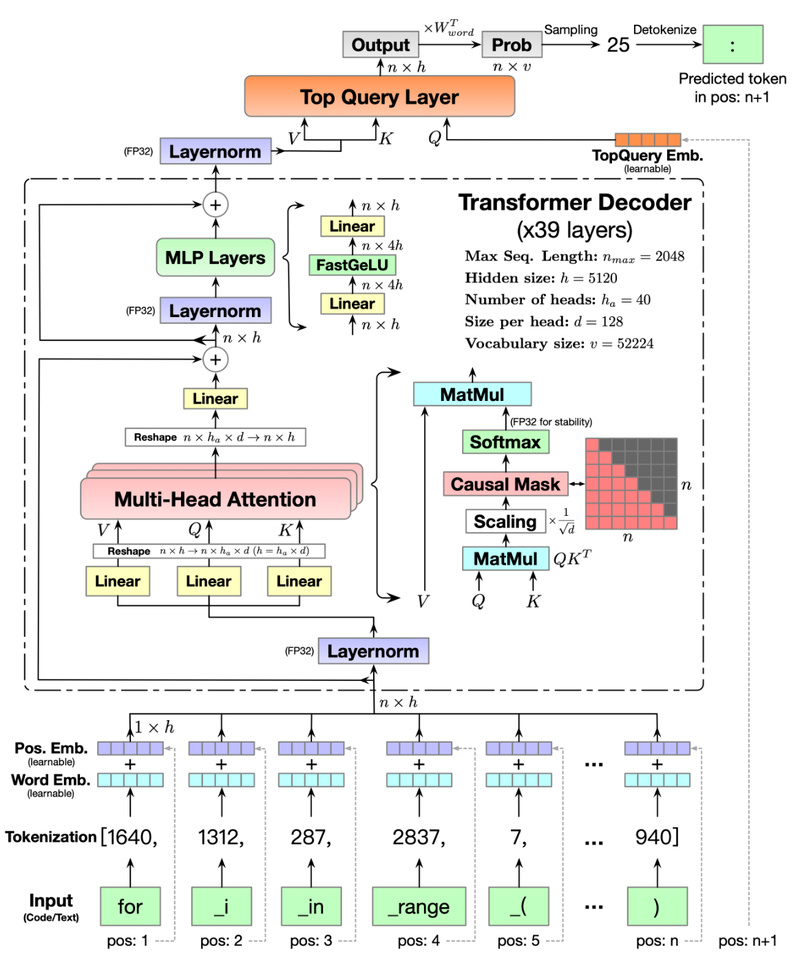
For software teams working across multiple programming languages—or developers tired of vendor lock-in with proprietary AI coding tools—CodeGeeX offers a compelling open-source alternative. Developed by Tsinghua University’s Knowledge Engineering Group (KEG) and Zhipu.AI, CodeGeeX is a 13-billion-parameter language model pre-trained on 850 billion tokens of source code spanning 23 programming languages. Unlike closed systems like GitHub Copilot or OpenAI Codex, CodeGeeX is fully open: its model weights, inference code, API, and IDE extensions are publicly available, enabling transparent evaluation, customization, and on-premises deployment.
What makes CodeGeeX especially valuable is its demonstrated real-world utility: it powers free extensions for VS Code and JetBrains IDEs, serving tens of thousands of active users weekly who collectively generate 4.7 billion tokens per week. A formal user study found that 83.4% of developers reported increased coding efficiency when using CodeGeeX—proof that this isn’t just another research prototype, but a practical tool solving everyday development bottlenecks.
Multilingual Code Generation That Just Works
At its core, CodeGeeX excels at generating syntactically correct and functionally valid code from natural language prompts or partial code snippets. While many code models focus exclusively on Python, CodeGeeX was designed from the ground up for multilingual programming environments. Its training corpus includes high-quality public code in languages such as Python, Java, C++, JavaScript, and Go, with special attention to data quality (e.g., filtering auto-generated files, enforcing size and readability constraints).
Crucially, performance isn’t just claimed—it’s rigorously benchmarked. The team introduced HumanEval-X, an extension of the widely used HumanEval benchmark that includes 820 hand-written coding problems across five major languages, each with executable test cases. On this benchmark, CodeGeeX outperforms other open-source multilingual models of comparable or even larger scale (e.g., CodeGen-Multi-16B) in average pass@k scores, demonstrating robust cross-language generalization without relying on fuzzy metrics like CodeBLEU.
One-Click Cross-Language Code Translation
Beyond generation, CodeGeeX supports zero-shot code translation between languages—a feature increasingly vital in polyglot enterprises. Need to convert a Java utility class into Python? Or migrate a JavaScript frontend module to TypeScript-compatible syntax? CodeGeeX can translate code snippets with a single click in its IDE plugins, preserving logic and structure.
HumanEval-X also evaluates this capability by testing 20 language pairs (e.g., Java→Python, C++→Go). Results show that CodeGeeX achieves strong performance, particularly when translating into Python and C++—likely reflecting their dominance in the training data. While translation quality varies slightly by direction (as is common in current models), the ability to automate even 70–80% of routine porting tasks can dramatically reduce migration costs and onboarding time for developers new to a codebase.
Developer-Centric Deployment and Integration
CodeGeeX removes common adoption barriers:
- Free IDE plugins: Official extensions for VS Code and all major JetBrains IDEs (including PyCharm, IntelliJ IDEA, GoLand, and CLion) are available in their respective marketplaces. No API keys or subscriptions required.
- Hardware flexibility: Supports both NVIDIA GPUs (V100/A100) and Huawei Ascend 910 platforms, making it viable in diverse infrastructure environments.
- Multiple inference options: Run the full model on a single GPU with ≥27GB VRAM, or use quantization to reduce memory usage to ~15GB. For smaller setups, model parallelism allows inference across multiple GPUs with as little as 6GB per device.
- Docker support: A pre-built container simplifies environment setup for teams using CI/CD pipelines or cloud workstations.
Critically, no fine-tuning is needed for standard code completion or translation tasks. This “out-of-the-box” readiness lowers the entry barrier for engineering teams without dedicated ML specialists.
Real-World Use Cases Where CodeGeeX Delivers Value
- Accelerating prototyping in polyglot systems: Quickly scaffold microservices in different languages without switching mental contexts.
- Reducing boilerplate fatigue: Automate repetitive code patterns (e.g., getters/setters, REST endpoint stubs, unit test scaffolds).
- Onboarding developers: Help new hires understand legacy modules by generating summaries or translating unfamiliar code into their preferred language.
- Modernizing legacy systems: Migrate older Java or C++ components to more maintainable languages while preserving core logic.
- Secure, offline coding assistance: Enterprises with strict data governance can self-host CodeGeeX, avoiding the risks of sending proprietary code to external APIs.
Limitations and Practical Considerations
While powerful, CodeGeeX has realistic constraints:
- Hardware demands: The base model requires significant GPU memory (27GB in FP16), though quantization reduces this to 15GB. CPU-only inference isn’t supported.
- Language coverage vs. quality: Though trained on 23 languages, the highest validation confidence comes from the five in HumanEval-X (Python, Java, C++, JavaScript, Go). Support for less common languages may be less consistent.
- Generated code requires review: Like all LLMs, CodeGeeX learns patterns from public repositories—it doesn’t guarantee correctness, security, or efficiency. Human validation remains essential.
- Inference speed: Without optimized backends like FasterTransformer (which the team provides separately), token generation may lag behind commercial offerings.
Summary
CodeGeeX stands out as a transparent, multilingual, and developer-friendly code generation model that delivers real productivity gains without vendor lock-in. By open-sourcing everything—from weights to IDE plugins—it empowers teams to adopt AI-assisted coding on their own terms, whether for rapid prototyping, legacy modernization, or secure internal tooling. For technical decision-makers seeking an ethical, flexible, and battle-tested alternative to proprietary coding assistants, CodeGeeX is a solution worth serious consideration.