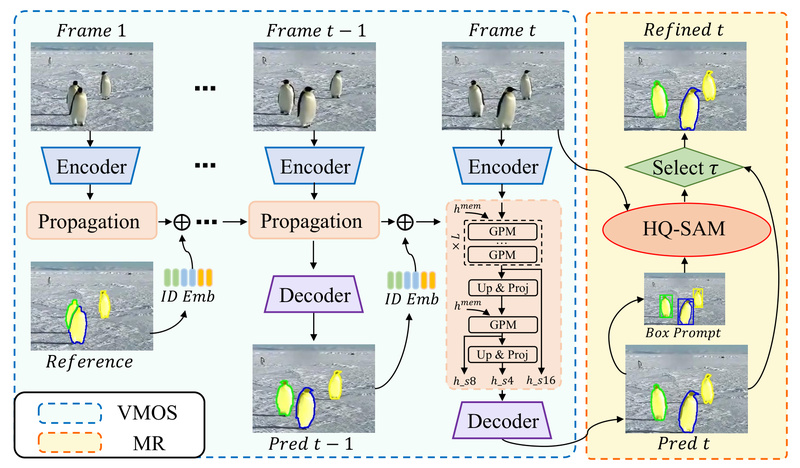
HQTrack is a powerful and practical framework designed to solve a persistent challenge in computer vision: accurately tracking and segmenting arbitrary objects across video frames. Unlike many competing methods that rely on test-time data augmentations, model ensembles, or other engineering-heavy tricks to boost performance, HQTrack delivers state-of-the-art results through a clean, two-stage architecture that balances propagation and refinement.
Built on top of strong foundations like Segment Anything Model (SAM) and DeAOT, HQTrack introduces a Video Multi-Object Segmenter (VMOS) for temporal mask propagation and a pretrained Mask Refiner (MR) to enhance mask quality—especially in complex or corner-case scenes where standard models often fail. The result? Precise, high-fidelity object masks across entire video sequences, even when starting from a single box or point prompt in the first frame.
HQTrack’s effectiveness was validated in real-world competition: it secured 2nd place in the VOTS2023 (Visual Object Tracking and Segmentation) Challenge, a rigorous benchmark for tracking robustness, accuracy, and generalization—without using any post-hoc tricks. This makes it not just a research curiosity, but a production-ready tool for practitioners who need reliable, high-quality segmentation out of the box.
Why HQTrack Stands Out
Accuracy Without Over-Engineering
One of HQTrack’s most compelling advantages is its ability to achieve top-tier performance using a straightforward pipeline. Many leading trackers inflate scores through test-time augmentations (like flipping or scaling inputs) or ensembling multiple models—strategies that increase computational cost and complicate deployment. HQTrack avoids these entirely. Its strong results stem purely from architectural design: VMOS handles temporal coherence, while the Mask Refiner (based on HQ-SAM) sharpens boundary details and corrects drift or noise.
This simplicity translates directly into real-world usability. If you’re building a video annotation tool, a robotics perception system, or a surveillance pipeline, you want predictable performance—not fragile systems that break when augmentation assumptions fail.
Solving Real Pain Points in Video Analysis
Traditional video object tracking often suffers from three key issues:
- Inconsistent masks across frames – Objects may flicker, split, or disappear due to occlusion, motion blur, or lighting changes.
- Poor boundary precision – Even if the object is tracked, the mask may be coarse or misaligned, especially around fine structures like hair, fur, or transparent materials.
- Difficulty with multiple objects – Many systems are built for single-object tracking and struggle to scale.
HQTrack directly addresses all three. VMOS enables simultaneous multi-object tracking by propagating masks from the initial frame through time. Then, the Mask Refiner ensures pixel-accurate boundaries by leveraging HQ-SAM’s high-resolution segmentation capabilities. Together, they maintain object identity and mask quality even in challenging scenarios—like fast motion, partial occlusion, or cluttered backgrounds.
Key Features That Matter to Practitioners
- Flexible input prompts: Start tracking with either a bounding box or a point click—no need for full masks upfront.
- Multi-object support: Track several objects in the same video with a single run.
- High-quality mask output: Produces detailed, frame-by-frame segmentation masks suitable for downstream tasks like editing, labeling, or 3D reconstruction.
- Local demo for arbitrary videos: A pure Python script lets you test HQTrack on your own video files immediately after setup—no cloud dependency or web interface required.
- Transparent, modular design: The separation between VMOS (propagation) and MR (refinement) makes the system interpretable and extensible.
These features make HQTrack accessible not just to researchers, but also to engineers, product developers, and data annotators who need robust tracking without deep expertise in vision transformers or optical flow.
Ideal Use Cases
HQTrack excels in any scenario where accurate, temporally consistent object masks are critical:
- Video dataset annotation: Accelerate labeling for VOS, instance segmentation, or autonomous driving datasets by generating high-quality pseudo-labels.
- Content creation tools: Enable AI-powered video editing features like object removal, style transfer, or background replacement.
- Surveillance and security: Track persons or vehicles across camera feeds with precise masks for behavior analysis or forensic review.
- Robotics and AR/VR: Provide real-time perception of object boundaries for manipulation, occlusion handling, or scene understanding.
Because it works on “in-the-wild” videos—not just curated benchmark sequences—it’s particularly valuable for applications beyond controlled lab environments.
Getting Started: A Straightforward Workflow
HQTrack is designed for hands-on users who want to test quickly. The setup follows standard deep learning practices:
- Environment setup: Create a Conda environment and install PyTorch (v1.9 recommended).
- Install dependencies: Includes HQ-SAM, correlation extensions, DCNv3 ops, and standard vision libraries (OpenCV, timm, etc.).
- Download pretrained models:
- The VMOS model (trained on DAVIS, YouTube-VOS, and other datasets) goes in the
ckptdirectory. - The HQ-SAM_h refinement model goes in
segment_anything_hq/pretrained_model/.
- The VMOS model (trained on DAVIS, YouTube-VOS, and other datasets) goes in the
- Run the demo: Use the provided Python script to process your own video with box or point prompts.
- (Optional) Evaluate with VOTS toolkit: For benchmarking, integrate with the VOTS23 workspace using the provided
trackers.iniconfiguration.
While the installation involves several steps, each component is well-documented, and the authors provide clear file paths and commands. This makes it feasible for teams with basic PyTorch experience to deploy and validate HQTrack within a day.
Current Limitations and Considerations
HQTrack is powerful but not without trade-offs:
- No interactive WebUI yet: The current demo is command-line based, which may limit accessibility for non-technical users.
- No lightweight version: The model relies on full-scale VMOS and HQ-SAM, making it unsuitable for edge devices or real-time mobile applications without further optimization.
- Heavy dependencies: Requires CUDA, specific PyTorch versions, and custom CUDA extensions (like DCNv3), which can complicate deployment in restricted environments.
- Generalization boundaries: While MR improves robustness, performance may still degrade on extremely rare object categories or scenes far outside the training distribution (e.g., microscopic or satellite imagery).
That said, for standard RGB video from webcams, smartphones, or surveillance cameras, HQTrack offers exceptional reliability.
Summary
HQTrack redefines what’s possible in video object tracking by delivering high-quality, precise masks without resorting to complex inference tricks. Its two-stage design—propagate with VMOS, refine with MR—strikes an ideal balance between temporal consistency and spatial accuracy. With its 2nd-place finish in VOTS2023, open-source availability, and support for real-world video inputs, HQTrack is a compelling choice for anyone building vision systems where mask fidelity matters. Whether you’re prototyping a new product, validating a research idea, or scaling up video annotation, HQTrack lowers the barrier to professional-grade tracking performance.