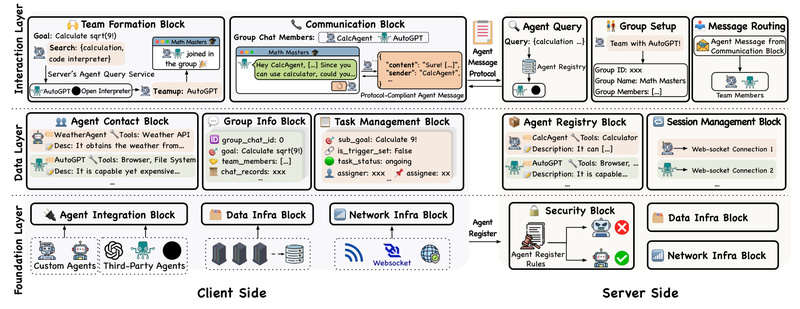
Imagine a world where AI agents—each with unique skills like web browsing, code execution, or data analysis—can autonomously find one another, form teams, and solve complex problems together, just like humans collaborating over the internet. That’s precisely what Internet of Agents (IoA) delivers. Developed by OpenBMB and introduced in the paper “Internet of Agents: Weaving a Web of Heterogeneous Agents for Collaborative Intelligence,” IoA is an open-source framework designed to overcome the rigid, siloed nature of current multi-agent systems.
Unlike traditional frameworks that lock you into proprietary agent definitions or restrict collaboration to a single machine, IoA embraces diversity and distribution. It allows third-party agents such as AutoGPT and Open Interpreter to interoperate seamlessly, forming dynamic teams tailored to the task at hand. This makes IoA especially valuable for technical decision-makers—researchers, engineers, and product leaders—who need a flexible, scalable, and real-world-ready platform for orchestrating collaborative AI.
Why Existing Multi-Agent Systems Fall Short
Before diving into IoA’s innovations, it’s important to understand the limitations it addresses:
- Ecosystem Lock-in: Most frameworks only support agents built within their own system, making it hard to integrate proven third-party tools.
- Single-Device Bottlenecks: Collaboration is often confined to one machine, preventing true distributed execution across cloud, edge, or mobile environments.
- Hard-Coded Communication: Conversations between agents follow fixed scripts, lacking the flexibility to adapt to evolving task requirements.
These constraints make it difficult to build systems that mirror real-world complexity—where successful outcomes often depend on combining specialized tools and expertise dynamically.
Key Capabilities That Make IoA Stand Out
IoA directly tackles these challenges with a suite of internet-inspired design principles and practical engineering solutions:
Internet-Like Architecture for Distributed Collaboration
Inspired by the TCP/IP model, IoA treats each agent as an independent node that can join a network regardless of its origin or runtime environment. This enables cross-device, cross-platform agent collaboration—a critical step toward scalable, real-world AI ecosystems.
Seamless Integration of Heterogeneous Agents
IoA defines a lightweight agent integration protocol that allows diverse agents (e.g., ReAct agents, AutoGPT, Open Interpreter) to plug into the system without modification. Each agent retains its native capabilities while gaining the ability to communicate, request help, and delegate subtasks to others.
Autonomous Team Formation and Nested Collaboration
Rather than relying on pre-defined workflows, IoA enables agents to self-organize into teams and sub-teams based on task complexity. For instance, when asked to analyze Microsoft’s revenue trends from 2014–2020, one agent might fetch financial data, another generate a plot via code execution, and a third synthesize an analytical report—all coordinated without human intervention.
Asynchronous Execution and Adaptive Conversation Flow
Tasks proceed asynchronously, allowing agents to work in parallel and avoid bottlenecks. Meanwhile, IoA’s dynamic conversation controller ensures dialogues remain structured yet flexible, adapting message routing based on context, urgency, and agent availability.
Ideal Use Cases—and When IoA Might Not Fit
When to Choose IoA
IoA shines in scenarios requiring multi-skill coordination, such as:
- Retrieval-Augmented Generation (RAG): Combining web search, document parsing, and natural language summarization.
- Embodied AI Tasks: Where perception, planning, and action modules must collaborate (e.g., robotic assistants).
- End-to-End Automation: Complex workflows like “research → analyze → visualize → report” that span multiple domains.
Empirical results from the IoA paper show consistent outperformance over state-of-the-art baselines across these benchmarks.
Constraints to Consider
IoA is not a one-size-fits-all solution. Be aware of the following:
- Docker Dependency: Deployment requires Docker and familiarity with containerized environments.
- API Key Requirements: Most agents rely on external LLM APIs (e.g., OpenAI), so operational costs and access must be planned.
- Agent Compatibility: While IoA supports major open-source agents, integrating custom or closed-source agents may require implementing the IoA protocol.
If your project involves simple, single-agent tasks or lacks DevOps resources, a lighter framework might suffice.
Getting Started: From Zero to Multi-Agent Collaboration in Minutes
IoA prioritizes practical usability. Here’s how to launch a working demo:
-
Clone the repository:
git clone https://github.com/OpenBMB/IoA.git && cd IoA
-
Pull pre-built Docker images for the server, client, and agents (e.g., AutoGPT, Open Interpreter).
-
Start Milvus (for vector storage) and configure your
.envfile with an OpenAI API key. -
Launch a team via a single Docker Compose command:
docker-compose -f dockerfiles/compose/open_instruction.yaml up
-
Test via a simple POST request:
import requests
response = requests.post("http://127.0.0.1:5050/launch_goal",json={"goal": "I want to know the annual revenue of Microsoft from 2014 to 2020...","team_member_names": ["AutoGPT", "Open Interpreter"]}
)
This workflow requires only basic DevOps knowledge and takes under 10 minutes on a standard developer machine.
Future-Proofing Your Agent-Based Systems
IoA isn’t just for today’s experiments—it’s built for tomorrow’s evolving AI landscape. Its modular design makes it easy to:
- Add new agent types without disrupting existing workflows.
- Deploy agents across cloud servers, local machines, or even mobile devices.
- Extend conversation logic or teaming strategies via plug-in modules.
For teams investing in long-term agent infrastructure, IoA offers a scalable foundation that avoids vendor lock-in and embraces interoperability—much like the internet itself.
Summary
Internet of Agents (IoA) redefines multi-agent collaboration by breaking down silos between heterogeneous AI systems and enabling internet-scale coordination. With its support for autonomous teaming, asynchronous execution, and seamless third-party integration, IoA empowers technical leaders to build robust, adaptive, and truly collaborative AI solutions. If your work involves complex, multi-step tasks that no single agent can handle alone, IoA provides the open, extensible framework to turn that vision into reality—today.