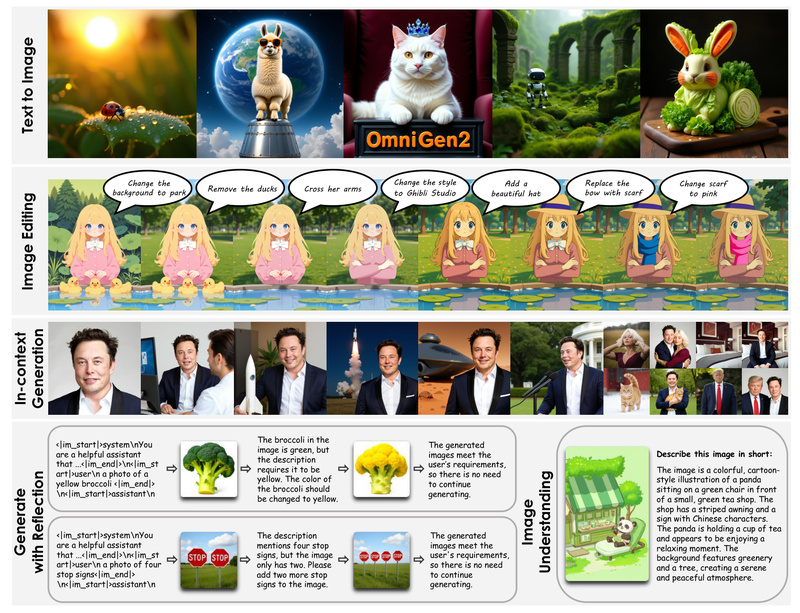
OmniGen2 is an open-source, unified generative model that seamlessly bridges text and vision in a single architecture. Unlike many multimodal systems that specialize narrowly in one task—such as text-to-image synthesis or visual question answering—OmniGen2 delivers four tightly integrated capabilities out of the box: text-to-image generation, instruction-guided image editing, in-context (subject-driven) generation, and robust visual understanding. Built on the Qwen-VL-2.5 foundation, it inherits strong multimodal comprehension while introducing a novel dual-decoding design that separates text and image generation pathways with unshared parameters and a decoupled image tokenizer. This architectural choice allows OmniGen2 to excel in visual tasks without compromising its native language generation ability—a rare balance in today’s generative landscape.
For developers, researchers, and creative professionals seeking a flexible, self-hostable alternative to closed commercial APIs, OmniGen2 offers performance, transparency, and practicality. It’s not just benchmark-optimized—it’s built for real-world workflows, from e-commerce product visualization to rapid design iteration and personalized content creation.
Why OmniGen2’s Architecture Matters
At the core of OmniGen2’s effectiveness is its dual-decoding architecture. Earlier unified models often force text and image generation through a shared transformer backbone, leading to compromises: either degraded text fluency or inconsistent visual fidelity. OmniGen2 avoids this by maintaining distinct decoding routes—one optimized for linguistic coherence, the other for pixel-level visual synthesis.
Crucially, this design enables direct reuse of pre-trained multimodal understanding models (like Qwen-VL) without re-adapting the vision encoder or VAE inputs. The result? Strong zero-shot visual reasoning inherited from its foundation model, plus state-of-the-art image generation—all without retraining the entire system. This modularity also simplifies fine-tuning and extension, making OmniGen2 a practical base for domain-specific applications.
Core Capabilities That Address Real-World Needs
Text-to-Image Generation with High Fidelity
OmniGen2 produces aesthetically pleasing, high-resolution (default 1024×1024) images from textual prompts. Unlike models that generate generic or distorted outputs, OmniGen2 leverages its dual-path design to maintain semantic alignment between prompt and image. This is especially valuable for use cases like marketing asset creation, where brand consistency and visual clarity matter.
Instruction-Guided Image Editing with Precision
Need to change a model’s outfit in a product photo, replace a background, or insert an object while preserving lighting and perspective? OmniGen2 follows natural-language editing instructions with high accuracy. It achieves state-of-the-art performance among open-source models on editing tasks, thanks in part to a tailored reflection mechanism and a dedicated editing dataset. For teams managing large visual catalogs, this eliminates the need for manual Photoshop work or expensive custom pipelines.
In-Context (Subject-Driven) Generation
One of OmniGen2’s standout features is its ability to generate novel scenes using multiple reference images—for instance, placing a person from one photo into a new environment while preserving their facial features, clothing, and pose. This “in-context” capability supports storytelling, personalized avatars, and adaptive design. To evaluate this complex task, the team introduced OmniContext, a new benchmark where OmniGen2 leads among open models in subject consistency.
Visual Understanding Without Extra Overhead
Because OmniGen2 is built on Qwen-VL-2.5, it can analyze and describe images, answer questions about visual content, and ground text in scene context—all using the same model that generates images. This eliminates the need for separate vision and language models in multimodal applications, reducing deployment complexity and cost.
Practical Deployment and Accessibility
Getting started with OmniGen2 is designed to be frictionless:
- Easy Setup: Clone the repo, install dependencies (PyTorch + requirements), and run example scripts for any of the four core tasks.
- Hardware Flexibility: While an RTX 3090 (17GB VRAM) is recommended, CPU offload options reduce VRAM usage by nearly 50%, enabling inference on GPUs with as little as 8GB. For extreme memory constraints, sequential CPU offload brings requirements under 3GB.
- Speed Optimizations: Tools like TeaCache (30% faster inference) and TaylorSeer (up to 2× speedup) allow real-time or near-real-time generation without quality loss.
- Community Integration: Official support for ComfyUI, plus Gradio and Jupyter demos, makes it easy to build UIs or integrate into existing creative pipelines. Web app access is also available for quick prototyping.
Navigating Limitations with Practical Tips
OmniGen2 is powerful but not perfect. Understanding its current constraints helps users get the best results:
- Instruction Following: Occasionally, the model may ignore parts of a prompt. Mitigate this by using detailed English prompts, increasing the number of output samples, or fine-tuning the guidance scales.
- Output Resolution: The default is 1024×1024. When editing, the output size matches the input image—but for multi-image in-context tasks, explicitly setting the target size prevents quality degradation.
- Subject Consistency: In in-context generation, subjects may drift from references. Best practices include:
- Using high-resolution input images (>512×512) where the subject occupies a large portion of the frame.
- Setting
image_guidance_scaleto 2.5–3.0 for stronger fidelity. - Using prompt templates like “She is smiling in a garden, maintaining her facial features and hairstyle.”
The team has also released EditScore, a family of reward models (7B–72B) for image editing evaluation, along with the EditReward-Bench—enabling users to quantitatively assess and improve editing quality via reinforcement learning.
Summary
OmniGen2 stands out as a rare open-source model that unifies text generation, visual understanding, image synthesis, and precise editing in a single, efficient system. Its dual-decoding architecture preserves language fluency while enabling high-fidelity visual creation, and its practical tooling—CPU offload, speed accelerators, and UI integrations—lowers the barrier to adoption. While not without limitations, its transparent design, active community support, and comprehensive release (including training code and datasets) make it a compelling choice for anyone building multimodal applications who values control, customizability, and cost efficiency over black-box APIs.
For teams in creative industries, research labs exploring subject-driven generation, or developers seeking a self-hosted alternative to commercial image generators, OmniGen2 offers a powerful, future-ready foundation.