In today’s fast-paced digital landscape, real-time awareness of emerging events—from natural disasters and political rallies to viral misinformation—is critical for governments, NGOs, media organizations, and tech companies. Yet, building reliable systems to detect such events in social media remains a formidable challenge. Researchers and engineers often face fragmented codebases, inconsistent evaluation protocols, and the steep overhead of integrating diverse algorithms and multilingual datasets.
Enter SocialED: a comprehensive, open-source Python library purpose-built for Social Event Detection (SED). SocialED eliminates the fragmentation by unifying 19 state-of-the-art detection algorithms and 15 real-world datasets under a single, consistent API—making it dramatically easier to prototype, evaluate, and deploy event detection systems at scale. Whether you’re monitoring crisis tweets during a hurricane or tracking cross-lingual disinformation campaigns, SocialED provides a robust, modular, and well-tested foundation that’s ready for production use.
Why Social Event Detection Is Hard (And Why You Need a Unified Solution)
Detecting events in social media isn’t just about spotting keywords. Real-world posts are noisy, short, multilingual, and often lack explicit labels. Worse, the field has suffered from a “one-off” research culture: every new paper introduces its own dataset format, preprocessing pipeline, and evaluation metric. As a result, comparing methods or reproducing results becomes a time sink—let alone deploying a model into a live monitoring system.
This fragmentation directly impacts downstream applications:
- Crisis response teams can’t rapidly assess which algorithm works best on disaster-related tweets.
- Public opinion analysts struggle to adapt English-trained models to French or Arabic social streams.
- Misinformation researchers waste weeks re-implementing baselines instead of focusing on novel detection logic.
SocialED directly addresses these pain points by offering a standardized, extensible, and rigorously tested framework—so you spend less time wrestling with tooling and more time solving real problems.
What Makes SocialED Different: A Toolkit Built for Practitioners
Unlike academic code dumps, SocialED is engineered as a production-grade library. It draws inspiration from trusted projects like scikit-learn, PyOD, and PyGOD, delivering:
A Consistent, Minimal API
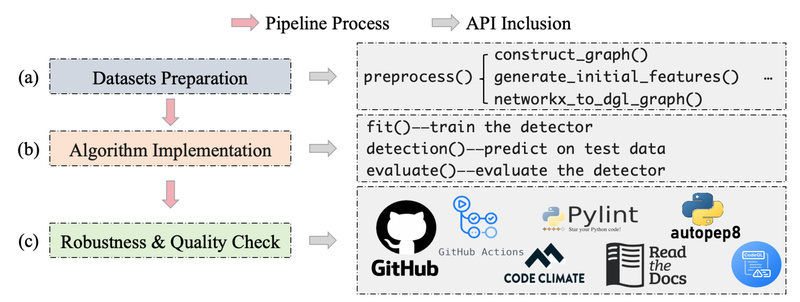
Every detector in SocialED follows the same four-step workflow:
preprocess()– Handles graph construction, tokenization, and feature extractionfit()– Trains the model on your datadetection()– Returns predicted event labelsevaluate()– Computes precision, recall, and F1-score against ground truth
This uniform interface means you can switch from LDA to KPGNN or HyperSED with a single line change—no rewrites, no custom glue code.
Built-in Support for Real-World Data
SocialED ships with 15 curated datasets, including:
- HumAID (76K+ tweets across 21 natural disasters)
- Event2018 (64K French tweets across 257 events)
- Arabic_Twitter (9K Arabic crisis-related posts)
- CrisisLexT6/T26 (large-scale emergency tweet collections)
These aren’t toy datasets—they reflect actual class imbalance, multilingual noise, and temporal dynamics you’ll encounter in production.
Modular, GPU-Accelerated, and Extensible
Under the hood, SocialED leverages PyTorch and DGL (Deep Graph Library) to support both CPU and GPU execution. Its modular design separates preprocessing, modeling, and evaluation—so you can:
- Swap in your own tokenizer
- Plug in a custom graph construction method
- Extend an existing algorithm (e.g., add a new loss function to QSGNN)
All without touching the core library code.
Real-World Scenarios Where SocialED Delivers Value
Crisis Monitoring at Scale
During emergencies, timely event detection saves lives. With SocialED, you can instantly evaluate models like ETGNN or HISEvent on the HumAID or CrisisMMD datasets to identify emerging disaster-related clusters—without writing data loaders from scratch.
Multilingual Public Sentiment Tracking
Need to monitor election-related chatter in both English and French? Use Event2012 and Event2018 with the same codebase. Algorithms like FinEvent and RPLMSED support cross-lingual detection out of the box.
Detecting Coordinated Misinformation
Virality doesn’t always mean legitimacy. SocialED’s graph-based methods (KPGNN, HCRC, HyperSED) model message relationships to surface anomalous clusters that keyword filters miss—ideal for identifying bot-driven narratives.
Getting Started Takes Minutes
SocialED is available on PyPI:
pip install SocialED
Then, run a full detection pipeline in just 7 lines:
from SocialED.dataset import Event2012
from SocialED.detector import KPGNN

dataset = Event2012()
model = KPGNN(dataset, batch_size=2048)
model.preprocess()
model.fit()
preds, truths = model.detection()
model.evaluate(preds, truths)
The library includes extensive documentation, unit tests, and CI/CD validation—so you can trust it in research and production alike.
Limitations to Consider
While powerful, SocialED has clear boundaries:
- Text-focused: It’s designed for short-text platforms like Twitter/X—not video, audio, or long-form content.
- Short-text assumption: Most algorithms expect tweet-like inputs; performance may degrade on paragraph-length posts.
- Partial real-time support: Only online-capable models (e.g., CLKD, FinEvent) handle streaming data natively; others are batch-oriented.
- GPU dependency: Full acceleration requires a CUDA-compatible GPU and proper PyTorch/DGL setup.
These constraints help you assess whether SocialED aligns with your use case—before you invest engineering time.
Why SocialED Beats DIY Pipelines
Building your own SED system from scattered GitHub repos means inheriting undocumented assumptions, missing tests, and incompatible data formats. SocialED solves this by providing:
- Reproducible evaluations with standardized metrics
- Automated testing across Python versions and OSes
- PEP 8–compliant, well-documented code
- Active maintenance via PyPI releases and GitHub
It’s not just a research artifact—it’s a sustainable engineering asset.
Summary
SocialED consolidates years of social event detection research into one reliable, easy-to-use Python library. By unifying algorithms, datasets, and evaluation under a clean API, it removes the biggest barriers to building real-world event monitoring systems. If your work involves detecting crises, tracking public discourse, or analyzing social narratives across languages, SocialED gives you a production-ready starting point—without the fragmentation.