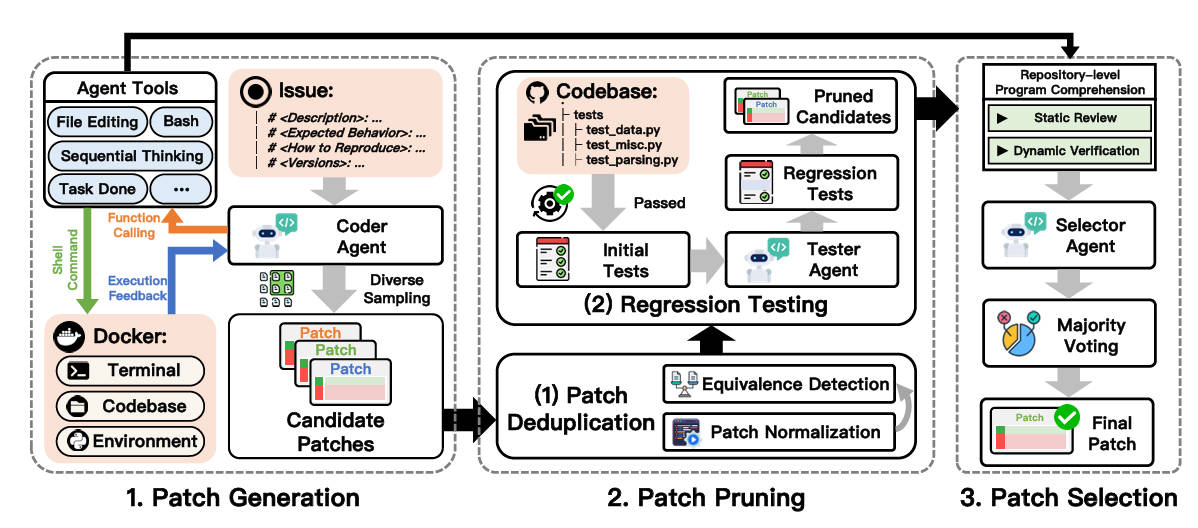
Overview
Software engineering is increasingly becoming a collaboration between humans and intelligent tools. Yet, many developers still face persistent challenges: fixing bugs across large codebases, writing comprehensive tests, or refactoring legacy systems—all while maintaining correctness and consistency. Traditional AI coding assistants often lack deep contextual understanding of entire repositories and struggle with complex, multi-step tasks.
Enter Trae Agent—an open-source, LLM-based AI agent purpose-built for real-world software engineering. Unlike generic coding assistants, Trae Agent treats issue resolution as an optimal solution search problem, combining modular agent reasoning, repository-level awareness, and test-time scaling to significantly outperform existing methods. In fact, it currently holds the #1 spot on the SWE-bench Verified leaderboard with a 75.20% Pass@1 score, surpassing prior approaches by an average of 10.22%.
Whether you’re a developer automating routine tasks, a researcher exploring agent architectures, or a team looking to accelerate software maintenance, Trae Agent offers a transparent, extensible, and high-performing solution backed by rigorous evaluation.
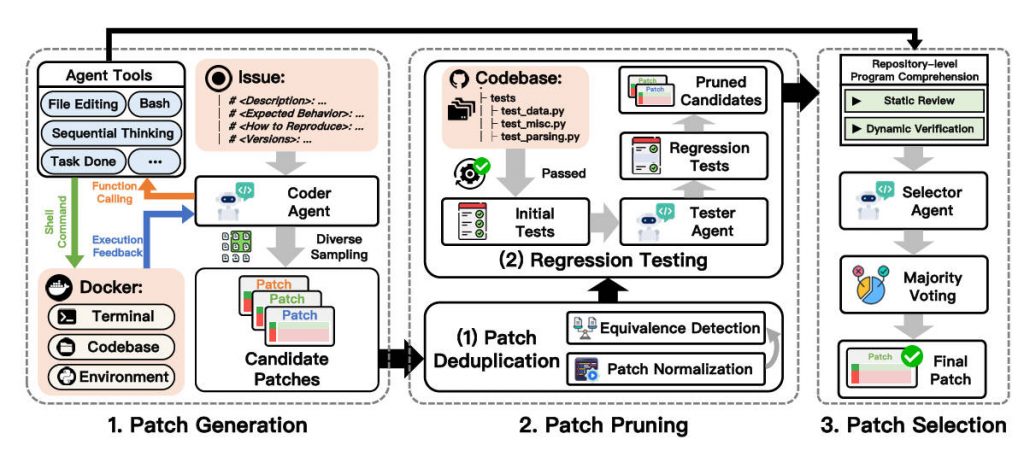
How Trae Agent Solves Real Engineering Pain Points
Most LLM-based tools work well on isolated code snippets but falter when faced with real repository-scale problems. Trae Agent directly addresses two critical limitations:
- Inefficient exploration of large solution spaces: Instead of relying on naive prompting or single-shot generation, Trae Agent uses an ensemble of specialized modular agents for generation, pruning, and selection, enabling systematic navigation of possible fixes.
- Lack of repository-level understanding: Trae Agent reasons over the full project context—not just the file in question—allowing it to make informed decisions about dependencies, API usage, and architectural patterns.
This design enables it to handle tasks that require deep integration with existing codebases, such as fixing subtle bugs that span multiple files or generating tests that respect project conventions.
Developer-Friendly Features for Practical Use
Trae Agent isn’t just powerful—it’s built for real-world adoption:
- Multi-LLM Support: Seamlessly switch between OpenAI, Anthropic, Google Gemini, Doubao, OpenRouter, Ollama, and Azure—letting you choose the best model for your task or budget.
- Rich Tool Ecosystem: Execute bash commands, edit files in-place, apply sequential reasoning, and signal task completion—all orchestrated by the agent.
- Interactive Mode: Iterate conversationally with the agent, refine instructions on the fly, and inspect intermediate steps—ideal for debugging or exploratory development.
- Lakeview Summaries: Get concise, high-level overviews of each agent step without drowning in raw LLM outputs.
- Trajectory Recording: Every action, tool call, and model response is logged to a JSON file, enabling full reproducibility, debugging, and offline analysis.
Critically, Trae Agent’s modular and transparent architecture stands in contrast to “black-box” agents. Researchers can easily modify components, run ablation studies, or plug in new tools—making it a valuable platform for advancing AI agent research.
Practical Use Cases in Daily Development
Trae Agent excels in scenarios that demand both technical precision and contextual awareness:
- Bug Fixing: “Fix the authentication failure in
login.pywithout breaking the session tests.” - Test Generation: “Add unit tests for the
utils/validation.pymodule using pytest.” - Code Refactoring: “Refactor the database module to use async/await patterns consistently.”
- Documentation: “Generate docstrings for all public functions in
api/client.py.” - Script Automation: “Write a Python script that parses logs and extracts error counts by service.”
Thanks to its repository-level reasoning, Trae Agent doesn’t just “guess” fixes—it validates them against the real codebase structure, dependencies, and existing test suites.
Getting Started in Minutes
Setting up Trae Agent is straightforward:
- Install using UV (a modern Python package tool):
git clone https://github.com/bytedance/trae-agent.git
cd trae-agent
uv sync --all-extras
source .venv/bin/activate
- Configure your LLM providers via a clean YAML file (
trae_config.yaml) or environment variables. Example:model_providers: openai: api_key: your_openai_api_key provider: openai models: trae_agent_model: model_provider: openai model: gpt-4o - Run tasks from the command line:
trae-cli run "Add tests for the utils module"
For isolated or reproducible environments, Trae Agent supports Docker—run tasks in containers, attach to existing ones, or build from custom Dockerfiles. This ensures consistent behavior across machines and CI pipelines.
You can also enter interactive mode for conversational problem-solving:
trae-cli interactive --provider anthropic --model claude-sonnet-4-20250514
Limitations and Considerations
While powerful, Trae Agent is still under active development. APIs and features may evolve, so check the project roadmap for upcoming changes. It requires valid LLM API keys (or local models via Ollama), and while it generates high-quality patches, human review remains essential—especially in safety-critical or production systems.
Additionally, advanced features like Docker execution assume your system has Docker properly configured and appropriate file permissions.
Summary
Trae Agent redefines what’s possible with LLM-based software engineering automation. By combining modular agent reasoning, full repository context, and a developer-first toolset, it delivers state-of-the-art performance on real-world coding tasks. Its open-source nature, transparent design, and support for multiple models make it both a practical tool for teams and a research-friendly platform for innovation.
If you’re looking to automate complex software tasks with reliability, reproducibility, and deep code understanding, Trae Agent is worth integrating into your workflow today.