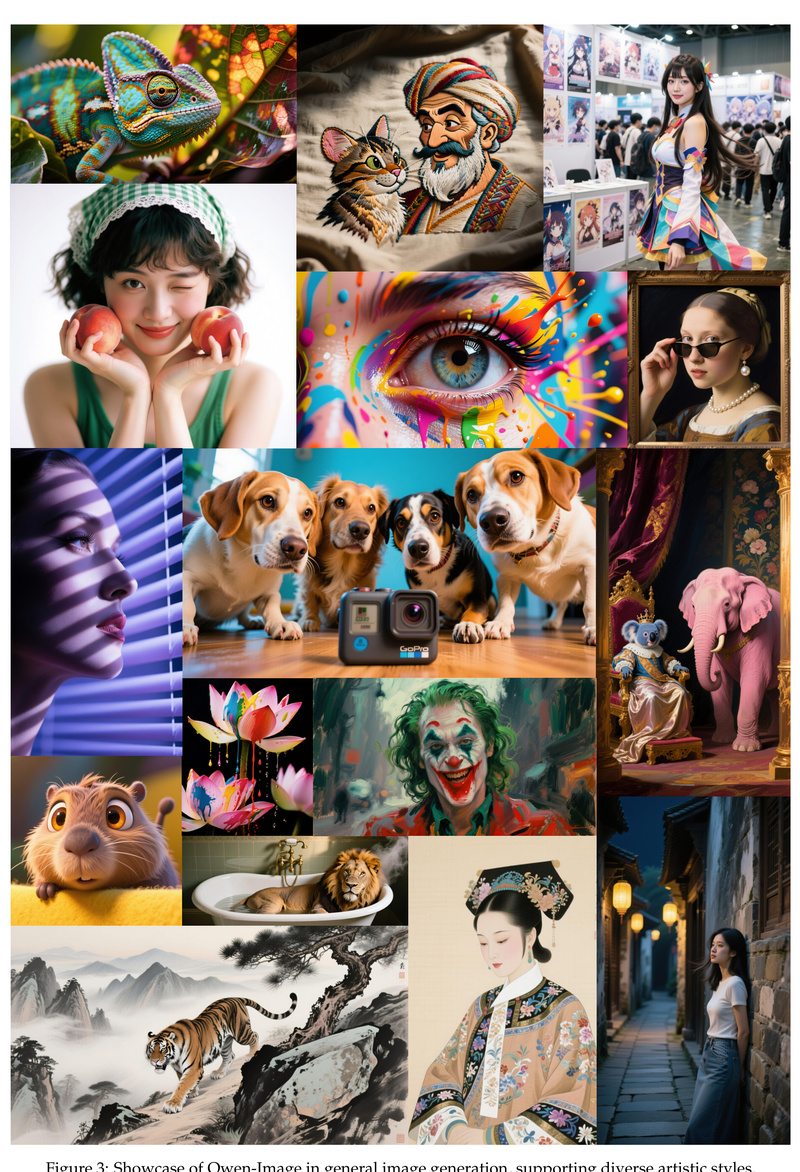
If you’ve ever struggled to generate marketing visuals with legible multilingual text—or tried to edit a product image only to end up with a distorted face or garbled logo—you’re not alone. Most open-source text-to-image (T2I) models falter when faced with real-world demands: rendering accurate English and Chinese text, preserving identity during edits, or understanding complex layout instructions.
Enter Qwen-Image, a 20-billion-parameter open-source foundation model from Alibaba’s Qwen series. Designed specifically to solve these pain points, Qwen-Image sets a new bar for two critical capabilities: complex text rendering (including logographic scripts like Chinese) and precise, consistent image editing—all under the permissive Apache 2.0 license.
Unlike generic diffusion models that treat text as an afterthought, Qwen-Image integrates advanced vision-language alignment from the ground up, enabling reliable generation and editing where others fail.
Why Text Accuracy Matters—and How Qwen-Image Delivers
The Text-in-Image Challenge
Traditional T2I models often misrender letters, scramble words, or ignore typographic details—especially with non-Latin scripts. This isn’t just a cosmetic flaw; it’s a dealbreaker for commercial applications like e-commerce banners, multilingual social media posts, or brand-compliant advertising.
Qwen-Image tackles this head-on through a curriculum-based training pipeline:
- Starts with non-text scenes, then introduces simple labels, and finally scales to paragraph-level descriptions.
- Uses large-scale, balanced datasets with real and synthesized text in both alphabetic (e.g., English) and logographic (e.g., Chinese) languages.
The result? State-of-the-art performance on benchmarks like T2I-CoreBench, where Qwen-Image outperforms other open-source models and rivals proprietary systems in compositional reasoning and text fidelity.
Real-World Editing Without Breaking Identity
Editing an existing image is notoriously unstable. Change a person’s outfit, and their face might morph. Replace product text, and the logo vanishes.
Qwen-Image-Edit—particularly the Qwen-Image-Edit-2509 variant—addresses this with:
- A dual-encoding mechanism: The original image is processed separately by Qwen2.5-VL (for semantics) and a VAE encoder (for visual reconstruction). This balance preserves identity while allowing creative changes.
- Multi-image editing support: Combine 1–3 inputs (e.g., “person + product” or “two people facing each other”) and generate coherent composites.
- Enhanced consistency for people (facial identity across poses), products (brand logo integrity), and text (editable fonts, colors, and materials).
Practical Applications for Teams and Developers
Qwen-Image isn’t just a research curiosity—it’s built for real projects:
- Multilingual marketing: Generate posters with accurate English and Chinese slogans without manual touch-ups.
- E-commerce automation: Upload a plain product photo and generate branded posters with consistent logos and stylized backgrounds.
- Avatar and meme creation: Edit portraits while preserving facial identity, even under dramatic style shifts.
- Legacy photo enhancement: Restore old photos while maintaining realistic textures and readable contextual text.
- Design tool integration: Leverage native ControlNet support (depth, edges, keypoints) for pose-guided editing or sketch-to-image workflows.
Getting Started: Simple Code, Immediate Results
Qwen-Image integrates seamlessly with Hugging Face Diffusers, requiring minimal setup:
Text-to-Image Generation
from diffusers import DiffusionPipeline
import torch

pipe = DiffusionPipeline.from_pretrained("Qwen/Qwen-Image", torch_dtype=torch.bfloat16).to("cuda")

prompt = 'A chalkboard reads "Qwen Coffee $2", beside a neon sign saying "Tong Yi Qian Wen"'
image = pipe(  prompt=prompt + ", Ultra HD, 4K, cinematic composition.",  width=1664,  height=928,  num_inference_steps=50,  true_cfg_scale=4.0,
).images[0]
Tip: Use the provided
positive_magicsuffixes for English or Chinese prompts to boost quality.
Image Editing (Single or Multi-Image)
For single-image edits:
from diffusers import QwenImageEditPipeline
pipeline = QwenImageEditPipeline.from_pretrained("Qwen/Qwen-Image-Edit").to("cuda")
output = pipeline(image=input_img, prompt="Make the rabbit purple, add flashlight background")
For multi-image compositing (Edit-2509):
from diffusers import QwenImageEditPlusPipeline
pipeline = QwenImageEditPlusPipeline.from_pretrained("Qwen/Qwen-Image-Edit-2509")
output = pipeline(image=[img1, img2], prompt="Magician bear on left, alchemist bear on right")
Critical note: Always use the official prompt rewriting tools (via
polish_edit_prompt) for stable editing results. Raw prompts often lead to artifacts.
Limitations and Best Practices
While powerful, Qwen-Image has practical boundaries:
- Prompt sensitivity: Editing quality heavily depends on rewritten prompts via Qwen-VL-Max. Skipping this step risks inconsistent outputs.
- Dependencies: Requires
transformers>=4.51.3and the latestdiffusersfrom GitHub. - Multi-image input: Works best with 1–3 images; more inputs may reduce coherence.
- Hardware: Full-precision inference needs a modern GPU, but community tools like DiffSynth-Studio enable 4GB VRAM usage via offloading and FP8 quantization.
Ecosystem and Deployment Options
You don’t need to build from scratch. Qwen-Image is already integrated across major platforms:
- Hugging Face Spaces and Qwen Chat for no-code demos.
- ModelScope for LoRA training, FP8 quantization, and low-memory inference.
- ComfyUI, LiblibAI, and WaveSpeedAI for workflow integration.
- LeMiCa and cache-dit for 3× faster inference without quality loss.
For teams, the Multi-GPU API Server (included in the repo) supports concurrent requests, automatic prompt enhancement, and aspect ratio handling out of the box.
Summary
Qwen-Image solves two of the most persistent challenges in generative AI: faithful multilingual text rendering and identity-preserving image editing. Backed by rigorous training strategies and dual-encoding architecture, it delivers production-ready quality for real-world applications—from global marketing campaigns to personalized design automation. With open weights, Apache 2.0 licensing, and deep ecosystem support, it’s one of the most practical open-source image foundation models available today.
If your project demands accurate text-in-image or reliable visual editing, Qwen-Image is worth your immediate evaluation.